Tag Archives: Amarillo City Council

MPEV, no MPEV … downtown must move forward

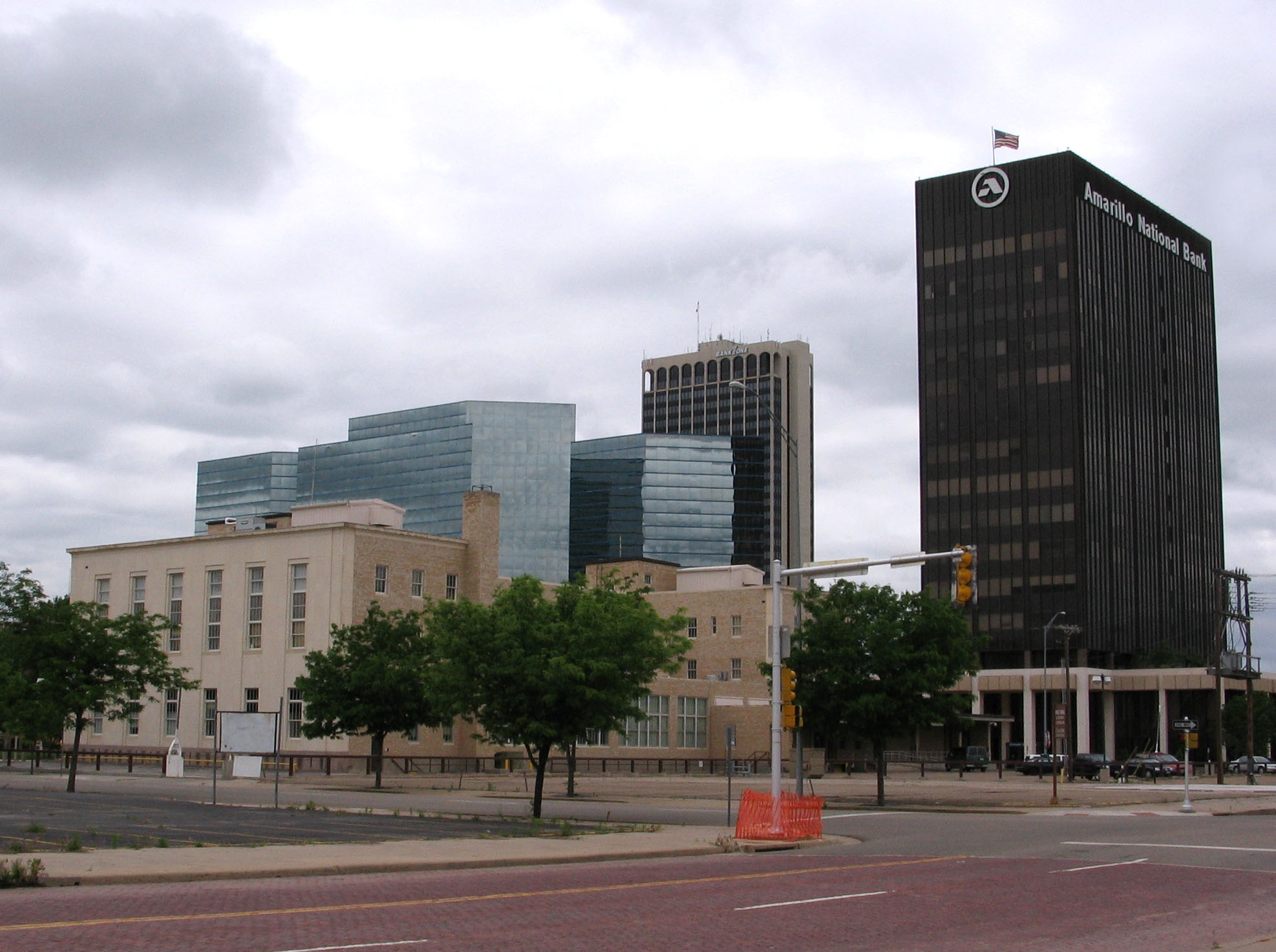
Amarillo_Texas_Downtown

An election is coming soon to Amarillo.

How will it turn out? I’m not going to venture a guess. It’s an advisory vote on whether the city should proceed with construction of a multipurpose event venue that at this moment includes an athletic component. Yes, it’s a ballpark.

Pro-MPEV interests contend that “momentum” is on their side.  I hope they’re right.

Anti-MPEV interests, though, suggest they have the Big Mo.

If voters say “no” to the MPEV as it’s currently configured, then the rest of the downtown Amarillo project could be put in jeopardy.

I do not want that to happen.

Pro-MPEV forces say that the Embassy Suites downtown convention hotel is going to open in 2017, no matter what. City leaders say as well that the inertia on that project is such that even a “no” vote on the MPEV won’t stop the hotel.

Again, I hope they’re right.

My gut is churning a bit these days, though, as I ponder the impact of a negative vote on Nov. 3.

That vote and the reconstituted Local Government Corporation board give me pause. A new LGC majority reflects the newly elected majority on the Amarillo City Council — and both majorities seem quite reluctant to proceed with downtown’s proposed future as it is currently configured.

If the MPEV vote gets stalled at the ballot box, will city planners be able — or willing — to cobble together a Plan B that allows the complete project to go forward?

I hope that can happen, too.

If not, then we’ve just wasted a lot of time, emotional and political capital and, oh yeah … money!

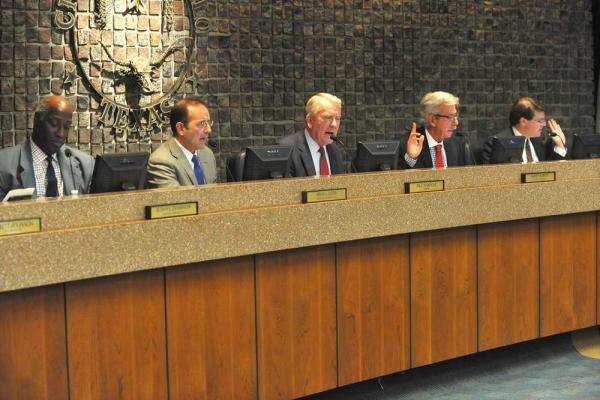
 

Downtown revival journey takes unsettling turn

amarillo downtown

It appears the debate over how Amarillo’s downtown revival proceeds has been joined fully.

Three new members of the City Council have made their preferences fairly clear: They dislike the multipurpose event venue concept in its current form. They want to put the MPEV to an advisory vote of the residents, believing most voters will agree with them.

Now the council majority has managed to stack the Local Government Corporation board with new members who agree with them.

The LGC board majority now appears to mirror the majority of council members who endorsed their joining the volunteer citizens board that has been front and center in many of the key decisions made regarding downtown revitalization.

I know full well that the May elections have consequences and that the new council members made their intentions clear during the council election campaign.

But you may count me as one individual who believes the new majority appears headed toward making a big mistake if it torpedoes the MPEV and does anything else that forestalls the development of a planned downtown convention hotel.

Look, I’m a believer in the democratic process. However, I sense a fairly deep division in this city over the scope of the downtown plan. The differences seem to center on the ballpark element included in the MPEV.

For me, the ballpark is a plus. Others see it as a minus.

Financing will come from hotel/motel tax revenue provided by those who come to Amarillo and spend time in our many lodging establishments. That’s a bad thing? Supporters say property tax rates won’t be affected. That, too, is a bad thing?

But the LGC — with one of the three new council members among its ranks — appears to look differently on all this.

OK, change has come — as promised. I get it.

I just believe deep down — and on the surface for everyone to see — that the change we’re about to witness won’t do our city any good.

I want desperately to be wrong.


Get set for lots of split City Council votes

ama city council

Three to two.

We’d all better get ready for a lot of those votes on critical issues that come before the Amarillo City Council.

Does a three-fifths vote in any governing body — no matter its size — constitute a consensus? Hardly. It says only that the body is divided. Does it represent the division that lies out here among us constituents? I’m not yet ready to concede that point.

Think of it in terms of the U.S. Supreme Court, which fairly routinely splits along ideological lines on key — sometimes landmark — decisions. The court likely will split 5 to 4, with the conservative majority winning the argument over the liberal minority.

Do all Americans see these 5-4 court decisions as a sign of consensus? Oh, no. Indeed, the court’s deeply split decisions are bound to trigger national debates over the rightness or the wrongness of whatever decision the court hands down.

I’m guessing a similar discussion might play out in Amarillo as the City Council takes up key issues. The city budget likely will be decided by a deeply split vote. You can rest assured that any issue relating to downtown Amarillo revival project will face a similarly split vote.

And just like the deep divisions that split the nation’s highest court, where dissenting opinions often produce as much as heat as the majority opinions, we here in Amarillo might have to expect fiery dissents from those in the minority on these key votes.

There used to be an unwritten rule at City Hall every one on the council — or commission, as it once was known — was expected to back whatever decision that came forth. Those who opposed a decision weren’t asked to support it publicly, but there was an accepted silence from those who voted on the short end of whatever decision came from City Hall.

I’m betting the mistrust that exists on both sides of this new 3 to 2 City Council divide won’t allow quiet acquiescence.

This, I submit, is part of the “change” that has arrived at City Hall.

Good luck with that, City Council.


City Council journey still a bit bumpy

ama city council

Looking at Amarillo City Hall from some distance — given that I’m no longer employed as a full-time print journalist — gives me some fresh perspective.

It also doesn’t diminish my own — or anyone else’s in a similar position — ability to discern dysfunction when I see it.

That’s what I’m seeing at City Hall these days. And, no, I don’t — as some have suggested on social media — have any skin in this game.

The City Council met this week to discuss the upcoming municipal budget and also to discuss how to fill three posts on the Local Government Corporation board.

The meeting got a bit heated, based on what I read about it.

Therein may lie the dysfunction that well could upend a lot of well-laid-out plans for the city’s future.

Ron Boyd, Richard Brown and Lilia Escajeda all cycled off the LGC board. I know two of them — Boyd and Escajeda — pretty well. Finding suitable successors apparently provided some significant friction among the newly constituted City Council.

Is this what we can expect on all matters that come before our city’s elected governing board?

It’s an interesting development that one of the three new members of the LGC is Councilman Randy Burkett, who took office in May and has suggested that he wants to derail the multipurpose event venue project planned for downtown. He voted to put the issue to an advisory vote in November and although I do not know Burkett I’d be willing to bet real American money that he’s going to vote “no” on whether to proceed with the MPEV as it’s been proposed for the city.

For the record — yet again! — I believe in the project that’s been presented.

Now he’s on the LGC board, which is up to its armpits in helping shape the course and the nature of downtown’s proposed redevelopment.

Two lawyers, Bryan Poff and Richard Biggs, have joined Burkett on the board. I’m only casually acquainted with those gentlemen. The council vote was 3-2, with Mayor Paul Harpole and Councilman Brian Eades voting “no” to change the LGC board.

And isn’t it interesting that Councilman Burkett was allowed to vote in favor of his own nomination to the board? Is that how it’s always been done?

I’m fearing more head-butting along the way as the City Council’s new majority tangles with the two veteran council members who managed to win re-election in May.

The council sits divided into two camps: those who liked the way things got done and those who vowed drastic “change” in the city’s modus operandi.

If the change is going to produce more bickering and back-biting just for its own sake, I’ll endorse the view expressed by Amarillo resident Cindi Bulla, who said: “Get over it. Work together and get the job done and get it done right.”


Be sure to respond to council overture, public citizen

ama city council

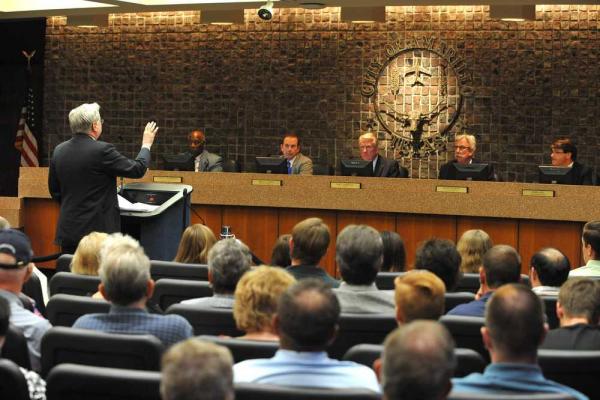
There might be an interesting back story developing once the Amarillo City Council commences its new meeting time at City Hall.

The council says it will start meeting at 6 p.m. each Tuesday to give residents a better chance to attend the meetings. They do, after all, deal with the public’s business.

The back story deals with some of the yammering we’ve heard over a period of time about the so-called “secrecy” that shrouds City Council business. Some of the critics of the downtown revival project, for instance, contend — wrongly, in my view — that too much of it was pre-determined in secret.

Other gripes have concerned the work sessions that precede the official open City Council meetings, where council members actually vote on issues under consideration.

Well, with the new after-hours meeting time, there will be plenty of interest from residents who have been unable to attend the council meeting when they took place at 3 p.m. So, logic would seem to dictate that the City Council chamber spectator seats will have more people in them to listen to council members discuss and act on public matters … correct?

If the interest holds up, then perhaps there might be some credence given to the gripes about a lack of “public involvement.”

If it doesn’t sustain itself and the public doesn’t flock to the third floor Council Chambers meeting room each Tuesday evening, does that suggest that all the grumbling about secrecy was coming from a highly vocal minority of malcontents?

Let’s watch for how this plays out.


This City Hall ‘change’ sounds constructive

ama city council

Three new Amarillo City Council members pledged “change” would come to City Hall when they were elected earlier this year.

Some of it has been counterproductive. The arguments and bickering have been distracting if not downright destructive. Two of the new council members took office and then started calling for immediate change at the top of the city administrative chain of command.

The latest effort at change, though, is worth supporting.

The council wants to start meeting at 6 p.m. each Tuesday. The aim is to allow more residents to attend these sessions. The 3 p.m. meeting time made it difficult at times for working men and women to break away from their jobs to hear the discussions taking place at City Hall.

An after-hours meeting time is more conducive to public involvement.

That element of change is worthwhile.

Indeed, it well might expose more residents to the occasional fits of petulance that shows itself among City Council members. Then again, with more people in the audience, the council members might tend to exhibit better behavior.

Still, improving public access to the public’s business is a good thing.

Well done.


Why not play ball at MPEV?

Amarillo MPEV

Jon Mark Beilue might have laid out what could be a pivotal argument for approving construction of a multipurpose event venue — as it’s currently configured — in downtown Amarillo.

The stellar Amarillo Globe-News columnist — and a friend of yours truly — noted in an essay: “I would bet all the change in my pocket that no less than two years after construction, independent baseball would be replaced with AA Texas League affiliated baseball. From there, the MPEV could be designed in such a way as to draw other events that are the other half in making the venue succeed and attracting downtown crowds to added retail.”

The MPEV is coming up for a vote on Nov. 3. It headed to the ballot on a narrow 3-2 Amarillo City Council vote, with the three newest council members voting to place the issue on the ballot.

The crux of Beilue’s column was that the new guys “whiffed” on common sense, and that they had their mind made up long before taking the vote.

But I’m intrigued by the notion of what might happen if the MPEV design gets voter approval this fall.

As has been noted before — in this blog and in many other forum — Potter County Memorial Stadium, aka the Dilla Villa and now the Thunderhead Park, is a dump. It’s hardly more than a piece of fecal matter as far as athletic complexes go.

Is it unreasonable to believe that a brand new, shiny, state-of-the-art venue could become a magnet for the kind of minor-league baseball organization that Beilue and others visualize for the city?

My answer is “no,” not in the least.

Beilue writes: “Neither I nor most others are married to a baseball stadium as the signature piece of an MPEV, but it’s the most logical. The MPEV needs an anchor tenant, and baseball fits that.

“A Hollywood Bowl design has appeal, but its events would be in direct competition with the Globe-News Center for Performing Arts and Amarillo Civic Center Complex. Baseball is a unique alternative that would draw thousands.”

I refuse to heed the naysayers who insist that Amarillo “isn’t a baseball town.” It hasn’t been a baseball town for years largely, in my view, because that rat hole at the Tri-State Fairgrounds is a lousy place to play — or watch — a baseball game.

The ballot measure states: “Should the Multi-Purpose Event Venue (MPEV) to be constructed in downtown Amarillo include a Baseball Stadium at the approximate cost of $32 million?”

It works for me.

Ballpark … or no ballpark?

I’m still trying to wrap my head around the debate over whether to put a ballpark near the heart of downtown Amarillo.

It’s called the multipurpose event venue. MPEV, for short.

It’ll be up for a key decision on Nov. 3. The city will ask voters if they want the MPEV to include the ballpark. If they say “no,” the ballpark won’t be built; a “yes” vote, of course, means what it says.

I believe the ballpark is a good deal. It can be a potentially great deal if we use our imagination, employ some creativity and relearn how we can enjoy the downtown district.

I keep hearing numbers about the cost of the MPEV. It’ll be around $32 million. The city plans to issue bonds to pay for it. It plans to retire those bonds with hotel-motel tax revenue and lease payments from the tenant who agrees to run the place. Bill Gilliland and Laura Street, a pair of big-hitter fundraisers, told the City Council they have received pledges totaling around $2 million from private contributors; there might be more in the wings.

Amarillo’s political/business/civic brain trust isn’t reinventing the wheel with this downtown ballpark concept. Cities all across the country — big cities and mid-sized cities, just like Amarillo — have enjoyed varying degrees of success with downtown ballparks.

There’s nothing particularly original or groundbreaking in the city’s effort to revive its downtown district.

Now, for the record, I’m not going to suggest that Amarillo can copy cities such as Oklahoma City in developing a downtown ballpark. The OKC project was paid for with a public tax levied specifically to raise money for the construction of that city’s ballpark in its Bricktown district. And I am acutely aware that OKC is a much larger city.

If we step back, though, we need to understand that no one with a lick of sense is suggesting that Amarillo’s downtown project can function on the same level as the one in OKC. It can, though, function nicely at its own level.

The MPEV as it’s been presented does represent a step forward for the city and presents a fascinating opportunity for the city to progress to some next, and perhaps largely still undefined, level.

Indeed, this project requires a leap of faith. I am prepared to take that leap.

Mayor Harpole hamstrung by state law

harpole

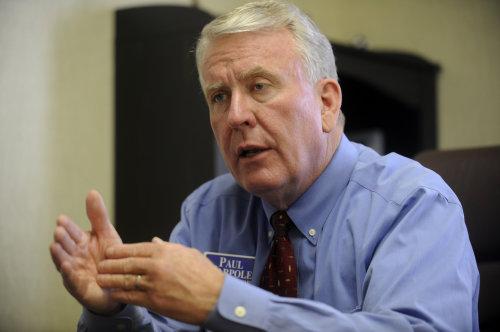
I had the distinct pleasure today of watching Amarillo Mayor Paul Harpole pull his punches so tightly he almost hit himself in the face.

He stood before the Rotary Club of Amarillo and talked about all the projects that are on-going throughout the city that have nothing to do with downtown redevelopment. But then he would remind Rotary Club members that, yes, there’s this thing called downtown revitalization that’s got him all fired up.

Indeed, he seemed wound tighter than a cheap watch today as he blazed through his luncheon program talking about highway access improvements, Loop 335 expansion, utility installations, drainage excavation, improvements to interstate access.

But you see, state law is kind of quirky. As mayor, he is not allowed to advocate for issues that are set to be voted on in an election. He presented himself today as mayor, which meant only that he could give us information about downtown revitalization.

You could tell — heck, it’s been all over the media — that he’s solidly behind the effort to revive downtown Amarillo. The package that’s been presented will proceed with a downtown convention hotel and a parking garage. During his presentation today at the Rotary Club meeting, Harpole showed slides of what the downtown district will look like when it’s done. He believes a key component to the city’s effort remains the multipurpose event venue — in its proposed configuration, which includes a ballpark.

But that state law prohibited him from proclaiming loudly and proudly what he really thinks of the MPEV.

That’s OK, Mr. Mayor. I got the message.

MPEV debate to turn on ballfield

Amarillo MPEV

It now appears that the Amarillo municipal election referendum this November is going to turn on a specific issue.

Should the city build a multipurpose event venue that includes a ballpark?

I say “yes!” With emphasis.

So, the MPEV-with-ballpark has at least one vote. I’m guessing it’ll get many more when the time comes to vote on it.

But the question came to me today from an Amarillo Millennial Movement member who wanted to know how they can sell the MPEV as it’s been proposed during the next 90 days. Honestly, I have never planned a campaign strategy and I don’t intend to do so now.

But I’ll just say that I am hearing from friends, acquaintances and others who want to talk about that they think the ballpark isn’t needed. They think the rat hole stadium at the Tri-State Fairgrounds is sufficient. It isn’t.

I happen to believe that a downtown venue for some minor-league baseball is a capital idea. And, yes, it can — and must — be used for other events. What might those events be? I will rely on the marketing geniuses around the city, the Panhandle and even the state to figure that out.

Outdoor concerts? Sure. A flea market … maybe? It’s been done.

Perhaps local high school teams could play ball during their regular season. There might even be an open date or two — or perhaps more — for the West Texas A&M University baseball team. Or perhaps the WT women’s softball team. Or maybe even some local high school softball teams.

I understand fully that these events don’t often draw more than a handful of fans. However, is that the way it has to be?

The world is full of opportunities.

I was heartened to hear from the newly elected City Council members this week that they favor an MPEV in some incarnation. They remain skeptical of the ballpark element.

I will continue to argue that a ballpark is a feasible attraction for downtown Amarillo. However, it’s going to require some creativity and some marketing genius to make it work as well as it can for the city.

If voters say “no” in November, my next-best hope is that the city can come up with a Plan B in a hurry and keep its downtown revival project moving forward.