Tag Archives: John Glenn

A great American has just left us

aalhlnh

A great American life has come to an end.

We shouldn’t mourn John Glenn’s death, which was announced this afternoon. We should celebrate what this man accomplished during his 95 years among us.

What a man! What a life! What an extraordinary legacy he leaves!

I almost feel as though I’ve lost a member of my family.

Glenn and six other Americans burst onto the scene in the late 1950s when a newly formed agency, NASA, selected these men to become the first Americans to fly into space.

Glenn would be third of them. He was the first American to orbit the planet.

This is just one chapter of this great man’s life.

He joined the Marine Corps. He flew combat missions during the Korean War. Then he became a test pilot. Then NASA selected him to fly into space. He took three quick trips around Earth, returned home and didn’t fly again into space again for another 36 years.

In the meantime, he got elected to the U.S. Senate from Ohio, ran or president once in 1984. Along the way, he became friends with presidents, princes and potentates.

aalh90m

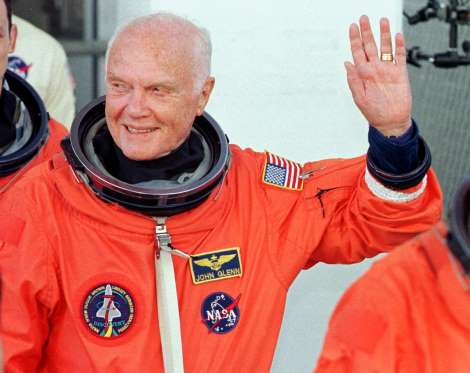
In 1998, he flew aboard the space shuttle Discovery. Sen. Glenn had a distinct advantage over two other members of Congress who flew previously into space — U.S. Sen. Jake Garn, R-Utah, and U.S. Rep. Bill Nelson, D-Fla. The Discovery flight crew and its support team didn’t have to translate their unique language to Glenn as they prepared for their flight. Glenn was fluent in astronaut-speak.

He boarded Discovery and the ship roared off the pad as the public address announcer told the world about the launch of the shuttle carrying “six astronaut heroes … and one American legend.”

***

Why the family-like connection with Glenn?

My mother and I were addicted to watching these early Mercury launches. We would awaken early and wait, and wait and wait some more for these rockets to blast off.

On Feb. 20, 1962 — after an interminable number of weather-related delays, holds, and mission scrubs — Mom and I watched on our black-and-white TV as Glenn Mercury-Atlas rocket roared into space.

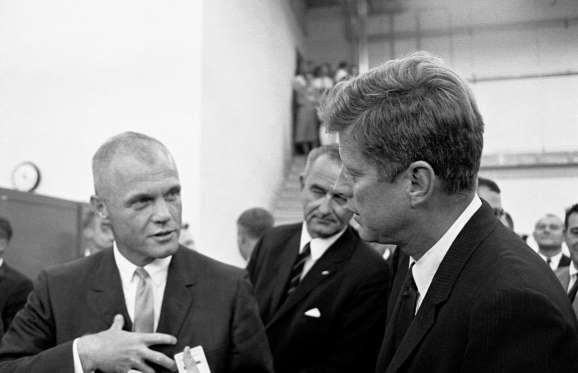
The flight lasted about five hours. Then he splashed down — and came home a hero. They had a ticker-tape parade in New York. President Kennedy toasted him at the White House.

John Glenn was a glamorous kind of guy. Ruggedly handsome, he fit central casting’s description of a test pilot-turned astronaut.

There’s perhaps a touch of irony that Glenn would be the final Mercury astronaut to pass on. He was the oldest among them; Glenn was 40 at the time of his first flight aboard Friendship 7 in 1962.

So it is, then, that we remember this great American.

I’m thinking at this very moment of something his late Mercury colleague Scott Carpenter said to Glenn as his friend sat atop the rocket waiting to be blasted into space.

Godspeed, John Glenn.

Get well, Sen. Glenn

I just heard that former U.S. Sen. John Glenn is in the hospital.

He’s 95 years of age now. He has lived an extraordinary life.

Marine Corps fighter pilot during the Korean War; test pilot; astronaut selected among the first men to fly into space; the first American to orbit planet Earth; U.S. senator; a return to space on the space shuttle Discovery.

The video here chronicles the launch of Glenn’s second trip into space. It took place in 1998, 36 years after he flew those three orbits aboard the Mercury spacecraft.

I get choked up every time I hear the space flight communicator announce the launch of “six astronaut heroes and one American legend.”

Get well, Sen. Glenn.

Hoping for a return of manned space program

6938210-space-shuttle-photos

The thought just occurred to me that of the original men chosen to fly into space, only one of them remains among us.

He is John Glenn, who’s now 94 years of age.

From what I understand, Glenn remains in good physical condition. But, hey, he is 94. At that age, you live one day at a time, or so many of the 90-somethings I’ve known have told me.

What troubles me particularly about Glenn’s advanced age is that once he leaves us, there will no one left from that exhilarating time who can argue forcefully for the return of the manned space program in this country.

https://highplainsblogger.com/2010/06/john-glenn-still-a-legend/

The Bush administration announced plans to retire the space shuttle program and then the Obama administration followed through with the plan. Two of the shuttles were destroyed by tragic accidents, leaving just three ships in use: Atlantis, Endeavor and Discovery. Challenger blew up shortly after liftoff in January 1986 and Columbia — with Amarillo’s Rick Husband in command — disintegrated upon re-entry in February 2003.

After the final shuttle mission — the flight of Atlantis in July 2011 — U.S. astronauts have been ferried into space aboard Russian rockets to spend time in the International Space Station. Think of that for a moment. During the height of the space race, of which Glenn was a major player, it would seem unthinkable that we’d ever have to depend on our adversary to take our astronauts into space.

We’re not hearing much talk during this presidential election campaign about the future of manned space travel. We don’t know whether Republican Donald J. Trump or Democrat Hillary Rodham Clinton will light the fire that re-ignites our national pride in the effort to explore beyond the bounds of our planet.

I know that NASA is working on a new launch vehicle that will take humans into space. I understand the space agency has plenty of work on its plate; it has unmanned probes to launch and plenty of research to complete. NASA, though, seems to be working in a closet. Does anyone ever hear updates, progress reports on the development of that launch vehicle?

Americans have few legends who can speak with authority on such things. John Glenn — who later served several terms as a U.S. senator from Ohio — is one of them who can speak with clarity and credibility on the value that space exploration brings to us.

If only we could keep him around forever.

We cannot, of course.

I get that we have a lot of pressing issues that are consuming presidential candidates’ time and attention.

My hope is that we will start hearing from one or both of the major candidates about how they intend to accelerate our return to space exploration.

I relished those mornings awaiting those flights by John Glenn and his early astronaut colleagues. I’m ready to get excited once again.

Sen. Nelson wasn’t an astronaut

nelson

I just listened to a brief interview that I cannot let pass. I put something on Facebook about, but I have to expand it just a bit.

MSNBC anchor Brian Williams was interviewing Florida U.S. Sen. Bill Nelson as part of the on-going coverage of this morning’s horrific massacre in Orlando, Fla.

Williams introduced Nelson to his audience as “an astronaut-turned-politician.” He then referenced Nelson’s “many years at NASA” while commenting on the prospect of extra security in the wake of the shooting.

I now want to set the record straight.

Sen. Nelson is a politician-turned-one-flight-astronaut. He served in Congress when he got picked for a flight aboard the space shuttle Columbia in January 1986.

He served as a payload specialist aboard the shuttle. He flew once, came back to Earth and went back to work in Congress.

What is equally fascinating is that Nelson didn’t correct Williams on either occasion.

—-

Nelson, a Democrat, was the second member of Congress to fly on a shuttle mission. The first was Utah Republican Sen. Jake Garn, who flew aboard the shuttle Discovery a year earlier, in 1985.

Oh, and the third member of Congress to fly? That would be a Democratic senator from Ohio, John Glenn. Yes, that John Glenn, the first American to orbit Earth in February 1962 aboard the Mercury capsule.

I should note here that Sen. Glenn had an advantage that his congressional “astronauts” didn’t have. The crews with which Garn and Nelson worked had to translate the jargon they spoke among themselves, as their rookie crewmen weren’t fluent in “astronaut-speak.”

Glenn needed no translator as he trained to fly aboard Discovery in 1998. He knows the language well. He spoke it himself while training with his six other initial American space travelers back in the 1960s.

Check out this video of that shuttle mission.


Godspeed, Scott Carpenter

And then there was one.

Of the seven men chosen initially to explore space on behalf of the United States, only John Glenn remains with us. Scott Carpenter, the second American astronaut to orbit Earth, died today at age 88.

Now only Glenn is left. The former U.S. senator from Ohio, in 1998, became the oldest man to fly in space when he took part in a mission aboard the shuttle Discovery.

Carpenter had just one flight into space. It was on May 24, 1962 aboard Aurora 7, the tiny Mercury capsule that made three orbits around the planet. Carpenter’s capsule splashed down off the Puerto Rico coast, but missed the mark by a couple hundred miles. The world waited as Navy ships searched the ocean before finding Carpenter safe and sound after his harrowing mission.

Those were the days, of course, before we took space flight for granted. That was before it all became “routine,” as if soaring off a launch pad atop a flaming rocket, accelerating to 17,000 mph ever was like walking your dog through the neighborhood.

My mother and I would get up early in those days to await those launches. We’d wait literally for hours on end in some cases. In the case of Glenn’s flight, we waited several days as one glitch after another resulted in the flight being “scrubbed” for the day.

Carpenter, and the six men chosen with him, embodied the can-do spirit of the time. We were involved in a space race with the Soviet Union, which had launched the first satellite in 1957 and put the first man into space in 1961. We were still playing catch-up when Carpenter took off. But we got to the moon first and, well, the rest is history.

Speaking of “can-do spirit,” recall that Donald “Deke” Slayton was one of the Mercury Seven, but he was grounded because of a heart murmur. He remained on active flight status until 1975 when he finally got the “go” sign from NASA and he took part in the joint Apollo-Soyuz mission that hooked up with the Soviet spaceship 200 or so miles above the earth’s surface.

Scott Carpenter and his fellow space travelers helped bring a generation of young Americans — such as me — along for a glorious ride into the unknown.

John Glenn is the last of that illustrious corps of explorers.

Just as Carpenter famously said “Godspeed, John Glenn” as his colleague took off in February 1962, let us now wish Godspeed to Scott Carpenter on his own final journey.