Tag Archives: Texas Panhandle

Happy Trails, Part 67

Rarely have I looked forward to new years with quite the level of anxiousness that I am looking toward 2018.

My wife and I are retired. You know that already.

We are preparing to relocate. You know that, too.

We have spent the week between Christmas and New Year in North Texas. We’ve played with our granddaughter, visited with our sons, our daughter-in-law, her parents and one of our grandsons. It’s been a glorious holiday.

We’ll return in our now-permanent home, which we are hauling behind our 3/4-ton pickup, back to Amarillo to prepare for the next big challenge in our life together.

Our house is going on the market. We keep hearing from those who say they’re “in the know” that the house will sell quickly. Truth be told, I don’t want to hear that. My interest only lies in the actual sale.

Most of our worldly possessions are stashed away in a storage bin. The rest of it we’ve jammed into our fifth wheel RV. We’ll live in it for as long as it takes to sell the house and then find a suitable dwelling to call “home” nearer to our precious granddaughter.

I’ve already said I’m “anxious” as the new year commences. By that, though, I don’t mean to infer that I am impatient. This RV lifestyle has been quite fun. We do intend to take our time looking for just the right place once we sell the house we’ve owned for 21 years.

The beauty of RV living is that we can take it all with us. We tire of one place? Fine. No sweat. We’ll pack it all up and go … somewhere else.

So it might proceed as we get farther into 2018.

It’s a bit of a leap of faith. However, my faith is strong that we are ready to take it.

‘Conservative Republicans’ are selling their wares

COLLIN COUNTY, Texas — Driving around this North Texas county revealed to me something I never appreciated until now.

It is that Republicans who call themselves “conservative Republicans” must mean they are seriously committed to their ideology.

You see, it’s always been understood that Republicans are more conservative than Democrats.

As we enter the 2018 midterm election season, I noticed a number of campaign lawn signs touting a candidate’s conservative credentials.

Now, when I see the words “conservative” and “Republican” displayed in that sequence, I conclude that the individual is seriously Republican.

I know that this suburban Dallas county tilts heavily toward the GOP. Indeed, all of North Texas leans in that direction, with the notable exception of Dallas County, which voted twice for Barack Obama and then for Hillary Clinton in the past three presidential elections.

I thought today of how campaign signage is displayed in Potter and Randall counties. There, in the Panhandle — the symbolic birthplace of modern Texas Republicanism — one doesn’t even see candidates displaying their party affiliation. In Amarillo — which straddles the counties’ common border — it’s simply understood that candidates are running in the Republican Party primary.

The differences in the campaign characteristics of both regions seemed to jump out at me. In Amarillo, the candidates don’t boast about their conservatism. Here? Boy, howdy! They shout it, man!

Happy Trails, Part 65

SHERMAN, Texas — Our retirement journey has entered a new phase.

It’s in a place they call “North Texas.” Why is that, given that Amarillo and the Texas Panhandle are much farther north than this community about 38 miles north of the reason we intend to move to this part of Texas permanently? I refer, of course, to our lovely granddaughter Emma.

That’s another blog post.

This time I want to comment briefly on our intentions relating to Sherman.

We pulled our fifth wheel here from Amarillo. We’re going to spend a few days here visiting with Emma, her brothers, her parents, and we hope other members of our extended in-law family.

The house we have vacated back in Amarillo is undergoing an extreme interior makeover at the moment. The fellows who are performing that makeover have told us “The house will look so good you won’t want to leave.” Umm. No chance of that, pal.

Among the tasks we’ll complete while visiting North Texas will be to do a little recon of some of the communities scattered between Sherman and the north Dallas suburbs. We have identified some of them already. We now intend to take a closer look at them to see which of them are the most physically attractive, offer the most potential real estate opportunities, provide the most amenities.

Our house in Amarillo will be finished upon our return in a few days.

Then … we hope for the best. And the “best” means we sell the place and then relocate to North Texas to continue our search in earnest for the place where we continue our last, great adventure.

Happy Trails, Part 63

I am going to miss many aspects about living in West Texas.

My friends; the big sky and the fabulous sunrises and sunsets; Palo Duro Canyon; the distinctly different seasons of the year.

I won’t miss one aspect of life on the High Plains: the distance one must travel to get anywhere.

Our 23 years on the High Plains has acclimated my wife and me to this reality. It is that you don’t measure travel in miles; you measure it in the time it takes you to get somewhere. If it’s only an hour’s drive, no sweat. Even a two-hour drive is tolerable. Three hours? Eh, it’s still doable.

It took me a while to get used to that element of West Texas life. But I did. It’s no longer a big deal for either of us — and I’m presuming this of my wife — to “commute” 30 or 40 miles in a morning. Hey, it’s still less than an hour behind the wheel!

We moved to the High Plains from the Golden Triangle, where any destination of note was much closer to home. Ninety minutes to Houston; four hours to New Orleans; five hours to Dallas-Fort Worth; 30 minutes to the beach.

Soon (I hope) we’ll be relocating to points southeast of the High Plains. We’ll be settling somewhere in the Metroplex. Our precise destination is yet to be determined.

I’m not yet sure how long it will take me to re-acclimate to travel in a region where destinations aren’t spread so far apart. I suspect it won’t take long. I figure it’s always easier to fall back on what we once knew than to venture into a strange — and largely unknown — way of life.

If only we could take our friends, the canyon and that gorgeous sky with us.

Boone Pickens: a complicated man

T. Boone Pickens is one of the most complicated human beings I’ve ever had the pleasure of knowing.

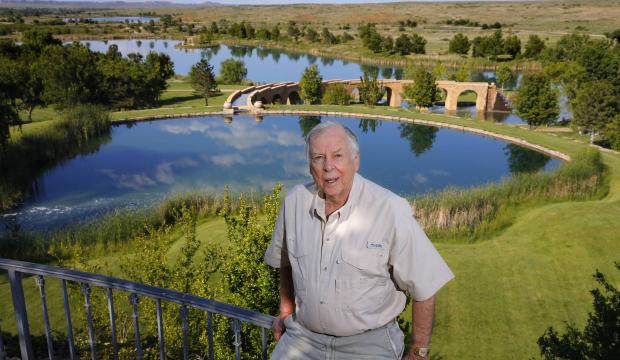
Let me be clear about something. To say I “know” Boone can be construed as a bit of an overstatement. I do not know him well. I’ve had precisely three meetings with the legendary Texas Panhandle oil and natural gas wildcatter: two of them in Amarillo and one at his magnificent ranch in Roberts County, which he calls Mesa Vista.

Take my word for it, the view at Mesa Vista is a sight to behold.

Pickens announced recently that he is putting his ranch on the market. He’s asking a cool $250 million for the place that sprawls across 80,000 acres — give or take.

Pickens is having some health problems relating to a series of strokes he reportedly has suffered. Thus, I am sad to hear the news of his effort to sell Mesa Vista. I want nothing but the best for this individual, who has had — and this is a charitable description — something of a checkered history with Amarillo.

***

It was around 1987 when I picked up a copy of the Wall Street Journal and began reading this front-page story about a flamboyant billionaire oilman launching a boycott against the Amarillo Globe-News. I was living and working in Beaumont. My first reaction when I saw the article: Who in the hell does this guy Pickens think he is? 

Pickens didn’t like the way the Globe-News covered the news, namely as it related to him. He sought to get advertisers to quit buying ad space in the paper; he urged subscribers to quit buying and reading the paper. He became enmeshed in a serious feud with the newspaper’s publisher at the time.

The feud with the publisher escalated. Finally, Morris Communications, which owned the Globe-News at the time, reassigned the publisher, Jerry Huff, and sent him packing.

That’s when Pickens did something that remains stuck in the craw of many folks in Amarillo. He hung a banner on the side of the building he once owned in the downtown district. The banner screamed “Goodbye, Jerry.”

Pickens himself would depart Amarillo not long after that. He relocated to Dallas.

That was the Bad Boone I had heard about. He was prone to vengefulness. He could be mean. He held grudges.

When I arrived in Amarillo in January 1995, the Pickens era in Amarillo had long since passed. But not long after my arrival in the Panhandle, I made an effort to meet this man I knew only by what I had read about him.

The effort took years. I talked many times with his press aide, trying to figure out a way to sit down with Pickens, to pick his substantial brain about energy policy, about his plans to sell Panhandle water downstate, or his efforts to build massive wind farms throughout the High Plains.

Pickens’s press suggested I could go to Dallas. I would have liked to do that, but my employer — the Globe-News — wouldn’t pay my way. I then offered to meet with Pickens at a diner in Pampa. I’d even buy his lunch! No go on that offer.

Then came the opportunity to meet. I had heard that Pickens was coming to Amarillo. I called his press guy. I asked if there was a chance to meet. Two days later, I got the go ahead. Pickens would come to the Globe-News.

He came and we met for a couple of hours.

What kind of man did I encounter? He was charming, talkative, and so very friendly. He admitted it was hard for him to darken the Globe-News door, given the history he had with the paper. But we had a wonderful and quite productive first meeting.

I would meet with him a second time not long after that at the Amarillo Civic Center. That meeting was much shorter, but he was no less charming.

The third meeting would be at Mesa Vista. I had left the Globe-News in August 2012 and was working as a part-time stringer for KFDA NewsChannel 10, writing news features for the station’s website. An on-air reporter, a cameraman and I drove to the ranch and had a fantastic view of this magnificent spread.

Pickens shared with me how he was slowing down because of his age; he was in his mid-80s when we met the final time.

I wanted to share this here because of the news of his effort to sell Mesa Vista. I don’t know who is going to come up with the kind of dough Pickens is asking for his spread.

Yes, news of his selling Mesa Vista seems to signal the end of an era in the Texas Panhandle, where Pickens earned the first part of his vast fortune. He has been through many peaks and valleys with this part of the world.

I am glad — and proud — to have been able to meet and visit with  the Good Boone.

Amarillo is hardly a Texas ‘outpost’

I hereby declare that never, ever again should Amarillo consider itself to be some sort of remote outpost in the great state of Texas.

My example? Take a look at all the money, manpower and machinery at work repairing, renovating and rebuilding the highways that course through this city.

Interstate 40, between roughly Quarter Horse Drive and Soncy? Serious rebuilding is underway. Interstate 27 from the I-40 interchange south to 34th Avenue? More reconstruction. I-27 northbound from 26th Avenue? More of the same. Loop 335 on the southern edge of the city? Ditto, man!

I am unaware of the total dollar cost the Texas Department of Transportation is spending on all this work. I’m pretty sure it’s in the high tens of millions.

Let’s flash back for a moment.

I was working in Beaumont in 1991 when I heard about a freshman legislator from the Texas Panhandle who suggested openly that the state needed to partition itself into several parts. This fellow didn’t like the way state government allegedly “ignored” the Panhandle. My initial reaction was, shall we say, not terribly flattering toward this gentleman.

Four years later, I moved to Amarillo and became acquainted with state Rep. David Swinford, a Dumas Republican. I asked him about his desire to carve up the state. He smiled and didn’t deny that was his intent, although it seemed to me at the time that he was only half-serious — or maybe he was half-joking … whatever.

We developed a good professional relationship over the years. I became convinced that Swinford’s desire in 1991 might have taken off had it earned any support from legislators downstate.

Suffice to say today, though, that Amarillo hardly sits at the edge of some desolate frontier. The state ended up building two prison units here about the time Swinford took office; Texas Tech University installed a pharmacy school near the city’s complex of hospitals and medical clinics.

I surely have heard how Amarillo is closer to the capitals of neighboring states than it is to Austin. And, yes, I’ve heard multiple tales of how President Johnson allegedly closed the Air Force base  here because he was mad that so many Panhandle counties for voted for Barry Goldwater in the 1964 presidential election.

But … that was then.

On this very day — and for the foreseeable future — Texas highway construction is telling us that the state is acutely aware of Amarillo’s importance to the rest of Texas.

‘Climate change’ anyone?

I am acutely aware that one cannot pigeonhole weather forecasting into neat categories.

What’s more, I also know that trying to predict what Mother Nature brings to any region is a crapshoot even in the best of circumstances.

But what in the world is going on this week?

Here we are in the Texas High Plains region. We’re tinder dry. It’s cold, but we’re continuing this dry pattern that’s beginning to cause the TV weather forecasters some anxiety.

Then we get news that snow is blanketing regions of this state and points east. It’s snowing this week in regions where (a) it hardly ever snows and (b) the snow is supposed to fall long after it blankets the Texas Panhandle.

We remain snow free. The Texas Gulf Coast is under several inches of snow. My friends along the Coastal Bend, Houston and the Golden Triangle are bundling up and driving ever so slowly and cautiously in conditions with which they are totally unfamiliar.

Is all of this a symptom of climate change? I’ve long argued that one cannot take a single weather event and equate it with whatever might be happening globally. I usually argue that it’s best to argue climate change by seeing the big picture.

This very weird reversal right here in big ol’ Texas, though, seems to suggest to me that we might be witnessing one element of a much bigger weather story.

Here is God’s gift to the High Plains

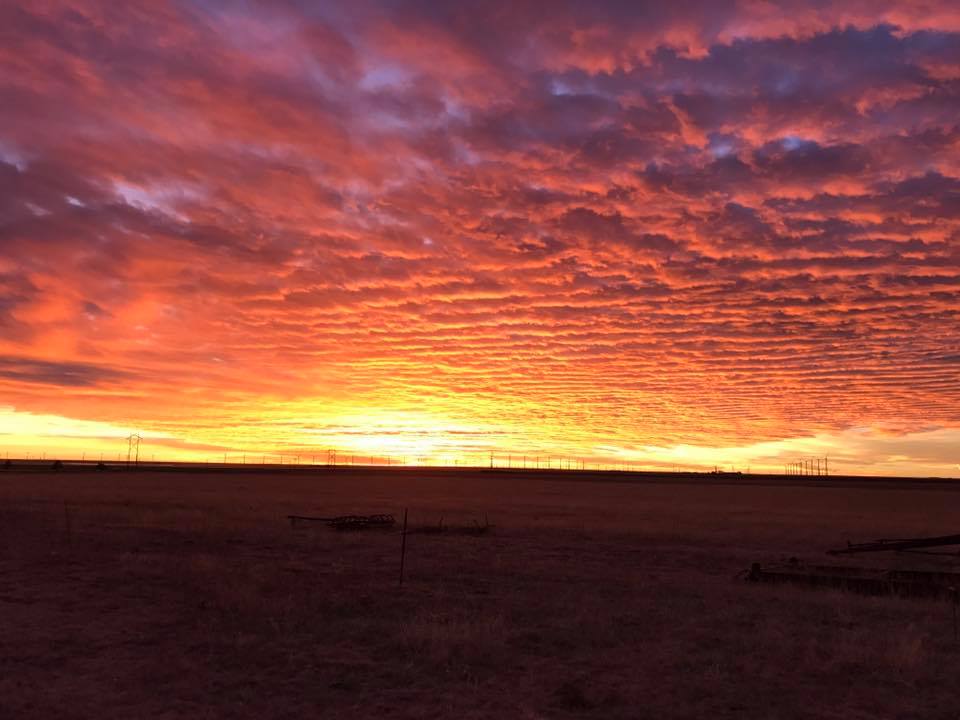
You don’t see any mountainous splendor in this picture.

Instead, you see flat land. You also see a very large sky that seems to be on fire. Those of us who live on the High Plains of Texas got to see this sunset on Black Friday, 2017.

Not a bad way to end the day, if you ask me.

I didn’t take this picture. I did snap a picture of the sunset, but this image comes from a social media acquaintance, Bill Bandy, a fellow Amarillo resident.

I want to share a view with you that I’ve had for as long as my wife and I have lived on the High Plains. It is that God Almighty has a way of paying us back for deciding to put those tall mountains and tall timber in other regions of the country.

My wife and I returned recently from a 4,200-plus-mile journey out west, where we got our full measure of nature’s splendor. The Rockies, the Cascades, the Sierra Nevada — along with the endless stands of tall timber we saw in the Pacific Northwest — all provided plenty of stunning landscapes for us to ogle on our journey to Oregon and back.

We don’t have that kind of scenic splendor out here on the Caprock. We do, though, have a sky that won’t quit. I have said before on this blog that whoever hung the “Big Sky” label on Montana never laid eyes on the Texas Panhandle.

The sky is the Almighty’s way of telling us: I get that I didn’t bless you with terrestrial grandeur, but I hope you appreciate the sunsets — and the sunrises — I am able to provide.

Yes, I do. I’m quite sure we all do.

Happy Trails, Part 45

I want to talk about the seasons of the year for a brief moment.

What that has to do with retirement and the happy trail on which my wife and I are embarking will become apparent quite soon.

I’m normally a Spring Man. Spring historically has been my favorite season of the year. It’s the season of renewal after long, cold and occasionally damp winters on the High Plains of Texas, where we have lived for the past 22 years.

The grass miraculously starts turning green. The trees regain their foliage. The rain comes — often in torrents. The playas fill with water. And, yes, the wind blows hard.

This year might bring a different appreciation for another season.

Autumn arrived just a few days ago throughout the northern hemisphere of Planet Earth. We’ve had a good summer on the High Plains. We’ve had unseasonably heavy moisture, which has cut down on our water usage.

This autumn, though, is a season of immense transition for my wife and me. We’re preparing to relocate to points southeast of here. You see, we’ve been telling family members, friends and even people we barely know that we are being pulled in that direction by a 4-year-old girl who just happens to be our granddaughter, Emma. You’ve read about her on this blog.

But first things first. This time of transition is occurring as autumn moves forward. The transition requires considerable preparation for the move that’s pending.

We have lived in our house for nearly 21 years. It’s the longest span of time either of us has ever called a single place “home.” Our 46 years of marriage, moreover, have enabled us — if that’s the right verb — to acquire a lot of possessions. We’ve stuffed them into this house we’ve occupied for more than two decades. We have jettisoned a lot of it already. There’s more to go as we prepare to “downsize” to a more livable arrangement befitting a retired couple looking to spend more time with their granddaughter.

Given that retirement has given us ample time to do all these things, the task at hand now requires us to buckle down and commit to getting it all done before too much more time passes. I consider it a mix between a blessing and a curse in this post-working aspect of one’s life.

I get asked all the time, “Are you now fully retired? Or are you still doing this and that?” I am fully retired. Period. Next question.

That doesn’t mean I have nothing to do. I have plenty of tasks ahead of me. I merely await my marching orders from my much better — and more organized — half.

This transition awaits. Depending on how it all goes in short order, I might find myself a year from now forsaking spring as my favorite season and falling madly in love with autumn.

Huge municipal resource calls it a career

They came on a rainy evening to honor a man who’s given four decades of his life to public service.

I was one of the hundreds of Amarillo residents who flocked tonight to a brand new hotel downtown to honor Gary Pitner. I didn’t get too much face time with my friend, as he was pretty busy schmoozing with a lot of others in the reception room.

But I do want to write a few good words about this fellow I’ve known almost from Day One upon my arrival around the corner from his office. In January 1995 I came to work as editorial page editor of the Amarillo Globe-News. Almost immediately I came to know the executive director of the Panhandle Regional Planning Commission. That would be Pitner.

The PRPC is a bit of a mystery to a lot of folks. Its duties include coordinating a whole array of issues involving communities throughout the 26 counties that comprise the Texas Panhandle. Pitner has worked as head of PRPC for 32 of his 40 years in local government.

So, why the big outpouring of affection, respect and admiration for this fellow who’s retiring from his lengthy career that sought to make our communities better? It’s because he was so good at it. Moreover, he became the go-to guy years ago when it came to Amarillo’s future growth issues.

There was some discussion this evening at the Embassy Suites hotel, where the retirement reception took place, that Pitner’s presence at PRPC positioned him to become a huge player in the downtown Amarillo planning. He became a voice of wisdom and knowledge; some have suggested he became the voice of all that.

Pitner never would presume to know all there is to know. I’ll say what he won’t say about himself: He knows a lot about this city’s history and how it arrived in the present day. He also is able to offer knowledgeable analysis about where he believes the city is heading and how it ought to get to the finish line.

I’m happy for my friend that he’s entering this next phase of his life. He’s still a young man and has much to offer anyone who’s looking for knowledge about local government.

He stood up to his armpits in downtown planning, in water conservation, in urban growth planning, in reasonable land use. He became a valuable resource for municipal, county and state officials who were looking for a strong base of knowledge about Amarillo and the Panhandle.

Pitner possesses all of that.

I am proud to have known him professionally and am proud to call him a friend. I did manage to speak a fundamental truth to Pitner this evening during my too-brief visit with him.

“There are damn few people I would drive all the way downtown in this hideous weather to pay respects to at an event like this,” I told him. Pitner laughed.

Go ahead and laugh, Gary. But here’s the deal: I wasn’t kidding.