Tag Archives: impeachment

Election security becomes a highly critical ‘back story’

An essential element of the impeachment and Senate trial of Donald John Trump, the current president of the United States, is being pushed toward the back of the proverbial shelf.

I refer to election security. Specifically, the security of our sacred rite of citizenship against foreign interference.

You know the story. Russia attacked our electoral system in 2016, the same day that Donald Trump invited the Russians to look for the “missing emails” produced by former Secretary of State Hillary Rodham Clinton, who was Trump’s presidential campaign foe that year.

Then the president, immediately after Robert Mueller III released his findings into a two-year-long investigation into the Russia hack and interference, placed a phone call to Ukrainian President Volodyrmyr Zellenskiy. He asked Zellenskiy for a “favor,” which was to launch an investigation into Joe Biden, a potential foe for Trump in 2020. Yes, the president asked a foreign government for political help. He wants to “cheat” his way to re-election.

How in the name of cybersecurity can we stand by and let this happen?

I am acutely aware that government cyber geeks are hard at work trying to provide fool-proof locks against this kind of intrusion. What troubles me in the extreme is that the individuals at the highest levels of our government are stone-cold silent on this matter.

Donald Trump, the intended beneficiary of the 2016 Russian election attack, continues to dismiss the interference. He disparages intelligence analyses that says, “Yes, the Russians did it!” He calls that phone call to Zellenskiy “perfect.”

It was “perfect” only insofar as he delivered a clearly defined message to a foreign head of state. He wanted a “favor” and asked that government to attack our electoral system — again! 

What measures are we taking to protect our election system throughout its massive network?

What in the world is POTUS hiding?

I remain a baffled American taxpayer.

Donald John Trump, the current president of the United States, keeps insisting he did nothing wrong when he made that “perfect phone call” to the president of Ukraine.

There are eyewitnesses to that telephonic “perfection,” or so the president says. They need to testify before the U.S. Senate, which has commenced its impeachment trial to determine whether Trump keeps his job as president.

The House of Representatives has impeached Trump on abuse of power and obstruction of Congress. The abuse charge stems from that phone call, the one in which Trump asked the Ukraine government for a favor. He wanted Ukraine to launch an investigation into Joe Biden, a potential foe of Trump. He asked Ukraine to, that’s right, interfere in our 2020 election. 

Except that Trump keeps saying the call was “perfect.” Well, perfection might lie in the eye of the beholder. White House chief of staff Mick Mulvaney was there. So was national security adviser John Bolton. These men need to tell us what they know, what they heard, what they told the president at the time.

If there is nothing to hide, then — if logic holds up — there wouldn’t be a reason on God’s treasured Earth for them to resist testifying before the U.S. Senate.

Am I right? I believe I am.

Just wondering: How did ‘Judge’ Cornyn handle witness questions?

I feel the need to focus for a moment on one of the U.S. Senate’s 100 “jurors” presiding over the impeachment trial of Donald John Trump, the current president of the United States.

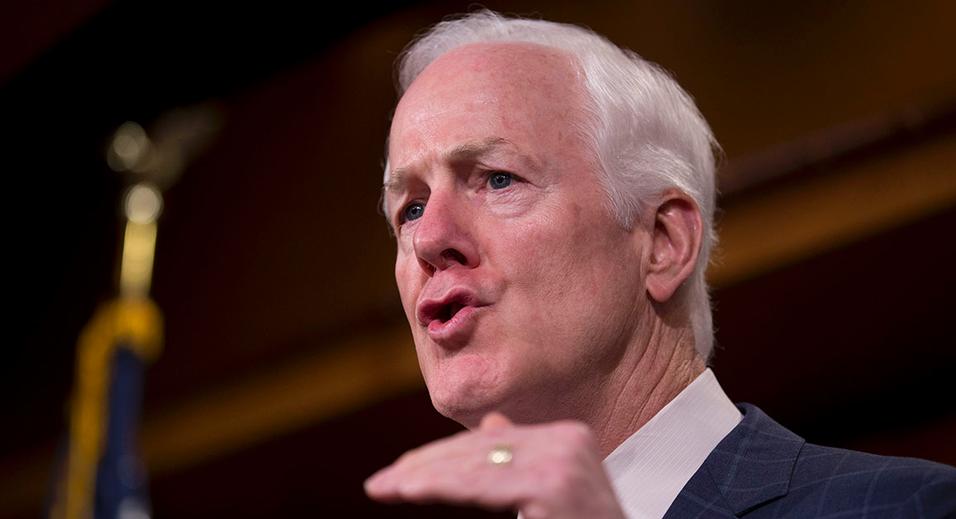
He is Sen. John Cornyn, a Republican, and the senior senator from Texas. He is aligned with the president. Cornyn remains one of Donald Trump’s allies in the Senate. He has resisted calls for witnesses to be heard in the Senate trial. I wonder why.

My curiosity is based on Cornyn’s professional history.

He once served as Texas attorney general, as a member of the Texas Supreme Court and, oh yes, as a trial court judge in the 37th Judicial District in Bexar County.

I know Sen. Cornyn. He and I have spoken several times over the years. I always have found him to be an engaging, occasionally affable fellow. However, I cannot grasp why a man with trial court experience would allow himself to be snookered into the goofy notion that a presidential impeachment trial need not include new witnesses.

Did he prohibit witnesses while presiding over a trial in San Antonio? I have never asked him directly, but I know the answer. It is hell no!

The impeachment trial isn’t quite the same as a judicial trial, but it ought to operate on many of the same tenets adopted for any judicial proceeding. One of them should include the calling of witnesses and additional evidentiary documents.

Why, then, is Sen. Cornyn turning his back on his own experience, knowledge and understanding of a trial?

Impeachment is quite ‘constitutional,’ Mr. President

So, here we go.

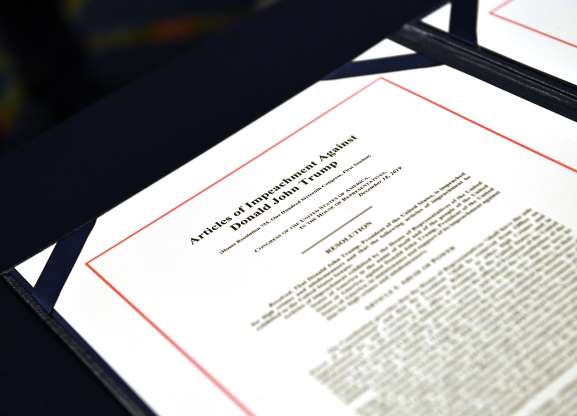
Donald John Trump’s legal team has declared that the impeachment articles that will be serve as the basis for a U.S. Senate trial to determine whether Trump keeps his job as the current president of the United States are “unconstitutional.”

What? They can’t be serious!

The impeachment articles alleging abuse of power and obstruction of Congress are as “constitutional” as they can possibly be. How do I know that? Because I have read the Constitution and the process that unfolded in the House of Representatives to produce the impeachment articles followed the Constitution to the letter.

The nation’s governing framework lays out in black and white that the House shall have “sole power” to impeach a president. That’s what it did. The House didn’t break any rules, didn’t violate any law, it didn’t skip any pre-ordained process laid out. The House followed the process to the letter.

Donald Trump solicited the president of Ukraine for a political favor. He wanted Ukraine to launch an investigation into a possible political foe. He then sought to withhold military aid to Ukraine, which is fighting rebels backed by Russia. Right there is your abuse of power, Mr. President.

The second article of impeachment? It involves obstruction of Congress. Trump blocked congressional subpoenas, ordering aides to refuse to answer them. Congress cannot do its oversight duties without being able to summon witnesses to answer questions from House members. So, there is your obstruction of Congress.

It was all done according to the process laid out in the Constitution.

For the Trump legal defense team to offer up a lame “unconstitutional” rationale is ridiculous on its face.

Impeachment about overturning election? No-o-o-o-o! Really?

Can we dispense with the tired — and patently ridiculous — notion that Donald John Trump’s impeachment is meant to “overturn” the results of the last election?

That goofy argument is part of the White House response to the articles of impeachment that the House of Representatives delivered to the Senate, which on Tuesday will commence the trial that will determine whether the current president of the United States keep his job.

I believe I shall remind everyone of a couple of historical facts.

The House Judiciary Committee voted for articles of impeachment against President Nixon in 1974. Nixon quit the presidency on Aug. 9 of that year. He had won re-election in 1972 in a smashing landslide: 49 states, 520 electoral votes, 60 percent of the ballots cast. That impeachment effort would have reversed the outcome of that election, too.

The House impeached President Clinton in 1998. He stood trial in 1999 and was acquitted. Clinton won re-election in 1996 with a handsome margin: 379 electoral votes and a healthy plurality of actual votes. And, yes, that impeachment was intended to overturn an election result, too.

Presidential impeachment by definition are intended to do the very thing that the White House is now accusing the House of doing. I know that House members who voted to impeach the president stand behind high-minded rhetoric about “defending the Constitution.” I believe that is the case here.

However, this act also carries with it a necessary political component, which is that it seeks to correct a ballot-box mistake. Let’s not be coy about this point as well: Trump did not win in anything approaching a landslide. He pulled in nearly 3 million fewer votes than his opponent in 2016 and won because of an adroit end-of-campaign tactic that saw him win three key Rust Belt states that put him over the top in the Electoral College count.

Impeachment is meant to overturn an election? Well, as we used to say in high school: No sh**, Sherlock!

‘I don’t know the guy’

All righty. Let’s see how this goes.

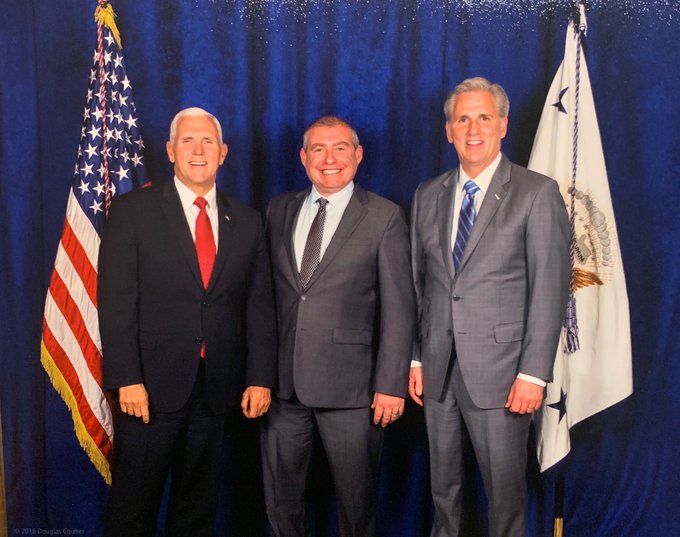
Lev Parnas, a Ukraine-born friend of Rudy Giuliani — one of Donald Trump’s personal lawyers — has become a key player in the impeachment trial of the president of the United States.

Parnas says Vice President Mike Pence was in the loop on the favor that Trump sought from Ukraine, when Trump asked Ukraine to produce some dirt on Joe Biden, a possible opponent of the president in the 2020 campaign.

Pence said “I don’t know the guy” when asked to comment on Parnas’ allegation.

OK, that’s Pence standing right next to Parnas — shoulder to shoulder — in the picture that accompanies this blog post. The fellow on the right is House Minority Leader Kevin McCarthy, a California Republican.

This is a serious pattern within the Trump administration. Trump says he doesn’t know someone, then pictures emerge of him schmoozing with the guy he said he doesn’t know.

Now it’s the VP’s turn to produce the question: Who you gonna believe, me or your lyin’ eyes?

I believe the learned professor is wrong about abuse of power

At the risk of wading into an argument over an issue that ought to be way above my skill level, I want to take issue with a learned law professor’s assertion that “abuse of power” is not an impeachable offense.

With all due respect to the great Alan Dershowitz, it is my considered opinion that presidents of the United States can be impeached over abusing the awesome power of their exalted office.

Dershowitz is going to argue next week in the impeachment trial of Donald John Trump that the Constitution shouldn’t be subjected to this action on the basis of what the House of Representatives has decided. The House impeached Trump on two counts: obstruction of Congress and abuse of power.

The abuse occurred, according to the articles of impeachment, when Trump asked Ukraine for a political favor; he wanted the Ukrainians to investigate Joe Biden and Hunter Biden and, in effect, interfere in the 2020 election because Joe Biden is a possible opponent of Trump. He then withheld military aid to Ukraine, which the Government Accounting Office has said is in violation of the law.

My goodness. If that isn’t an abuse of power, then the term has no meaning.

My reading of the Constitution, which I’ve been doing a lot of lately, tells me the founders were deliberately vague on what constitutes “high crimes and misdemeanors.” Dershowitz seems to suggest that because abuse of power does not fall into a category of a criminal offense, that it doesn’t quality as an impeachable offense. Other scholars have argued that the founders hadn’t yet established any statutes when they wrote the impeachment clause into the Constitution. Therefore, those offenses could be interpreted broadly.

I’ll go with them and not with Dershowitz.

I am not going to say the Harvard law professor emeritus is a dummy. Far from it. I just believe he has concocted a standard that I don’t think exists in the U.S. Constitution.

Of course, this is an academic exercise anyhow, given the Senate’s likely disposition to avoid convicting Trump of what I believe is a “high crime and misdemeanor.” The GOP-led Senate is more prone to protect the president than the document they all took an oath to “protect and defend.”

POTUS turns salute to football champs into a campaign event

Donald John Trump, the current president of the United States, just cannot help himself.

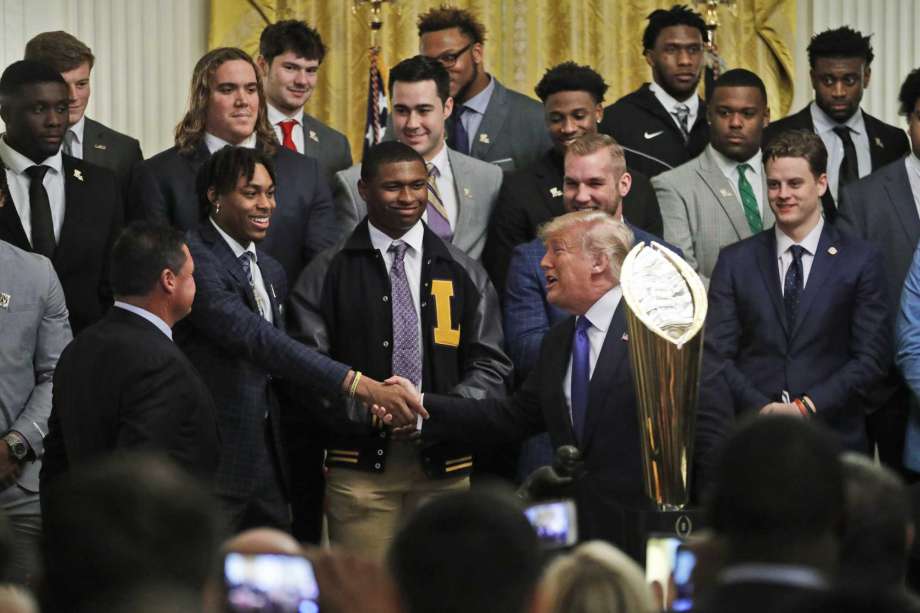
The Louisiana State University Tigers showed up at the White House ostensibly to receive a salute from Trump for the Tigers winning the college football championship. Hey, LSU whipped Clemson by a score of 42-25.

So, Trump invited them to the White House, per the customary reception given to sports champs.

What does the president do? He turns the event into a campaign event. He yapped and yammered about the impeachment, saying that despite the great economy they want to “impeach the son of a bi***.”

Yep, that’s the language that flew out of the mouth — at the White House — of the evangelical Christian movement’s favorite politician. He makes me so (not) proud of the president.

He blathered some more about how he has supposedly rebuilt the military, brought justice to terrorist leaders.

This is what we get when we have an impeached president who also is running for re-election. Indeed, this also is what we get when we have a president who cannot separate his own political fortunes from events — such as a ceremony to salute a college football team — that have nothing to do with those political fortunes.

Donald Trump clearly is obsessed with this impeachment trial. He also is obsessed — to the nth degree — with his political standing. Trump takes every opportunity he can find to further buttress his status.

Even when such politicking has no place in an unrelated event.

Weird.

Ex-WH ethics guru calls McConnell a ‘perjurer’

Well now, that didn’t take long.

U.S. Supreme Court Chief Justice John Roberts told all 100 U.S. senators Thursday to raise their right hands and swear under oath to conduct “impartial justice” in the trial of Donald John Trump, president of the United States.

One of senators to swear to follow that oath is Majority Leader Mitch McConnell. Except, wait! He’s said many times already that he has no intention of being impartial. McConnell said he will take his cue from Trump’s legal team.

Just hours after taking the oath, former White House ethics lawyer, Richard Painter, who served President George W. Bush from 2005 to 2007, accused McConnell of committing an act of perjury.

Painter went on Twitter to say McConnell has contradicted himself. “This man just swore an oath saying the exact opposite,” Painter said in a tweet. “This man is a perjurer.”

Well now. Isn’t that a crime punishable with a jail sentence?

To be fair, there are a number of senators on both sides of the aisle whose statements need careful examination. However, I believe I have seen statements only by two prominent Republicans — McConnell and Senate Judiciary Committee Chairman Lindsey Graham — that have declared that the senators have made up their minds. Other senators are trying to cover their rear ends by saying they intend to listen to all arguments before making up their minds.

McConnell needs to recuse himself from this proceeding. If he cannot abide by the oath he just took, then he has no business presiding over a Senate that is going to put the president of the United States on trial.

SCOTUS chief to get his feet wet at the highest level imaginable

U.S. Chief Justice John Roberts is a serious man who takes his responsibility as seriously as is humanly possible. Of that I have not a single, solitary doubt.

However, I heard something tonight that made my jaw drop. It was that Chief Justice Roberts, who today took an oath to preside over a U.S. Senate trial of the Donald John Trump, has never tried a case in court.

Yep, this will be the first trial over which he will preside.

President Bush appointed Roberts to the D.C. Court of Appeals in 2003. An appellate court doesn’t hear witness testimony; it doesn’t rule on court objections. It hears lawyers argue their cases. Then the court decides which side wins the argument.

After that, Roberts got the nod in 2005 to become chief justice of the nation’s highest court. He does more of the same thing he did at the lower-court level.

Prior to the D.C. court appointment, Roberts worked in private practice, then went to work for the attorney general’s office during the time William French Smith was AG during the Reagan administration.

Trial court experience? None, man. Now he’s been dragged into the role of presiding judge in the U.S. Senate, where he will be charged with keeping order. He’ll get to rule on whether witnesses will be called, although the Senate can overturn whatever ruling he issues.

Still, it is mind-boggling to think that the chief justice’s first actual trial involves a case involving whether the president of the United States keeps his job.

I am certain the chief justice is up to the challenge that awaits him.

Wow!