Tag Archives: GOP

How do you campaign against a moving target?

donald-trump-gag-big

So much about this presidential campaign is a puzzle and I’m having trouble finding the pieces to complete it.

I’ll start and finish with Donald J. Trump, the presumptive Republican nominee.

He has tossed every single bit of conventional wisdom into the Dumpster. Trump has no public service experience; he has demonstrated zero understanding of how government works; he has blustered, bullied and bloviated his way to this point in the campaign; his insults and innuendo should have doomed his candidacy months ago; his personal history is, well, checkered.

To my way of thinking, the most confusing element of this campaign is the absence of any philosophical grounding for this individual.

In normal election years, Democrats nominate a candidate who stands for a set of principles; Republicans do the same.

Hillary Clinton is about to become the Democratic nominee. She, too, has switched positions on occasion as she battles Sen. Bernie Sanders for her party’s nomination.

But one gets a general idea of Clinton’s world view: It seems to tilt left, with a more hawkish view of the use of military power than her more progressive political brethren.

Trump? Where does this guy stand? On anything?

He changes his positions almost hourly. Women should face punishment if they obtain an abortion; on second thought, he didn’t mean that. He would ban Muslims from entering the United States; oh, wait, that’s just a “suggestion.” He once was pro-choice on abortion; now he’s pro-life. He once called Hillary Clinton “great”; now he calls her “Crooked Hillary.” He said Mexico is sending drug dealers, rapists and killers into this country: but he says “I love Hispanics.” He has boasted about his philandering; now he seeks to woo the evangelical voters who comprise much of the GOP “base.”

How is Clinton going to campaign against any of that? How is she going to pit her ideas against his ideas, when he doesn’t seem to stand on a single principle — other than furthering his own ambition?

The late Gertrude Stein once said of Oakland, Calif., that “there is no ‘there’ there.”

I’m sensing that Trump lacks a “there.”

‘Low energy’ Jeb to back Trump

Jeb  Bush

This is hilarious.

Donald J. Trump eviscerated a field of 16 fellow Republican presidential contenders with insults and counterattacks.

Remember when he called Jeb Bush a “low energy” candidate? It was a devastating attack on the former Florida governor who once was considered to be the man to beat for he 2016 GOP presidential nomination.

Bush then dropped out of the race.

Now we have Trump saying that Jeb is going to find a burst of “energy” and will endorse the presumptive presidential nominee.

I need to sort this out.

Trump insults Bush with the “low energy” crack. Trump then says Bush will find some “energy” and endorse him?

http://www.politico.com/story/2016/05/donald-trump-jeb-bush-223582

Jeb Bush will endorse the GOP candidate who levels yet another veiled insult?

I do not think that will happen.


Obama lacks GOP go-to pal in Congress

Valerie-Jarrett

Valerie Jarrett gave a stellar defense Sunday night of her boss and long-time friend President Barack Obama.

Her appearance on “60 Minutes” was notable in her defense as well of her role — in addition to senior adviser — as friend, confidante and her easy access to the Leader of the Free World.

But she pushed back when CBS News correspondent Nora O’Donnell asked her about the president’s continuing prickly relationship with congressional Republicans. She said Obama has done all he could do to reach out.

O’Donnell, though, asked — but did get an answer — about the lack of a leading Republican in either the Senate or the House to whom the president could turn to fight for his legislative agenda.

It brought to mind the kind of relationship that previous presidents have cultivated with members of the “loyal opposition.” President Lyndon Baines Johnson could turn to GOP Sen. Everett Dirksen in a pinch; President Ronald Reagan had a fabulous after-hours friendship with Democratic House Speaker Tip O’Neill; GOP President George W. Bush relied on help from Sen. Ted Kennedy to push through education reform.

Barack Obama doesn’t seem to have that kind of personal friendship with members of the other side. He relies on his own instincts, his own circle of friends — such as Jarrett — and the vice president, Joe Biden, who to this day retains close friendships with Senate Republicans.

It’s that lack of kinship that has troubled many of us who want the president to succeed. I recall having this discussion once with retired Amarillo College president Paul Matney, who lamented that Obama had not developed the legislative know-how that LBJ brought to the presidency.

LBJ had served as Senate majority leader before his one-time foe John F. Kennedy asked him to be his running mate in 1960. Ol’ Lyndon knew how the Senate worked and he was able to parlay that knowledge — along with tremendous national good will after JFK’s assassination in 1963 — into landmark legislation.

Barack Obama has been forced to struggle, to battle relentlessly, to get anything past a Republican-led Congress intent on blocking every major initiative he has sought.

The reasons behind the ultra-fierce resistance will be debated long after President Obama leaves office.

He seems, though, to have lacked one essential ingredient to move his agenda forward: a good friend and dependable ally on the other side of the aisle who could run interference for him.


Third party looking more like an option … really

ORLANDO, FL - SEPTEMBER 22:  Former New Mexico Gov. Gary Johnson speaks in the Fox News/Google GOP Debate at the Orange County Convention Center on September 22, 2011 in Orlando, Florida. The debate featured the nine Republican candidates two days before the Florida straw poll. (Photo by Mark Wilson/Getty Images)

I am a dedicated two-party presidential election traditionalist.

My tendency is to dismiss third-party candidacies. My thought always has been that they have no chance of winning, therefore I won’t waste my vote, which I value greatly.

I am now about to announce that I am considering following the lead of one of my sons, who declared just the other day that he’s likely to vote for someone other than Donald J. Trump and Hillary Clinton.

There, I’ve announced it.

Two former moderate Republican governors have teamed up as Libertarians seeking to run for president and vice president.

New Mexico’s Gary Johnson is running for president; he’s tapped Massachusetts’ William Weld as his running mate.

The Libertarian Party must nominate them. My strong hunch is that they will.

This won’t be Gov. Johnson’s first rodeo. He ran four years ago and collected about a million votes. I’ll bet you some serious money he and Gov. Weld will do a lot better than that this year.

The last major alternative to the two parties came in 1992 when Henry Ross Perot challenged President George H.W. Bush and Arkansas Gov. Bill Clinton. He won 19 million votes, but not a single Electoral College vote.

And, no … he didn’t cost President Bush his bid for re-election. I’ve seen ample polling data that suggest that even without Perot on the ballot that Clinton would have won by roughly the same margin he rolled up in 1992.

Why am I thinking about a third party? I’m not entirely thrilled with Hillary Clinton as the Democratic nominee. Trump never — in a zillion years — would get my vote.

Don’t misinterpret me here. I haven’t yet committed to a third party candidate. I’m merely thinking about it, which by itself represents a major shift from my normal political thought process.

Johnson’s major claim to political fame was his call for legalization of marijuana. I was working for a newspaper — the Amarillo Globe-News — at the time he issued that call and the paper’s corporate ownership never would support legalization of marijuana; therefore, I wrote editorials criticizing Gov. Johnson’s “wacky” notion. I’m now writing my own blog, under my own name, and my view on that issue is, well, evolving.

Weld is another moderate former GOP governor. No single stands out, but I’ve long perceived him to be far from what’s becoming the Republican “mainstream” that wants to round up illegal immigrants, wants to criminalize abortion and wants to send American troops into battle at the slightest sound of gunfire.

Yes, this is just another example of how wacky this election campaign has become.


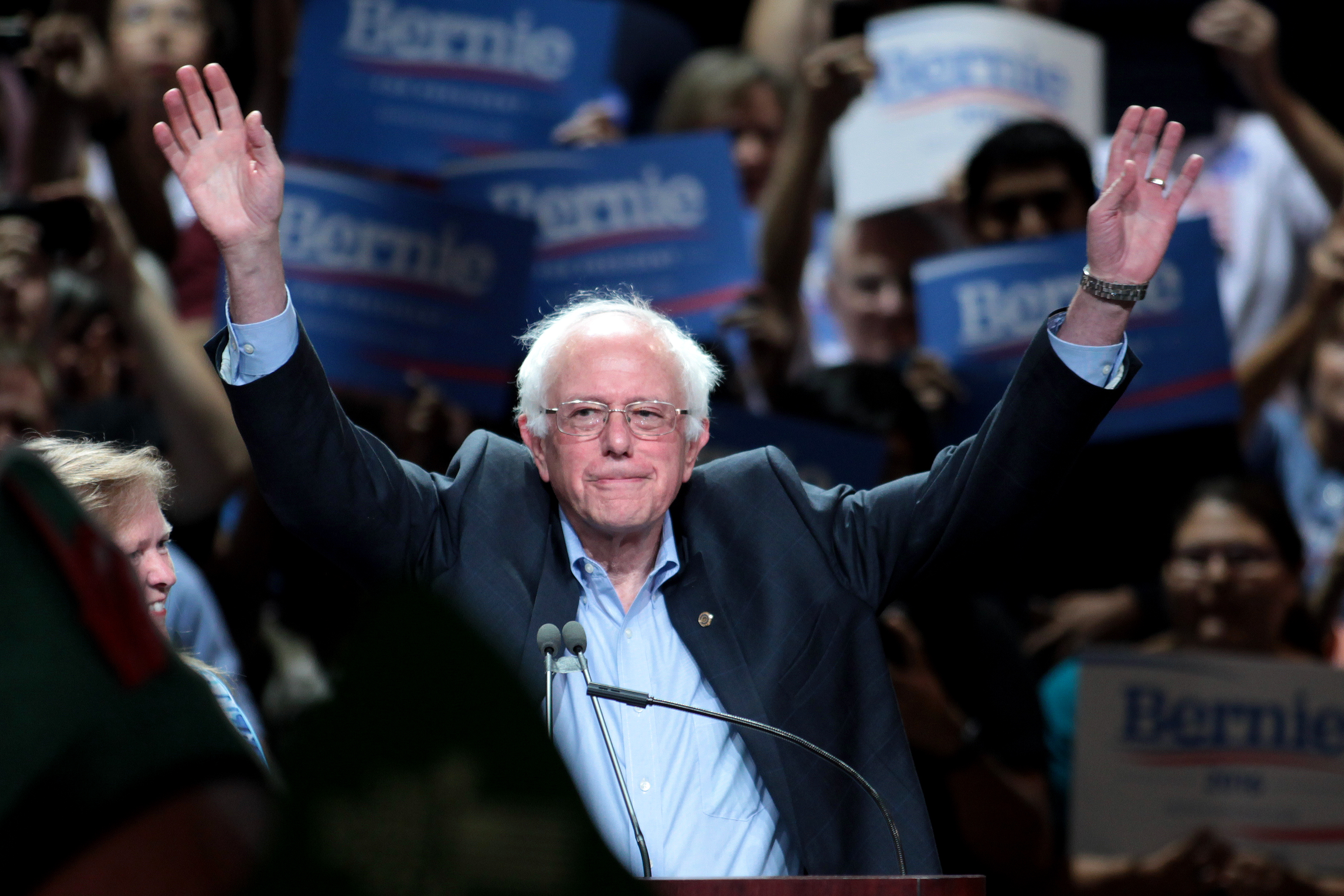
It’s over, Sen. Sanders

Bernie_Sanders_by_Gage_Skidmore

Democrats and Republicans seem to operate under differing rules of political combat … in this presidential election cycle, at least.

Republicans opened the presidential primary campaign with 17 individuals seeking their party’s nomination. One of them remains. He is likely the most improbable candidate you ever could imagine.

Donald J. Trump is a man with zero public service record, a scatter-shot approach to what passes as foreign and/or domestic “policy” and a checkered personal history.

He’s the last man standing among all those Republicans.

Democrats opened their season with just five candidates. Three of them are now off the grid. Two are left: U.S. Sen. Bernie Sanders and former Secretary of State Hillary Rodham Clinton.

Clinton’s all but got her party’s nomination in the bag. Sanders is hanging on, cheered on by those big rallies.

So, here’s what I believe should happen: Sanders needs to call it a campaign. He’s made his point — repeatedly — about income inequality and Wall Street corruption. He’s not going to be nominated president.

It’s time for him to clear the field for Clinton to run against Trump — head to head.

Democratic gurus are growing a bit restive. They see these polls that show Clinton and Trump in a close race. They fear that the longer Sanders continues his sniping at Clinton, the more damage he inflicts on her chances to become the nation’s 45th president.

My own view is that this contest shouldn’t even be close.

Trump is patently — at virtually every level one can name — unfit to become president. Yet he continues to win cheers from those who think he “tells is it like it is.” They rally to his calls against what he calls “political correctness.” The man is a buffoon … yes, a wealthy one, but a buffoon nonetheless.

Clinton is far from the perfect candidate. But she’s been examined up close and personal for more than two decades. Her career — as first lady, U.S. senator and secretary of state — has been dissected more carefully than a laboratory frog.

She continues to fend off the challenge from the remaining other Democrat in this contest.

The primary season is over, Sen. Sanders. You lost. Hillary Clinton won.

It’s time for Sen. Sanders to “suspend” his campaign and then start writing the fiery speech he plans to give at the Democratic Party’s presidential nominating convention this summer in Philadelphia.

As for Trump … well, uh, keep doing what you’re doing.

‘People’ do care about these things, Mr. Chairman

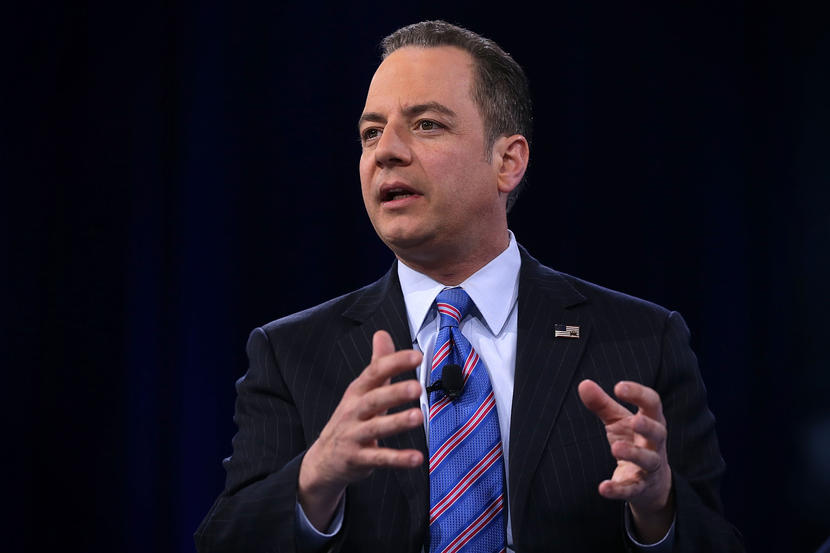
NATIONAL HARBOR, MD - MARCH 04:  Chairman of the Republican National Committee Reince Priebus participates in a discussion during CPAC 2016 March 4, 2016 in National Harbor, Maryland. The American Conservative Union hosted its annual Conservative Political Action Conference to discuss conservative issues.  (Photo by Alex Wong/Getty Images)

Reince Priebus is painting the American electorate with a pretty broad brush these days.

The Republican Party’s national chairman says “people don’t care” about the controversies surrounding the GOP’s presumptive presidential nominee.

I beg to differ, Mr. Chairman.

“People” do care. Many of us — such as yours truly — care a lot.

http://www.msnbc.com/msnbc/rnc-chairman-reince-priebus-donald-trumps-controversies-people-just-dont-care?cid=sm_fb_msnbc

— Tax returns that Trump refuses to disclose to the public?

— Statements attributed to him about women?

— The myriad lies he’s told while campaigning for president?

— The ridiculous story about Trump posing as a publicist to promote himself?

Yeah, those things matter, Mr. Chairman. They speak to the character of the man who wants to become president of the United States.

I won’t get too far into this blog post without mentioning that Trump isn’t the only candidate with “issues” to address. Hillary Rodham Clinton has her own and they, too, are bothersome.

The issue at the moment deals with the huge speaking fees she collected — allegedly from Goldman Sachs .

The other matters — Benghazi, the email controversy — are being dealt with by a Republican-led Congress that is still on the hunt for something to derail her campaign.

The RNC chairman shouldn’t give his party’s presumed nominee a pass because of some belief that “people” don’t care about the things that are dogging his campaign.

I dislike saying I speak for others. I am fairly confident, though, in presuming that the nation is loaded with inquisitive voters who want these issues settled.


Trump upsets the national political truism

donald-trump-gag-big

Donald J. Trump’s presidential candidacy has turned everything on its ear.

The Republican Party is at war with itself. How does the party back a presidential nominee who opposes traditional GOP orthodoxy? And just how does the party define “unity” if it cannot back its nominee fully?

Let’s play this out a little more.

What, then, about the rest of us who at the same time oppose traditional GOP dogma while also being repulsed by the very idea of Donald Trump ever settling behind a big desk in the Oval Office?

I’m trying to grasp the apparent conflict I’m enduring now as I watch Trump get ready to become the Republicans’ next presidential nominee.

I dislike the traditional GOP view on abortion, on tax policy, on wage and marriage equality, on gun control and on immigration.

I also dislike Trump’s views on at least one of those issues: immigration. The rest of Trump’s views are, to say the least, malleable. I don’t know precisely what he thinks about any of the rest of them.

Which brings me to this point. Why do I oppose this guy’s candidacy so vehemently?

I guess it’s his unfitness for the office he’s seeking.

Trump has no record of public service;  we have nothing on which to base his past performance. He has no grasp of the basics of government, let alone any idea on how to manipulate its complexities. Trump has lied constantly throughout this campaign — and until recently has been allowed by the media to get away with it.

He is a reality TV celebrity. He “owns” beauty pageants. He’s built glitzy hotels and has lived an opulent lifestyle. And American voters are supposed to relate to this?

And I haven’t yet gotten into his moral fitness for the job. He seems to possess no moral bearings. He has boasted openly about his marital infidelity. The things he has said about women simply stand as some of the most revolting things I’ve ever heard from anyone … let alone from someone on the brink of become a major-party presidential nominee.

How many other major, mainstream presidential candidates can you name who’ve spoken to shock jock Howard Stern about his sexual exploits?

This is what I mean about Trump upsetting every political calculation there is.

True-blue Republicans don’t trust him. My goodness, this guy is the classic RINO — a Republican In Name Only. Yet, he continues to collect the votes of millions of GOP base voters who, I guess, are trying to send some kind of “message” to the party establishment.

If he’s a RINO, which he is, then he ought to appeal to the rest of us who don’t swallow the Republican orthodoxy. Am I right?

Not even …


Trying to take Trump comments seriously

trump

Maureen Dowd is one of my all-time favorite columnists.

She writes with an inimitable flair for the New York Times. She takes on serious topics with a sometimes-unserious tone, which is all right with me. Her brilliance is shown by her ability to know the boundaries she mustn’t cross. Truly serious topics get the serious treatment they deserve in her essays.

I am having trouble, though, with one of her occasional topics. It’s Donald J. Trump, the presumed next Republican Party nominee for president of the United States. The trouble comes when I read quotes attributed to Trump in one of Dowd’s columns and question whether they’re real. Did she make this stuff up? Is he really, seriously responding in this manner?

http://www.nytimes.com/2016/05/15/opinion/sunday/the-mogul-and-the-babe.html?action=click&pgtype=Homepage&clickSource=story-heading&module=opinion-c-col-left-region&region=opinion-c-col-left-region&WT.nav=opinion-c-col-left-region&_r=0

Even the headline, referencing “the Mogul and the Babe” makes me wonder. When you read the piece, you learn that “the Babe” has nothing to do with a beautiful woman.

Dowd writes about the meeting Trump had this past week with House Speaker Paul Ryan. It was just supposed to be the two men. Here’s Dowd: “They let Reince Priebus stay. ‘He’s a hard worker and a good guy,’ Trump said.”

Gee. That’s deep.

What about Trump’s infamously insensitive campaign style? More from Dowd: “So Ryan didn’t ask Trump to stop making remarks that alienate women? ‘No,’ Trump said, ‘he wants me to be me.’ So much for the showdown.

“When I asked if he had been chided by any Republicans for his Twitter feud with Elizabeth Warren, he replied, ‘You mean Pocahontas?’ So much for reining it in.”

Here’s one more example. Dowd mentioned Texas U.S. Sen. John Cornyn’s advice on how Trump should deal with Hispanic Americans: “I noted that John Cornyn said he gave Trump some tips on how to discuss illegal immigration more sensitively to woo Hispanic voters. ‘I love getting advice,’ Trump deadpanned. ‘It’s just what I need, just what I need is more advice. The 17 people I beat are still giving me advice.’”

As I read this Dowd essay this morning, I was struck by how shallow and self-serving Trump’s answers were … how they always are.

I’ll keep struggling to make sense of what Trump says and try to determine if what I read is intended to be taken at face value.

Dowd declares at the start of her column that she is decided to “dispense with satire.” Thus, she would have us assume she wrote this piece with actual answers to actual questions.

But did she? Really?

Tax matters become our business

13firstdraft-trump1-tmagArticle

You’re running for president of the United States.

It’s a grueling event. It has required candidates to do things they dislike doing, but they do them anyway.

One of those things is to reveal to the public they intend to govern how much they pay in taxes to the federal government. Presidential candidates have been doing it since 1976. It’s not required by law; candidates just do it. Some do so more willingly than others.

So, when a media representative asks the candidate about his or her tax rate, how much they pay in taxes, how is the candidate supposed to respond?

Donald J. Trump got that question this morning from George Stephanopoulos on ABC-TV’s “Good Morning America.” Trump’s response? “It’s none of your business.”

Well, actually it is.

The man now presumed to be the Republican Party’s next presidential nominee is throwing out tax plans left and right. He’s back-tracking, switching his views, telling us what he intends to do — before he changes his mind — about how much money he wants the rest of us to pay in taxes.

Trump has been less-than-forthcoming on his tax returns. He won’t release them for public review, contending that the Internal Revenue Service is in the midst of an audit. IRS officials respond with, “So what?” He still can release the returns.

Trump won’t do it.

Then he tells a network news anchor that the information is “none of your business.”

http://www.nytimes.com/politics/first-draft/2016/05/13/donald-trump-on-his-tax-rate-its-none-of-your-business/?_r=0

It is absolutely our business to know how much a man who wants to be president pays in taxes to the government — our government, the one financed by American taxpayers.

Of course, the president doesn’t set tax policy by himself — or herself. Tax legislation originates in the House of Representatives. As the saying goes, “The president proposes, Congress disposes.”

Still, if a president is going to propose tax policy to Congress — which might then become law that has a direct impact on every American’s household income — then the public has a right to know whether the presidential candidate is paying his or her fair share.

Who determines what is fair? We do.


Unity? It’s not necessary, according to Trump

12TRUMPMANDATE-master768

There once was a time when political unity spelled success for candidates who traded on it.

In 1968 and again in 1972, Democrats nominated candidates for president who sought to win with their party in shambles.

In 1976, Republicans nominated an incumbent president who had to fight for his political survival against an insurgent.

In every case mentioned here, the disunited party lost the election.

Is that going to happen in 2016? Those of us who’ve been proven wrong at almost every turn about the Republican primary campaign should hold our thoughts to ourselves.

http://www.nytimes.com/2016/05/12/us/politics/donald-trump-campaign.html?hp&action=click&pgtype=Homepage&clickSource=story-heading&module=first-column-region&region=top-news&WT.nav=top-news&_r=0

Donald J. Trump says unity isn’t a prerequisite for him winning the election this fall. The Republican Party is ripping itself into pieces over this individual’s pending nomination for president.

Big deal, says Trump. He has a “mandate” to keep doing what he’s been doing, Trump says. According to the New York Times:

“Mr. Trump, in a telephone interview, compared his candidacy to hit Broadway shows and championship baseball teams, saying that success begot success and that he would be foolish to change his behavior now.

“’You win the pennant and now you’re in the World Series — you gonna change?’ Mr. Trump said. ‘People like the way I’m doing.’”

Still, he’s going to meet Thursday with House Speaker Paul Ryan and some other leading Republicans to talk about, oh, unifying the party.

I’ve become more of a political traditionalist as I’ve gotten older. I once worked real hard to elect the late Sen. George McGovern in 1972. It didn’t work out for us.

I now believe unity is better for the candidate than disunity.

Trump needs virtually all Republicans — and a lot of Democrats and independents — to vote for him if he intends to take the presidential oath next January. My own sense is that he’s still got a gigantic hill ahead of him.

Far more women view him unfavorably than favorably; same with Hispanics and African-Americans. He’ll need far more of them if he has a prayer against the Democratic nominee, who likely will be Hillary Clinton.

Does he obtain majorities with those key voting blocs by leading a divided, disjointed and dysfunctional Republican Party?

For the life of me, I don’t know how he does that.

Then again, I don’t know how this clown finds himself on the doorstep of a major-party presidential nomination.