These are the ‘thoughts’ of the 45th POTUS?

I am going to attach a link to this blog that really ought to stand alone, with little — if any — comment from yours truly.

It’s the transcript of an Associated Press interview conducted with Donald J. Trump, the nation’s 45th president.

One comment has jumped out and received considerable media attention already. It’s the part where the president talks about his ratings on CBS News’ talk show, “Face the Nation,” and how his appearance on the show boosted the ratings to a place not seen since the 9/11 terror attacks.

Narcissism, anyone? Hmmm?

Beyond that, if you read the entire transcript, perhaps you might draw the same conclusion that I have drawn, which is this individual cannot communicate. He cannot focus. He cannot think clearly and express himself concisely.

Here’s the interview.

It’s full of sentence fragments, stream-of-consciousness riffs and rants, and an amazing lack of empathy or compassion.

I am left to ask: Is this how one “tells it like it is”?

City clearing the way toward more progress

I’ve actually discovered a downside to no longer working full time in the job I used to do.

It is that I am no longer “in the loop” with events that occur daily in Amarillo’s downtown business district. My perch as editorial page editor of the Amarillo Globe-News kept me close to the action. Those days are gone.

They’re knocking down an old retail building at the corner of Ninth Avenue and Polk Street. I had to find out about it by inquiring on social media.

I also learned that once was known as the Blackburn Building is going to become a parking lot for motor vehicles driven into downtown to use some of the other sites being rehabilitated, renovated and rebuilt.

There’s the usual expressions of dismay by those who lament the loss of an old building. I feel their angst and their pain. I hate seeing old structures knocked down, too. Then again, it’s fair to ask: What would the Blackburn Building have become had the wreckers hadn’t started leveling it?

This, I suppose, is my way of expressing continued support for the makeover that’s underway in Amarillo’s downtown district.

The old Levine Building next to where the Blackburn Building once stood is being redone. That’s a good thing, yes? On 10th Avenue, the old Firestone service center is being transformed into a residential/retail location, or so I understand. That, too, preserves an old structure.

There’s plenty of new-building construction also underway farther north along Polk. Let’s not forget the major makeover being done to the Commerce Building, which eventually will become home to West Texas A&M University’s downtown Amarillo campus; the WT site won’t resemble the Commerce Building and it will essentially be a new structure.

All this activity isn’t producing a completely positive short-term outlook. For instance, WT is going to vacate the Chase Tower, along with Southwestern Public Service, which is set to move into a new office complex on Buchanan Street. Many floors in the Chase Tower are going dark — and soon. Commercial real estate brokers have assured me that they are supremely confident the Chase Tower’s darkened offices will be filled again in short order.

Let’s hope for the best on that.

Change can be painful, especially when it involves wrecking balls, dump trucks and front-end loaders. We’re seeing some of the pain being inflicted now where the Blackburn Building once stood.

I remain hopeful that we’ll get past the pain just as soon as new business and entertainment activity breathes new life into Amarillo’s downtown district.

Saudis on UN women’s panel? Huh?

Critics of the United Nations — and I am not one of them — gripe often about the absurd decisions the world body makes.

I have to concede that the U.N. has made a bonehead call by placing Saudi Arabia on its Commission on the Status of Women.

Huh? What the … ?

Does anyone need reminding here that women are not allowed to, um, drive motor vehicles in Saudi Arabia? How about pay equity? Women earn a fraction of what Saudi men earn. Saudi women aren’t even allowed to make critical decisions without a man’s approval, for crying out loud!

Sheesh!

The Miami Herald reports that the Saudis formed a “girls council,” but didn’t appoint any females to it.

Good ever-lovin’ grief, man.

The United Nations needs to think about this. I doubt the U.N. would rescind the appointment. Bureaucrats tend to cover their backsides even as they undergo push back from goofy decisions.

The anti-U.N. crowd in this country has been handed plenty of grist with which to beat the world body bloody. I won’t join them in calling for the end of the United Nations.

Decisions such as this one involving the Saudis and the women’s commission, though, does give me pause.

Trump keeps taking narcissism to new levels

My trusty American Heritage dictionary defines “narcissism” this way: An excessive love or admiration for oneself.

Do you think Donald J. Trump fits the bill?

Consider what he told The Associated Press in a rambling interview that seems to make zero sense when you read the transcript.

One of the things he mentioned was how the TV news/talk show ratings would zoom upward whenever he appeared on them. He said they were the “best since 9/11.”

Let that sink for a moment or two. The president of the United States somehow sought to equate the soaring ratings he brought to TV news shows to their coverage of one of the worst days in the history of the Republic.

Nearly 3,000 people died when the Twin Towers collapsed in Lower Manhattan, N.Y. More victims died at the Pentagon. Even more perished in that Pennsylvania field after passengers battled valiantly against terrorists aboard a doomed jetliner.

And yet …

The president manages to meld that terrible, horrifying tragedy with his TV ratings?

Trump is redefining narcissism. Indeed, they need to put his picture next to the dictionary definition of the word.

No, not everyone loves the border wall idea

Before I launch into my latest criticism of Donald J. Trump, I want to stipulate something up front.

I recognize that politicians of all stripes play to their “base.” Whether on the left or the right, they know from where they draw their political strength.

There. That said, the president’s belief that the border wall he wants to build between the United States and Mexico is popular with his base and, thus, is worth doing is utter nonsense.

He isn’t just the president of the Republican Party faithful who got him elected — along with a few million formerly loyal Democrats. He represents all 300-plus million Americans. Take it from me, Mr. President, not all of us are the least bit fond of the idea of walling off this country from one of our nation’s most loyal allies.

The wall won’t work. It won’t keep bad guys from coming into the country. It will separate families. It will create untold misery. It also is highly impractical — if not impossible — to build, given all the technical and legal issues involved with property condemnation and how the two countries were to settle the myriad issues relating to its construction.

According to the Washington Post: In a recent interview with the Associated Press, Trump said: “People want the border. My base really wants the border. My base really wants it.”

Really, Mr. President? Do I need to remind this individual that the base comprises a tiny minority of Americans. Indeed, this man finished second in the popular vote count to Hillary Rodham Clinton. Sure, he won where it counted — the Electoral College — but the popular vote disparity wasn’t even close.

He’s not the first pol to proclaim his base’s support for controversial policy initiatives. He won’t be the last.

However, he is the man of the moment. Remember, sir, that you are every American’s president, whether you — or millions of your constituents — care to admit it.

Negativity rearing its head down the stretch

Amarillo’s municipal election campaign never figured to be one conducted entirely with sweetness and warm-and-fuzzy expressions of grand visions for the city’s future.

There’s been some negativity expressed of late.

Moreover, I’ve heard a bit of grumbling from some residents who dislike what they’re hearing.

Let’s hold on.

What I’m hearing so far hasn’t been of a destructive nature. It has challenged — in a couple of instances — assertions made by a couple of incumbents; both councilmen, Elisha Demerson and Mark Nair, have responded to the challenges.

Amarillo Matters enters the fray

The political action committee formed to help shape the discussion has decided to weigh in. It has endorsed a slate of candidates, calling for an entirely new City Council to be elected on May 6.

There’s been some push back against some of the recommended candidates. Again, it’s nothing to cause extreme angst and anxiety, although I’ve learned over the past two-plus decades living in Amarillo that the community often doesn’t respond well to any sort of negativity when it involves our friends, neighbors, fellow church attendees and parents of children who attend school together.

My hope is that this election produces a voter turnout that far exceeds the norm for our municipal campaigns. The way I see it, voters respond to negativity. It’s not an indictment, per se, of this community; I merely am stating what I believe to be an obvious trait among red-blooded American voters.

I still like the slate of candidates that Amarillo Matters recommends. I continue to endorse their general outlook and the approach they bring to City Hall governance.

As for some of the negative stuff that’s starting to get a bit of traction, that’s, too, is the longstanding nature of American politics — even at the local level.

Even in Amarillo, Texas.

Early voting begins today. Per my usual practice, I intend to wait for Election Day to cast my ballot. One never knows what could erupt down the stretch.

There shouldn’t be this kind of angst at a university

I detest stories like this, reports of so-called “liberal intolerance.”

Actually, I am forced to acknowledge that such intolerance is real and it exists in the most unsuitable places: colleges and universities across the United States.

Ann Coulter, a fiery conservative columnist and TV pundit, was supposed to speak to students at the University of California-Berkeley. Then the school canceled her appearance, citing “security concerns.” UC-Berkeley took back the cancellation and then rescheduled Coulter for another date.

Coulter might not speak after all. She contends she has scheduling difficulties that will keep her otherwise occupied.

When did universities become so exclusive?

Students who want to hear from Coulter now are threatening to sue the school.

Good grief, folks!

All of this is a symptom of the intolerance that grips colleges and universities. There can be little doubt about that, in my view.

Coulter is provocative. That is her shtick. She likes to stir people’s emotions and she’s quite good at it. Coulter also is a darling of the conservative media in America and is no friend of liberals, many of whom run our nation’s major university systems — such as the University of California.

This kind of uproar shouldn’t exist at these institutions of higher learning. Security concerns? Are they real or imagined?

Universities should be a place where all points of view from across the broad political spectrum are welcome. Should every student, faculty member or college administrator embrace every point of view expressed? Of course not. But neither should they reject them outright because they might be, oh, politically incorrect.

All this hubbub about “security concerns” regarding Ann Coulter looks and sounds like a dodge that masks the real motivation, which is to silence a leading conservative voice.

We can argue until we all run out of breath about whether Coulter deserves the standing she enjoys among conservatives. The fact is that she is part of a political movement that isn’t to my particular liking. She still deserves to be heard.

After she speaks, then let the students and their professors argue among themselves about what she has said. Who knows? They might learn something from each other.

Happy Trails, Part 11

We have been doing some housecleaning around here lately.

Moving day will arrive eventually as we prepare to launch ourselves into a new adventure. Retirement has given us time to do some serious evaluation and re-evaluation of what we possess and what we should keep or discard. Those of you who’ve been through this get my drift.

I have been rifling through my home office desk and I’ve come across three items that — strangely enough — I just cannot discard.

Two of them involve tools of the craft I pursued for nearly 37 years. Old-line journalists will know of what I speak. The newbies out there, well, listen up.

One of them is a pica pole. It’s like a ruler only with a specific newspaper-related purpose.  A pica is a unit of measurement. Six picas equal one inch. The pica pole has inch markings on it, but when you’re working with this device in a newsroom, you rely on the pica measurement.

It tells you how wide to make your photographs, how wide your columns of type will be, how deep the stories will run along a page of type.

Pica poles are relics of the past. To my knowledge, they have no practical use today in this age of desktop publishing.

I actually have two of them, one of which I am certain was issued to me at the first full-time journalism job I had, at the Oregon City (Ore.) Enterprise-Courier. The E-C, as we called it then, also has gone dark. It no longer publishes. The building has been wiped off the slab at its downtown Oregon City site.

My boss at the time told me to “guard this with your life” when he issued it to me back in 1977. I have done as he said.

The second item is a proportion wheel. We used this item to measure the size of pictures we would place on our news pages. You line up the inner wheel measurements with the outer wheel measurements and you determine by how many percentage points you want to expand — or shrink — the original print to make it fit the space you have on the page.

That’s all done electronically now.

The third relic from my former life? That would be a luggage tag I collected on the trip of a lifetime I took in November 1989. It’s a Thai Air tag that went on a piece of luggage from Bangkok to Hanoi — yeah, the city in Vietnam.

I was among a group of editorial writers making a fact-finding trip to Southeast Asia. The National Conference of Editorial Writers arranged for this trip that originated in Thailand, then to Vietnam, then to Cambodia and back to Vietnam.

Once the official NCEW portion of the trip concluded, I was able to travel to Da Nang with two of my colleagues and visit the place where I had served 20 years earlier as a member of the U.S. Army. A life-changer? You bet it was.

I am not sure why I kept the Hanoi bag tag, but I am glad I did.

It is one of those wonderful — if small — reminders of the many great things I was able to see and do pursuing a craft to which I was deeply devoted.

That was then. The here and now beckons my wife and me to places still to be determined. I’ll keep you posted.

Sen. Cruz: a little self-awareness … please!

Ted Cruz suffers from a serious bipartisan affliction that affects politicians of all stripes.

It’s an acute case of lack of self-awareness. The Texas Republican said that he fears that U.S. Senate Democrats are all in favor of shutting down the federal government over some spending proposals.

Gosh, who knew?

Sen. Cruz said that would be horrible, I tell ya — just horrible! We can’t shut down the government, he said, forgetting — or ignoring — his own role in the previous government shutdown.

You might recall that Cruz sought to filibuster an end to the Affordable Care Act; the filibuster failed but the government had to shut much of its operations down for 16 days thanks in good part to the Cruz Missile’s efforts to repeal the ACA.

As the Texas Tribune reports: “You know, one of the dynamics we’ve got is the Democratic radical left is demanding of Senate Democrats that they oppose everything, that they engage in across-the-board obstruction,” Cruz said Monday. “And so I do have some concern that to appease the radical left, Chuck Schumer and the Democrats may do everything they can to try to provoke a shutdown.”

That’s politics, Sen. Cruz

Young man, you need to look back on your own role as part of the “radical right” of your own party. It was quite all right for Cruz and others within the Republican Party to try to talk the ACA to death and produce a partial government shutdown in the process.

“You know, I very much hope we don’t have a shutdown,” Cruz said. “I will say I’m concerned. I think [Senate Minority Leader] Chuck Schumer and the Democrats want a shutdown.”

Excuse the disagreement, Sen. Cruz. No one wants to shut down the federal government.

Not even those dreaded Senate Democrats. Honest.

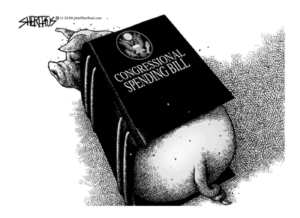
Wishing for days of ‘pork barrel’ bickering

My late mother had a retort when I would say, “Mom, I’ve been thinking.”

“Oh, beginner’s luck?” she would ask … rhetorically.

I’ve had a rash of beginner’s luck lately. I’ve been thinking about the good ol’ days of politics in Washington, D.C., when we used to single out politicians who had this habit of being champions for “pork barrel spending projects,” or those projects that benefit a specific area.

These days, worries about pork barrel spending has given way to rank ideology, where one side calls the other side “evil.” Liberals think conservatives have evil intent; the feeling is quite mutual coming from the other side.

Frankly, I prefer the old days when politicians used to bitch at each other because of all the money they funneled to their states and/or their congressional districts.

The former Republican U.S. senator from Texas, the loquacious Phil Gramm, used to boast about all the “pork” he brought home. “I’ve carried so much pork back to Texas,” he would say, “I think I’m coming down with trichinosis.”

Gramm, though, was a piker compared to some of his Senate colleagues. The late Democrat from West Virginia, Robert Byrd, was known as the king of pork barrel spending. He would attach riders onto amendments to bills that had dough for this or that federal project. As a result, Byrd’s name is on more buildings and bridges in West Virginia than one can possibly imagine.

However, is pork barrel spending a bad thing?

Look at it this way: Politicians do what their constituents want them to do. That’s the nature of politics in a representative democracy, as near as I can tell. We elect pols to represent our interests. If it means carving out a few bucks for this project or that back home, well, then that’s what we send them off to do for us.

These days we hear from rigid ideologues in the U.S. Senate and House. Texas’ two senators — Republicans Ted Cruz and John Cornyn — offer prime examples. One won’t likely accuse Cruz especially of being loaded down with pork; he’s too busy promoting rigid conservative ideology to worry about rebuilding highways and bridges back home in Texas; Cornyn, too, has this leadership role among Republicans in which he seeks to elect more of them to the Senate.

The House features much the same sort of ideology. My congressman, Mac Thornberry, R-Clarendon, once criticized President Obama for considering air strikes against Syria; then he praised Donald J. Trump for doing that very thing. Thornberry isn’t the least bit interested in pork barrel spending, which seems to fit the desires of his constituents; if they insisted on him bringing home more money to the 13th Congressional District, my hunch is that he’d do their bidding.

Where am I going with this?

I guess I’m trying to suggest two things.

One, I long for a return to the late House Speaker Tip O’Neill’s maxim that “all politics is local.” Why not argue the merits of this or that spending program and whether our member of Congress — in the House or Senate — is doing what we want him or her to do on our behalf?

Two, let’s quit the purely ideological battles and demonization of each other just because they happen to be of a different stripe. From where I sit, I still consider good government to be a team sport where each team respects the other side.