A mystery of life needs solving

eggs

Life is full of mysteries.

There are too many of them to list, but given that one of this blog’s stated missions is to discuss “life experience,” I am going to veer far, far away for a moment from politics, policy and the future of American jurisprudence in the wake of a Supreme Court justice’s death to discuss one of those mysteries.

Perhaps you’ve tuned in to one of cooking shows that tells you the secret of peeling an egg.

Here’s what just happened to me.

I boiled two eggs this morning for breakfast. I left both of ’em in the water for exactly the same length of time. I peeled the first egg and tore it ribbons. Half of the egg white stuck to the shell as I struggled to remove the shell.

Then I turned to the second one. The shell came off almost in a single piece. Slick is a whistle, man. No sweat.

I’ve never bought into this theories one hears from the likes of Racheal Ray or Martha Stewart about how to perform this simple, mindless task. Put salt in the water? Put cooking oil in it. Heat the water that’s already warm? Heat it when it’s cold? Mutter some ancient Native-American chant? Cross my eyes, stick out my tongue and stand on one leg?

These eggs came from the same carton. For all I know they might have come from the same damn chicken!

It’s a bloody mystery, I’m telling ya.

Whoever can solve this mystery — definitively! — is my candidate for a Nobel Prize of some kind. I’m willing to make up a category.


Unanimous picks loom as favorites for high court

untitled

Politics rules on Capitol Hill. It swings both ways, influencing both political parties.

Consider what might be about to happen.

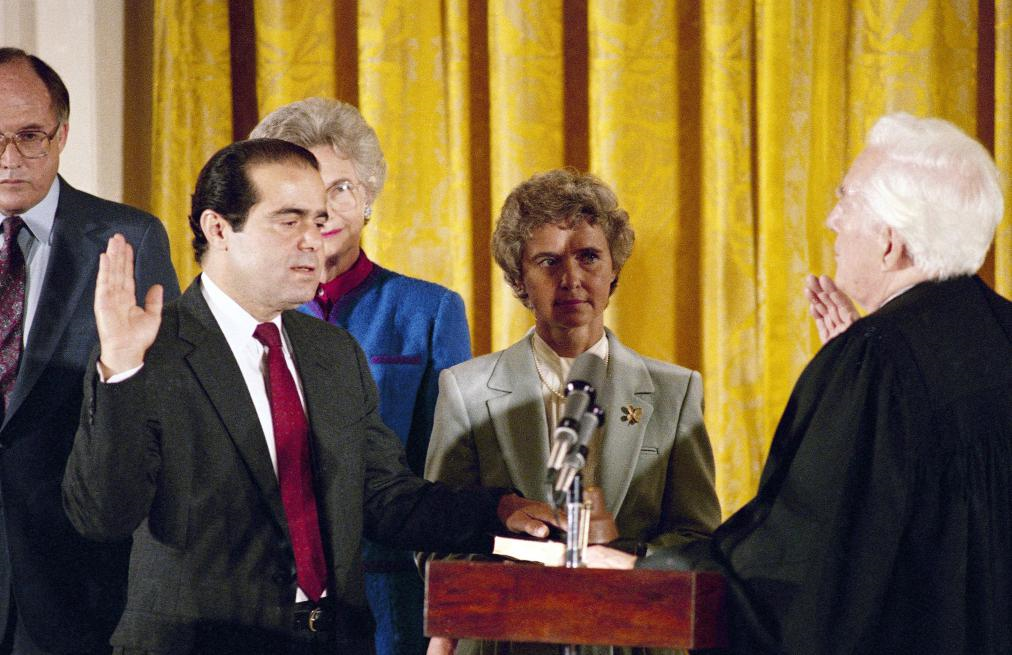
President Barack Obama, a Democrat in the final full year of his second term and final term, is likely to name someone to fill a vacancy created by the death of Supreme Court Justice Antonin Scalia.

The U.S. Constitution grants him the authority to do so. It also grants the Senate the authority to approve anyone nominated to the court.

The Senate is controlled by Republicans.

Democrats and Republicans don’t like each other much these days. Republicans really dislike the Democrat in the White House and the feeling appears to be quite mutual.

What’s the president going to do about this high court vacancy?

One theory getting kicked around in the hours and days after Scalia’s death is that the president could name an appellate judge who’s already been approved by the Senate. One name has emerged as a possible favorite, Judge Sri Srinivasen, an Indian-American who was approved unanimously the Senate before he took his federal appeals court seat.

He’s apparently thought of as a moderate. He doesn’t lean far left. He surely doesn’t lean far right. He shoots straight down the middle, according to a number of legal experts.

So, will this fellow breeze through the confirmation process as he did when the Senate considered him for a lower court?

OK. You can stop laughing.

Republicans are vowing to deny the president any action on a pending nomination. They want to wait until after the November presidential election in which they hope a Republican wins the White House.

Democrats will have none of that. They want the president to make a nomination and they want the Senate to vote on it. Quickly.

Why not select someone who’s already been vetted by the Senate? Would a judge like Sri Srinivasen be just as qualified to sit on the Supreme Court as he is on a lower court?

Well, in my version of a perfect world, it would seem like a natural for the president to find a moderate judge who’s already been approved. Except that he would be succeeding a towering figure of the judicial conservative movement.

Scalia led what has been called a “conservative renaissance” on the Supreme Court. Anyone — regardless of credentials, standing among peers or legal brilliance — is going to be run through a political sausage grinder.

Politics. Sometimes it’s downright ugly.

And sometimes it doesn’t serve the nation well.


Confusion has a strangely familiar Texas feel to it

111005_antonin_scalia_ap_605

Antonin Scalia’s tragic death in far West Texas has taken on an air of weirdness that somehow only seems possible in this state.

The U.S. Supreme Court justice — the senior member of the nation’s highest court — died in Marfa while on a hunting vacation.

How did he die? It seems that a justice of the peace issued a cause of death without ever seeing the late justice’s body. There also was a significant amount of time before anyone was able to contact a JP to make the pronouncement in the first place.

As the Washington Post reported, Justice Scalia’s life was one of order, process and decorum. The hours after his sudden and shocking death have been an exercise in confusion and chaos, the Post reported.

These rather startling circumstances bring to mind some of the criticisms that have been leveled at this level of Texas jurisprudence — and I use the term loosely.

It’s that justices of the peace are empowered to make these declarations with little or no actual medical training to do so. We put this responsibility in the hands of elected politicians who, as often as not, are laypeople with little or no formal training in the law, let alone in medicine.

What’s worse in this instance is that the JP allegedly made the call in absentia. How in the world does someone do that? How is it possible that the death of a member of the United States Supreme Court can be handled so sloppily and be the subject of so much confusion?

Only in Texas, it seems, is such a thing even remotely possible.

I am sensing an investigation into the madness that ensued after Justice Scalia’s death is in order.


Is this the year the U.S. gets hit?

ISIL%20fighters

Well before the sun set on Sept. 11, 2001, defense analysts and terror experts were almost unanimous in their assessment of our nation’s future.

If was not a matter of “if” we would be hit again, but “when.”

The head of the Defense Intelligence Agency, Lt. Gen. Vincent Stewart, told the U.S. Senate Armed Services Committee, that he believes this is the year it will happen.

The Islamic State, he said, is going to continue to hit Europe and well might plan a coordinated attack on our shores.

When will it occur? The general didn’t say. He cannot know.

In reality, though, he didn’t provide a serious scoop on what’s been understood since the terror attacks of 9/11.

That attack on the World Trade Center and the Pentagon was so daring, so audacious, so brilliantly executed that it prompted President Bush and his national security team to create an entirely new Cabinet agency assigned to protect us. The Department of Homeland Security has been on the job ever since.

Now, the question always has been: Will this country be able to protect itself forever against the next terror attack? There can be zero guarantee against another attack that could rival the horror that al-Qaida brought to our shores on the beautiful Tuesday morning in New York and Washington.

But then again, had we been fully alert to the dangers that always have lurked, perhaps we shouldn’t have been so totally shocked at what transpired that day.

The Bush administration — once it gathered itself after the horror of that day — managed to keep us safe for the remainder of its time in office. The Obama administration has kept up the fight and has continued to keep the terrorists at bay.

But Gen. Stewart’s prediction of another terror attack — this time by the Islamic State — shouldn’t be seen as a big-time news flash.

Al-Qaida managed to get our guard up. Our task always has been to ensure we stay on the highest alert possible.

The enemy, though, is as cunning as they come. Many of us will not be surprised when they strike again.


Get ready for the biggest fight of all

Supreme-Court-blue-sky

The fight over immigration?

Or the Affordable Care Act?

Or budget priorities?

How about gay marriage?

All of those battles between President Barack Obama and the U.S. Congress are going to pale in comparison to what’s coming up: the battle to find a suitable nominee to the U.S. Supreme Court.

Justice Antonin Scalia’s sudden and tragic death Saturday has caused political apoplexy in both sides of the divide in Washington.

Democrats want the president to nominate someone sooner rather than later. Republicans want the nomination to wait until after the election, with the hope that one of their own will occupy the White House beginning Jan. 20, 2017.

President Obama indicated last night he’s inclined to move forward, to nominate someone and to insist on a “timely vote.”

He is correct to insist that he be allowed to fulfill his constitutional responsibility and that the Senate fulfill its own duties.

One of the Republican candidates, Sen. Marco Rubio, said last night that no one has been appointed during an election year. He’s half-right. President Reagan appointed Anthony Kennedy to the high court in 1987; a Democratically controlled Senate confirmed him in 1988, which certainly was an election year.

Consider this, though: Justice Kennedy succeeded another GOP nominee, the late Justice Lewis Powell (picked by President Nixon). Kennedy’s appointment and confirmation did not fundamentally change the balance of the court.

This vacancy is different. By a lot.

Justice Scalia was a towering figure among the conservative majority that serves on the court. Whoever Obama selects surely will tilt to the left.

Therein lies the fight.

Senate Majority Leader Mitch McConnell, a Republican, said the vacancy should be filled after the election, adding that the “American people deserve a voice” in determining who sits on the court.

He could not be more off base. Yes, the voters deserve a voice. However, they spoke decisively about that in November 2012 when they re-elected Barack Obama as president.

Indeed, elections have consequences. There can arguably no greater consequence than determining who gets to select candidates to sit on the nation’s highest court.

The president — whoever he or she is — has a constitutional responsibility to act on a timely manner when these vacancies occur. Moreover, the Senate has an equal responsibility to vote up or down on anyone nominated by the president.

I’ve long believed in presidential prerogative — and my belief in that has never wavered regardless of the president’s party affiliation.

So, let’s mourn the death of a distinguished and, in the president’s words “consequential” justice. Then let us allow the president to do the job allowed by the Constitution and then let us demand that the Senate do its job by voting on whoever the president selects to fill this critical court vacancy.


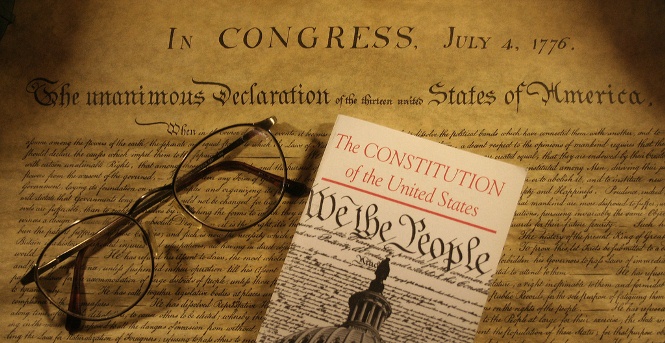
What, precisely, does ‘original intent’ mean?

founders

U.S. Sen. Marco Rubio tonight paid glowing tribute to the late U.S. Supreme Court Justice Antonin Scalia.

The praise came while Rubio was taking part in the Republican presidential debate.

He said something that struck me as, well, fascinating. Rubio said Scalia’s legal brilliance was rooted in his belief that the U.S. Constitution is not a “living document,” but that the Constitution should be interpreted precisely as the founders intended.

I don’t believe for one second that Justice Scalia wanted to roll back the advances that came about in the many years since the founders wrote the Constitution — in the late 18th century.

However, if Rubio’s praise of Scalia is to be taken literally, it seems fair to wonder: Does he believe the founders were right to deny women the right to vote, or that African-Americans should be enslaved?

Of course he doesn’t.

However, we can see the discrepancy — in my view — in the debate over whether the Constitution is a living document. The argument of those who favor the so-called “original intent” of the founders breaks down.

Why? Because of the many reforms approved in the 200-plus years since the Constitution was ratified, the document does indeed evolve as our nation has evolved.

It’s alive, man.


A major battle now looms

chapman.0830 - 08/29/05 - A Supreme Court headed by Supreme Court Justice Antonin Scalia has questions for Chapman University Law School professor John Eastman as he and California Attorney General Bill Lockyer argue the 1905 ''Lochner v. State of New York'' case during a re-enactment Monday afternoon at Chapman University. (Credit: Mark Avery/Orange County Register/ZUMA Press)
)

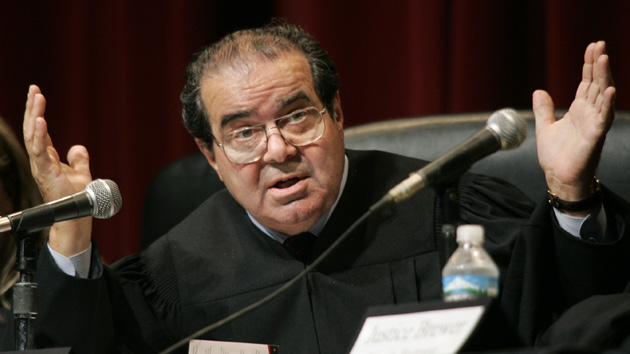
Supreme Court Justice Antonin Scalia’s sudden death today has stunned the nation.

As President Obama said this evening, the 30-year member of the nation’s highest court was one of the “most consequential” legal minds of our time.

The president now faces arguably the “most consequential” appointment of his time in office.

To say that Justice Scalia’s passing upsets the ideological balance of the highest court would commit the supreme understatement.

And, oh yes, the partisan divide opened wide immediately upon news of Scalia’s death. Senate Majority Leader Mitch McConnell, a Republican, said the Senate should wait until after Barack Obama leaves office to vote on a replacement; meanwhile, Senate Minority Leader Harry Reid, a Democrat, wants the Senate to act quickly.

Who could have seen that coming?

The president said he’ll make the appointment “in due time.” He wants a thorough, fair hearing and a “timely vote.” As the president — lame duck nor not — Barack Obama deserves the chance to nominate someone of his choosing.

Indeed, the appointment coming from a left-of-center president to fill a vacancy created by the death of a right-of-center Supreme Court justice sets up a huge battle that likely will dwarf any of the many fights Barack Obama has waged already with the U.S. Senate.

The court’s narrow balance has just been shaken to its very foundation.


Kasich gets the nod from a major media outlet

kasich

Newspaper editorial boards have at times been accused of being “homers,” sometimes favoring the home-town or home-state candidates over more qualified challengers.

The Dallas Morning News has chosen, however, to make its recommendation for the Republican presidential nomination — and it’s not U.S. Sen. Ted Cruz of Texas.

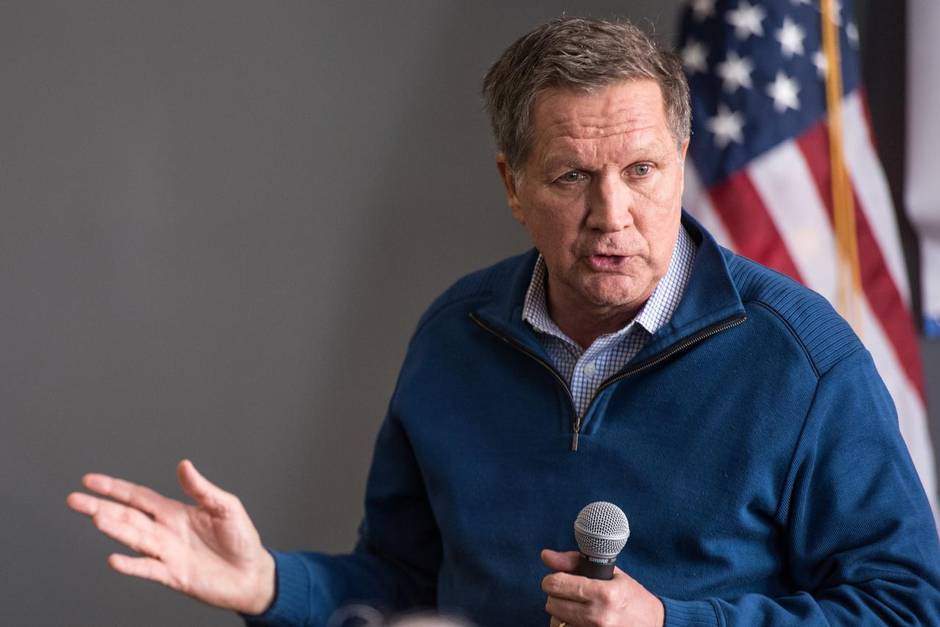
The DMN’s nod goes to Ohio Gov. John Kasich.

The paper likes Kasich’s record of accomplishment and believes it would suit him — and the nation — well if he were to be elected the next president of the United States.

What’s most compelling — to me, at least — is the paper’s nod to Kasich’s ability and willingness to work with Democrats. He did so while serving in Congress, where he chaired the House Budget Committee and helped craft a balanced federal budget.

One does not do such a thing in a vacuum, and Kasich showed his bipartisan chops in that regard.

I’m glad to see the Dallas Morning News climb aboard the Kasich bandwagon, such as it is in Texas.

* *

But what does a newspaper endorsement mean?

More than likely not a damn thing, at least not in this election season.

The leading Republican candidate for president says outrageous things about his foes, other politicians in general, the media, the voters, women — he uses amazingly grotesque language to describe one of his leading opponents — but, what the heck. That’s OK. He scores points for tossing aside “political correctness.”

Kasich remains one of the grownups in this GOP primary contest. A newspaper editorial board endorsement likely won’t be singularly decisive in determining whether he wins the state’s primary on March 1.

I just hope Texas Republicans heed the rationale behind the recommendation.

North Heights getting a fresh look

15064445


Every city in America has them.

Good neighborhoods and, well, not-so-good neighborhoods. Amarillo is just like every other city in that regard.

But there’s a bit of a difference here. Our city is governed by five individuals who represent the entire city; they’re all elected at-large. So, when residents of one part of the city feel as though their neighborhoods are being neglected, they tend to point the finger at the City Council and accuse its members of favoring other parts of the city.

It’s been on-going in Amarillo since, oh, probably The Flood.

Amarillo is now launching — one should hope — a concerted effort to revive, rejuvenate and rediscover the North Heights neighborhood.

It’s one of those areas of the city where residents have felt a bit neglected.

Does this effort require a huge change in local government attitude? The fellows who sit on the City Council say “no.” The city always has been equally concerned about all the neighborhoods, not just those with the more expensive homes or those with the leafy streets.

The Heights is long overdue for a serious makeover. The goal is to make residents proud of where they live.

City officials have planned a series of public meetings with residents. They want to hear from residents what they want. As KFDA NewsChannel 10 reported: “It’s really key to get their input because it’s their input that is going to help us get to where we want to be for this neighborhood,” said City of Amarillo Planning Director Kelley Shaw. “It’s their neighborhood. It’s not the city’s neighborhood, so we really need their input to make it all work.”

It’s good to watch how the city reacts to the concerns it hears. Perhaps the victory can be achieved if the city responds aggressively to what officials hear and start putting some serious effort into lifting up a neighborhood that’s felt neglected.

Think of it as a potential hedge against efforts to overhaul the city’s voting plan to expand the size of the City Council and create a single-member district plan for the city.

Let’s get busy.


What’s in a name?

Obama-Cruz

Social media provide a wonderful — but occasionally maddening — forum for passing around silly quips and observations.

This one came across my Facebook feed the other day.

It noted that President Obama’s critics have been fond of referring to him as “Barack Hussein Obama.” Yet one of those critics doesn’t get the same treatment by his foes who could refer to him as “Rafael Eduardo Cruz.”

To be fair, I don’t recall hearing Texas Republican U.S. senator and presidential candidate Ted Cruz use the president’s full, given name when referring to him. Maybe he did. Whatever …

I have heard the president make plenty of fun of his own name.

During two appearances with Republican rivals at the Al Smith Dinner in New York City — which is a political ritual of sorts, bringing opponents together for a night of fun and bipartisan fellowship — Obama cracked jokes about his name.

In 2008, he said he got his name from “someone who never thought I’d run for president.” Referring to a line that Republican nominee U.S. Sen. John McCain had used in a debate with Sen. Obama, he joked, “Barack is actually Swahili for ‘that one.'”

In 2012, while running for re-election, the president noted something in common with his GOP foe, Mitt Romney. “We both have unusual names,” he said, noting that “Mitt” is Romney’s middle name. “I wish I could use my middle name,” the president quipped with feigned wistfulness, again to huge laughter.

What’s the connection between Obama and Cruz? They both have faced — and are facing — equally ridiculous questions about their eligibility to seek the presidency.

What’s the lesson here?

It might rest in that old saying about something being “sauce for the goose … and the gander.”