Category Archives: media news

Time to put politics aside to wish this man well

I have stated my share — maybe more than my share — of disagreements with Rush Limbaugh over the years.

I won’t go there today.

Limbaugh is arguably the most well-known radio political talk show host in the United States. He announced today he has “advanced lung cancer.” He is taking some time off the air but vows to return soon to continue his ultra right-wing commentary on the issues of the day.

It would be my hope that all of us, even those of us who do not listen to Limbaugh, could set aside our political differences. I want to wish this fellow well as he fights this hideous disease.

Many of speak of a return to political civility. Limbaugh isn’t one of them. He rants, rails, vents and bloviates at everything and everyone with whom he disagrees. Were he to read my blogs, he would level his invective at me as well.

This isn’t the time to rant. It is a time to understand that the United States of America is a beacon for those who seek to speak their mind. They are unafraid of those who oppose them, just as they welcome those who favor them.

I want to salute Rush Limbaugh for his fearlessness. It’s an American tradition.

I wish Rush well. I want him back in the game. I want him to continue offering his world view just so I can continue to disagree with him … respectfully, of course.

Trump’s media demonization continues

Donald John Trump just loves to demonize the media, even though they merely are doing their job.

There was the current president today, standing next to Israeli Prime Minister Benjamin Netanyahu. Trump dropped the name of Secretary of State Mike Pompeo, prompting cheers and applause from the Trump-friendly White House crowd gathered at the White House.

Trump then decided to launch a brief riff on Pompeo’s recent dust-up with National Public Radio reporter Mary Louise Kelly. “I think you did a good job on her, actually,” Trump told Pompeo, who was in the room.

What he did was decline to answer a direct question from Kelly about how he has defended former U.S. ambassador to Ukraine Marie Yovanovitch. He then summoned Kelly to a private room and lashed her with f-bombs. He didn’t like the questions she asked.

That’s the “good job” to which Trump referred.

Trump’s ignorance over the media’s role in reporting on government and the officials who run it simply is stunning in its scope.

In defense of NPR

Secretary of State Mike Pompeo needs yet another lesson in just how the media do their job.

They ask tough questions. They seek direct answers. They also seek to report those answers to the public they serve. You and I depend on the media for answers to our own questions about what our government — especially at its highest levels — are doing ostensibly on our behalf.

National Public Radio reporter Mary Louise Kelly asked Pompeo why he hasn’t defended former Ukraine ambassador Marie Yovanovitch against criticism leveled at her by the current president of the United States, Donald John Trump.

He dodged the question, saying he has defended “everyone” in the State Department. Kelly sought a specific example of how he has defended Yovanovitch. He cut her off, summoned her to his private quarters, then lashed at her with a profanity-laced tirade, saying that NPR is part of the “unhinged” media that demonstrate a hatred for Trump.

Kelly was doing her job. She has not done a thing for which she should apologize.

Time for full disclosure: I work as a freelance blogger for a public radio station, KETR-FM, based at Texas A&M University-Commerce. 

With that out of the way, I want to tell you that NPR goes the extra mile in ensuring that it reports the news fairly and without overt bias.

A friend of mine who works in public radio explained to me once about NPR’s policy that it enforces strictly. He said that during the coverage of the health-care changes that resulted in the Affordable Care Act, NPR reporters were counseled by their editors to refrain from using the term “reform” to describe the ACA. “It isn’t a ‘reform,'” my friend told me. NPR affiliates were told us call it “overhaul.”

You see, the term “reform” implies an improvement over the status quo. Thus, to describe the ACA as a “reform” would be to endorse it as a policy in NPR’s news coverage. That’s how my friend characterizes the ethos that drives NPR’s reporting of important issues of the day.

And so, it is against that backdrop that I find Mike Pompeo’s tirade against a seasoned, well-educated, dedicated reporter such as Mary Louise Kelly to be just another ignorant tirade coming from a senior official in the Donald Trump administration.

Reprehensible.

Place that drew me there has vanished

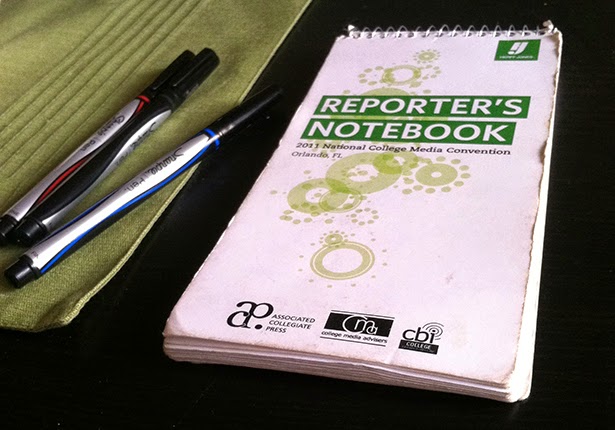
The image you see with this blog illustrates what I did for a living for nearly 37 years. I took notebooks such as this with me to jobs in Oregon and then to Texas.

I mention this notebook today because we have returned from visiting the last stop on my professional journey. I came away with a huge trove of good feelings, seeing old friends, celebrating my son’s birthday and enjoying the unseasonably warm weather under a bright Texas Panhandle sun.

However, I also came away with a feeling of sadness. You see, the newspaper that summoned my wife and me there 25 years ago has all but vanished. The Amarillo Globe-News used to be a towering presence in the community. It has been decimated, reduced to a tiny fraction of its former self.

The Globe-News’s building — at the corner of Ninth Avenue and Harrison Street — is empty. Its signage has been stripped off the exterior wall. There’s an “AVAILABLE” sign on the property.  What’s left of the operation has moved into Suite 103 inside the tallest building in Amarillo, a 31-story bank tower down the street and around the corner.

News racks? Where they sell single copies of the Globe-News? I didn’t see a single one anywhere. I was told that convenient stores still sell the paper. I had a thought about buying the paper, but then I realized I would shell out more than $3 for a journal that would have little news of interest to me. I took a pass.

I guess it’s a sign of the times and the changing media era into which we are still plunging. My previous professional stop, in Beaumont, way down yonder on the Gulf Coast, is undergoing similar retrenchment. It, too, has all but vanished. The newspaper still operates out of its historic structure at 380 Walnut Street, but the corporate owners are looking for a smaller site to house its diminished staff. The Enterprise will vacate that site eventually, although the Hearst Corp., which owns the newspaper, is a proven media company with much greater newspaper chops that Morris Communications, which sold all its properties — including the Globe-News — and then closed its newspaper operation.

That ain’t all, man. My first professional stop, the Oregon City (Ore.) Enterprise-Courier has vanished. It closed completely in the late 1980s. Its parent company — Scripps League Newspaper — sold all its remaining properties and then ceased functioning altogether.

I am saddened by what has happened to print daily journalism. It was driven home to me this weekend on a return to Amarillo. The fellowship of friends was wonderful. The absence of any tangible evidence of the newspaper where I once practiced my craft with great joy and excitement, though, pains my heart.

But … retirement from all of that remains equally joyful and full of adventure.

We’ve lost a first-rate print … and broadcast journalist

Jim Lehrer is gone. I just learned it a few minutes ago and I am saddened by the news.

He was a longtime PBS news anchor, co-hosting the “MacNeil/Lehrer NewsHour” on the public TV network. Before he went to broadcasting the news to us, he was a print guy, a solid newspaper reporter who earned his spurs right here in Texas, where he spent much of his youth.

That brings me to a brief recounting of an encounter I had with Jim Lehrer.

I was working at the Beaumont Enterprise in the early 1990s when I spotted a gentleman standing in front of our newsroom secretary’s desk. I walked across the newsroom, turned the corner and stood at the elevator. I looked back at the secretary and whispered, “Is that Jim Lehrer?” To which the gentleman answered, “Yes. It is.” I was embarrassed to the max.

I came back around the corner, introduced myself and he returned the intro to me. We chatted right there and then headed into the newspaper library. He was looking for newspaper clippings as part of his research for a book he was writing. He attended French High School in Beaumont and spoke of his Golden Triangle connection.

We had a wonderful and fruitful visit for seemingly forever in the library.

Then he left. I felt as if I made a new friend. I don’t know how he felt about me. It would be my hope that he got as much out of our visit as I did. I never continued that relationship.

A year later, he came back to Beaumont to offer the keynote speech to the Press Club of Southeast Texas. We met again in the buffet line at lunch. I said “hello,” and — as God is my witness — he remembered our meeting the previous year.

Was I a bit star struck? More than likely. It is my story and I am sticking to it.

R.I.P., Jim Lehrer.

Listen up! No politics in church!

I have sought to follow a time-honored credo, which is that I don’t discuss politics or my work while I am in church.

My response usually goes like this when someone would challenge something I wrote in the newspaper where I worked at the time: I came here to talk to God, not to you … about my work; call me in the morning, then we’ll chat.

We have relocated in the past year to a lovely community in Collin County, Texas. We have found a new church where we like to worship each Sunday. It’s a small congregation, but it fulfills our need. Everyone is welcoming, warm, hospitable and the place is full of love.

However … we have run into individuals who like to talk politics with us, or I presume just about anyone who’ll listen. It wouldn’t surprise you to learn that the congregation is a pretty conservative bunch, which is all right with me. That’s their call. I adhere to, um, a different point of view.

Thus, when one of our new friends decides to engage us in a political discussion, I am inclined to nudge them away. I change the subject. I haven’t yet offered up my longstanding retort. Hey, I don’t know them well enough yet. Perhaps over time, they’ll get the hint and I won’t need to drop the verbal hammer on ’em.

If not, I am ready to put them into what I perceive to be their place.

NY Times double endorsement: a head-scratcher

The fuddy-duddy in me is making me scratch my noggin over the New York Times’s decision to split its endorsement in the Democratic Party presidential primary, offering its nod to two of the challengers remaining in the still-large field.

The Times, admitting it was “breaking with convention,” went with U.S. Sens. Elizabeth Warren and Amy Klobuchar for the party’s nomination. Warren is a champion of the party’s liberal/progressive wing, while Klobuchar bears the standard for the party’s more moderate wing. Therefore, the Times figured, why choose just one of ’em? They went with both.

Here’s where this endorsement strategy breaks down for me. Only one of them can emerge as the party nominee this summer. One candidate will get the nomination and will face Donald John Trump, the current president who is seeking re-election.

I am going to presume — and this is no giant leap into the unknown — that the Times likely will endorse whoever is running against Trump. Why won’t the Times take the leap that Democratic voters all across the land in primary states are going to take? They can’t choose two candidates. Voters’ choice is limited to just one.

A few years before resigning from my final job as a daily print journalist I enacted a policy that did away with endorsing in party primaries when there was a contest in the other party. The Amarillo Globe-News decided to make endorsements only in those primary races where there was no candidate waiting for the nominee in the fall. In the Texas Panhandle, that almost always meant that Republicans would have contested primaries while Democratic primaries had no candidates on the ballot.

My thought then was that primary contests generally are the work of political parties. A one-party primary, though, was tantamount to election. Thus, we would weigh in on a primary.

In all the years I interviewed political candidates and wrote editorials offering a newspaper recommendation on who voters ought to choose, I never wrote a two-fer.  My thought always has been that if we’re going to ask voters to make a choice, then the newspaper ought to show the same level of courage … and make a single choice.

Here is the Times editorial: You make the call.

I won’t argue the merits of the candidates’ points of view. I merely question a great newspaper’s decision to hedge on a critically important decision.

Time of My Life, Part 43: Walking a libel tightrope

Most newspaper editorial pages have sections set aside to allow readers of the newspaper to vent, to complain, to speak their minds either positively or negatively about issues of the day and the individuals who make that news.

They also present editors of those pages at times with vexing problems. They involve that mysterious line that separates harsh commentary from libel.

I experienced many of those episodes during my 37 years in print journalism.

Here’s how it went … most of the time.

Someone would submit a letter for publication on our page. It might be full of anger at, say, a mayor or a city council member; perhaps the target is a county commissioner or a school board member; or, maybe it’s aimed at public figure not necessarily holding a public office, someone like a prominent businessman or woman.

The letter levels accusations that I cannot substantiate. The rhetoric is harsh, man. I call the author of the letter to confirm its source. I question the assertions made in the letter.

The writer of the letter stands by his or her assertion. He or she says it’s true and he can prove it. I ask the letter writer to provide documented proof. The writer can’t deliver the goods. I tell the writer that I am afraid the letter is libelous, which means it makes statements that could bring harm to the individual being criticized.

The letter writer then says something like this: “It’s my letter. Let ’em sue me!” To which I then say, “Actually, once you turn it in to me, it becomes my letter, too. Moreover, I don’t care if they sue you. I do care that they sue me and my employer. Therefore, I cannot publish this letter. I will not publish it. Thanks and have a great day.”

I had that conversation countless times over the years. It presents a stunning example of the responsibility that newspapers editors have when they go through each day dealing with issues that present themselves, sometimes in unexpected fashion.

There were times when I was less than patient with letter writers. I regret those instances. Then again, my patience occasionally was rubbed away when letter writers presumed to know more about the nuts and bolts of my job than I did.

They were wrong. I never did apologize for telling them so.

What took so long to build has collapsed in virtually no time at all

It took print journalism, chiefly newspapers, nearly two centuries to attain what used to be a virtually exalted status among their consumers.

And yet, the craft has all but collapsed in virtually no time.

What took years to erect has all but vanished in the blink of an eye.

That observation came from a dear friend of mine with whom I used to have a professional relationship when I worked in Amarillo as editorial page editor of the Globe-News. My friend was a freelance columnist; he had a regular day job, but wrote for us because he was good at it. Our professional relationship ended when I left the newspaper in August 2012. Happily, our personal friendship remains intact.

We were visiting the other evening when he made that stunning observation. His point is that newspapers climbed for a long time up a proverbial mountain to attain an important status in people’s homes. Readers of newspapers depended on them for news of their community, of their state, nation and the world around them. If you wanted to know what was happening in the world, you collected your newspaper off the porch, opened it up and spent a good deal of time reading what it reported to you.

We believed what we read. I mean, if it’s in the daily newspaper then it had to be true. As my friend noted, it took a long time for newspapers to achieve that status.

Then it all changed. Rapidly! Dramatically! Newspapers fell with a loud thud!

The Internet arrived. I can’t remember when it happened, but suffice to say it was the equivalent to the “day before yesterday.” Cable TV exploded. Social media burst forth, too.

All of that media took huge bites out of newspapers’ influence in people’s lives. Has print journalism become less reliable, less believable, less credible than before? I do not believe that is the case. Americans are still reading some first-class reporting from major newspapers that remain important purveyors of vital information.

And yet, we hear the president of the United States refer to the media as “the enemy of the people.” Right-wingers blast what they call the “mainstream media.” They accuse newspapers and other legitimate media organizations of peddling “fake news.” The attacks have exacted a terrible toll on newspapers.

The smaller papers, those that tell us about our communities? They are struggling. Many of them — if not most of them — are losing the struggle. The Amarillo Globe-News, my final stop in a career that I loved pursuing, has been decimated by competing media forces and — in my view — by incompetence at the top of its management chain of command.

My friend’s analysis, though, rings so true. It saddens me beyond measure to realize that it has taken so little time for it all come crashing down.

Blog about to close out a record year

The year is about to pass into history. We’re getting set to enter the third decade of the 21st century. What a year it has been.

With that I want to take a moment to look back on High Plains Blogger’s year.

For starters, I set another record for page views and visitors to this blog. It’s my fourth year in a row setting records from the previous year. Two stupendous months in early 2019 set the pace.

I cannot predict if another record will fall in 2020. Some of that depends on the news that will unfold.

We have an election coming up. We’ll have a trial in the U.S. Senate (eventually!) to determine whether Donald Trump remains as president. My guess is that he will. So he’ll keep this blog full of grist on which to chew for the coming year. That’s how the president rolls. He craves being the center of attention, so he’ll likely be at or near the center of this blog’s attention.

I also want to thank those who have chosen to read this blog’s musings. Some might call it spewage. It all depends on whether you agree with yours truly’s world view of politics and public policy.

Moreover, take my word for it that I appreciate the constructive criticism I get. Some of it, though, isn’t so constructive. Some folks prefer to scold me. That’s OK, too.

All told, though, critics keep me humble. They serve to remind me in real time that the world is full of diverse points of view. Some of us choose to express our view out loud and for the record in forums such as, oh … blogs!

I appreciate those who take the time to read this blog. I appreciate even more those who spread the blog’s word among their own social media networks. All told, I have posted more than 12,800 blog items during the life of High Plains Blogger.

Let us proceed toward a new year with a tinge of optimism. That’s how I prefer to look toward the future. If it disappoints, though, I’ll be ready to unload my frustrations through this venue.

We’ll all just be able to enjoy the ride.