Tag Archives: Donald Trump

Where are the hordes of illegal immigrants?

ROMA, Texas — This is one of those hardscrabble towns strung out along the Rio Grande River just on this side of our border with Mexico.

The main drag is U.S. Highway 83, which is populated with assorted convenience stores, an occasional chain outlet, fast-food restaurants and a flea market.

You see a lot of Spanish-language signage here. We stopped for lunch at a pizza joint and the young hostess who served us there was pleasant and attentive.

We did not see something that one might be tempted to look for: hordes of illegal immigrants.

We did notice two U.S. Border Patrol vehicles parked on the medium just northwest of Roma about a mile or so apart. All was quiet at both locations.

I bring this up only to illustrate what I think has been something of a mischaracterization by some politicians — including one highly notable one — about what appears to be going on along the U.S.-Mexico border.

I understand fully that people are indeed sneaking into the United States without the proper documentation. I also understand that some of them are, um, undesirable.

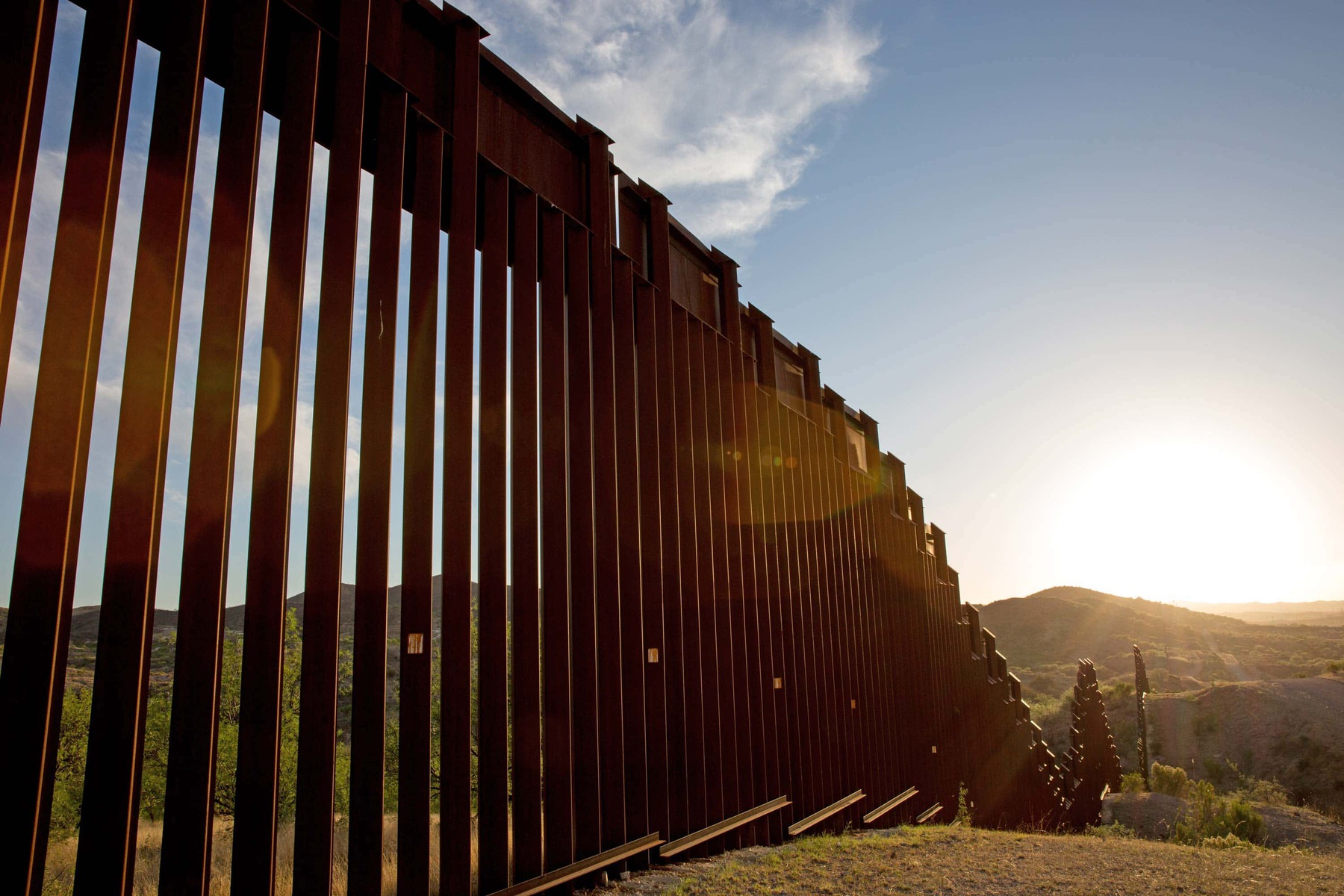
The president of the United States — Donald John Trump — wants to build a wall the length of our southern border. I keep wondering: how and why?

We stopped briefly at Falcon State Park and noticed a wide and deep reservoir between the United States and Mexico. We didn’t see anyone splashing out of the reservoir behind the Falcon Lake Dam; nor did we see any boats loaded with families.

OK, we are just two people out of many who visit places like this. We were unable to cast our eyes on every mile along our border. We did see a good bit of it from Laredo to Roma.

I am going to presume as well that had we kept going we would have seen more of the same. Which is to say we’d see nothing out of the ordinary.

Life seems to go on in South Texas. It all looks pretty normal to me.

Some pols, though, would have us believe we’re in crisis mode. We’re being overrun by international terrorists, drug dealers, murderers and rapists. That message seemed to resonate with a lot of Americans during the 2016 presidential campaign.

That message was lost on me. Based on what we saw along the border, I understand why.
The Dossier: It’s ba-a-a-a-ck

I am still trying to figure this one out. So, too, are federal and international law enforcement authorities.

Donald J. Trump went ballistic not long after becoming president at media outlets that reported the existence of a “dossier” that allegedly had been compiled on him. The president called out CNN in particular for being a “fake news” outlet because it reported the existence of unsubstantiated reports contained in this dossier.

Now it appears the dossier’s existence might be gaining some credibility among law enforcement spooks.

Some truth is in order. The issue centers on some information reportedly compiled by a British spy alleging that Russian authorities had some negative information regarding Trump’s business dealings in Russia.

The curiousness of all this seems to center on Trump’s dismissal of allegations that Russian government hackers were trying to influence the 2016 presidential election at the time CIA and other intelligence agencies were saying they had proof that such activity was occurring.

The arc of this ongoing story might find its way back to the president’s continued refusal to release his tax returns for public review.

I have no clue where this story will end up. It frightens me that it might produce some ghastly information regarding Trump’s business interests inside of Russia and whether they involved direct dealings with a government that might have tried to manipulate our electoral process.

Trump, of course, denies any business dealings with Russian government authorities. He asks us to believe him, to take him at his word. Sure thing, Mr. President … just like you want us to believe the baloney about “millions of illegal immigrants” voting for Hillary Clinton or the lie you perpetuated about Barack Obama being born in Kenya..

Let’s get to the whole truth.

Hey … what happened to the Russian hacking story?

Events often overtake other events. News gets shoved aside when events bury them.

Such appears to be the case with the Russian hacking controversy.

Remember that one?

Donald J. Trump got elected president of the United States amid reports/rumors/allegations that Russian government computer geeks hacked into our electoral system in an attempt to aid Trump’s campaign.

The president has dismissed any kind of link. He has disparaged our intelligence agencies, which have concluded that the Russians played a role in hacking into our electoral process.

Isn’t it a big deal to have a foreign power — Russia, no less! — involved in such activity?

Well, it turns out that Trump has a way of changing the subject: executive order banning travel into the country from several Muslim-majority nations; strange confirmations of Cabinet officials; questions about his daughter’s line of clothing; his continual tweets criticizing federal judges; a Supreme Court nominee telling senators the president’s tweets are “disheartening” and “demoralizing.”

All the while, the Russian hacking story has been tossed aside. It’s been pushed to the back of the bottom shelf, way behind the other stuff.

We still need some definitive answers about the Russians supposedly did and how they might have affected the outcome of the 2016 U.S. presidential election.

Government isn’t like a business, Mr. President

It’s become a throwaway line for politicians to toss around.

“I’m going to run this government like a business,” they tell us. Many folks buy into it. “That’s my guy!” they say. “He’s going to turn things around because that’s what he’s done before … in business.”

Donald J. Trump might be learning the hard way that the presidency of the United States is far more complicated than any business he’s ever run.

Politico is reporting that many of the new president’s aides and allies have become perplexed at Trump’s frustration with the pace of change he promised when he took office.

As Politico reports: “The administration’s rocky opening days have been a setback for a president who, as a billionaire businessman, sold himself to voters as being uniquely qualified to fix what ailed the nation. Yet it has become apparent, say those close to the president, most of whom requested anonymity to describe the inner workings of the White House, that the transition from overseeing a family business to running the country has been tough on him.”

Trump seeks simple answers to complex questions. That’s been the view of those interviewed by Politico. The president’s inability to find those simple answers has frustrated him early in his term.

My sense is that Trump needs to buck up and get ready to understand the complexities of the job he sought — and then won!

He talked tough during the campaign. He “told it like it is,” in the words of those who voted for him. He bragged about doing for the country what he did for his business empire; he didn’t mention, of course, the many failures his business interests have produced.

The point, though, is that the massive federal government is a complex machine. It’s a labyrinth of agencies — some of which compete against each other. The president is the chief executive of the government, but he cannot run it like a CEO.

He must be a team player. He must learn to cajole, not coerce.

Will this president learn the lesson? Can he overcome the obstacles he didn’t see laying before him? Can this man actually learn to govern and run a government with which he had zero prior contact?

Believe it or not, I hope he succeeds.

I just am doubting he can rid himself of the temptation to “run the government like a business.”

FEC to Trump: Show us the proof of fraud

A federal elections commissioner has called Donald J. Trump’s bluff.

Good for her!

The challenge has come from Ellen Weintraub, a commissioner from New Hampshire, who is demanding that the president of the United States provide proof of allegations he has made about “widespread voter fraud” in the 2016 presidential election.

Trump has said “millions” of illegal immigrants voted for Hillary Rodham Clinton, resulting in her hefty popular vote margin over the actual “winner” of the presidential election.

In so doing, Trump has impugned the integrity of the U.S. electoral process, not to mention that of state and local elections officials throughout the nation.

He hasn’t produced a shred, a scintilla, a scant hint of evidence to back up what he has alleged.

It’s time for Trump to produce the goods. Weintraub said Trump has in effect accused elections officials of committing “thousands” of felony crimes.

According to The Hill: “The President has issued an extraordinarily serious and specific charge,” added Weintraub, who was appointed by former President George W. Bush. “Allegations of this magnitude cannot be ignored. I therefore call upon President Trump to immediately share his evidence with the public and with the appropriate law-enforcement authorities so that his allegations may be investigated promptly and thoroughly.”

Well, Mr. President? Play your hand, sir.

Wall price tag keeps escalating

Donald J. Trump’s wall is going to cost a lot of money.

It will cost about twice what he said it would cost; and it will cost billions more than U.S. House Speaker Paul Ryan said it will cost.

A Department of Homeland Security report puts the cost of the wall at $21.6 billion.

That ain’t chump change, ladies and gents. What’s more, many of us have yet to be convinced that building a wall across our southern border is going to work. We doubt it will keep every illegal immigrant out of the United States; nor is it even in keeping with the welcoming values that gives this country its “exceptional” status.

How do we pay for this?

Paying for this wall is going to be the biggest debate topic — if our government actually proceeds with this specious plan.

Let us consider a couple of critical factors.

* The president insists Mexico will pay for it. The Mexican government says categorically it won’t pay a nickel. Trump insists that a steep tariff on all imported goods from Mexico will foot the bill. That means importers are likely to pass the cost of those imported goods on to you and me. Bottom line? We pay for it

Suppose, then, that the tariff doesn’t come to pass. And suppose that Mexico holds firm on its refusal to pay for the wall.

* How does Congress find the money to pay for this monstrosity? Fiscal conservatives have insisted in the past that the government cut money elsewhere to spend funds on new programs. Example? Joplin, Mo., was devastated by a killer tornado in 2011 and Republican House leaders insisted the government peel money from other programs to pay for emergency relief for the storm victims.

If the government is going to shell out $21.6 billion — assuming the price tag doesn’t escalate even more — then how do we intend to pay for it? More taxes? Do we decline to spend money on other government programs? Which programs get cut?

The wall is far from done. Its cost is far from settled. Its future is far from certain.

One-China Policy is OK, right, Mr. President?

Donald J. Trump now is ready to adhere to one of the more complicated elements of U.S. foreign relationships.

It’s called the One-China Policy, which recognizes only one China … and it’s not Taiwan.

Not long after being elected president, Trump took a phone call from Taiwan’s president and then declared the United States ought to rethink its decades-old policy that recognizes the People’s Republic of China.

Bad idea, you know? The conversation between a U.S. president-elect and the leader of Taiwan was the first that had occurred since the United States recognized the PRC as the “real” China.

Taiwan, China maintain complicated relationship

Taiwan is, in fact, a prosperous independent nation that broke away from the Chinese mainland at the end of a bloody civil war that erupted after World War II. Taiwan’s Nationalist government set up shop on Taiwan in 1949 and for three decades it was the recognized government of China.

That all changed dramatically in 1979 when the United States recognized the PRC, kicked out the Taiwanese ambassador. The United Nations booted Taiwan out, too, and welcomed the PRC.

Thus, the One-China Policy was born amid an interesting mix of economic and defense-related agreements that the United States still maintains with Taiwan. We trade with the Taiwanese, we pledge to protect them if the PRC decides to retake the island nation — but we do not recognize them diplomatically.

Trump spoke this week to Xi Jinping, the Chinese president, and reaffirmed out commitment to the policy that recognizes the PRC exclusively as the sole China.

As for Taiwan’s relationship with the PRC, that too, is a matter of delicate maneuvering. Taipei and Beijing allow travel between the countries; family members are allowed to communicate with each other.

Taiwan also believes in a “One China Policy,” but insists that the island nation — not the mainland — is the “real China.” Here’s the deal: Most of Taiwan’s inhabitants were born on the island and consider themselves to be “Taiwanese.”

The president, though, needs to settle down and stick with a policy that recognizes only one China. To do anything different is to insert the United States directly into the middle of a simmering dispute between China and Taiwan.

Trump team continues to ‘unify’ Congress

Donald Trump’s effort to “unify” Congress is continuing to produce a bumper harvest.

For instance, the U.S. House Oversight Committee chairman, Republican Jason Chaffetz of Utah, has called for an investigation into senior White House adviser Kellyanne Conway’s apparent shilling for Ivanka Trump’s line of clothing. Ranking Democratic committee member Elijah Cummings of Maryland joined Chaffetz in seeking to know whether Conway violated federal ethics laws.

The lawmakers sent a letter to the head of the Office of Government Ethics, Walter Shaub, Jr., suggesting that Conway’s appearance on “Fox and Friends” could have crossed the line that bans federal officials from promoting private business endeavors.

Chaffetz and Cummings have recommended punishment for Conway.

Trump, quite naturally, is standing by Conway, who has told the media that the president is “100 percent behind me.”

Ethics just keep getting in the way.

The president’s myriad business interests — along with those of his grown children — are likely to continue dogging the administration until all of the Trumps decide to divest themselves of all that lucrative activity.

Meanwhile, I will give the president a left-handed compliment. He vowed to “unify” the country. He is keeping that pledge by unifying some of our elected representatives — although clearly not in ways he envisioned.

President gets real-time lesson on government limits

Donald Trump had zero government experience when he became president of the United States.

He seemed to think he could step into the presidency, assume the role of CEO and everyone would do his bidding.

He is now finding out that it doesn’t work quite that way. He is learning in real time that the founders established a government that limits presidential power. They created a government that allows two other branches to rein in an executive branch that could overstep its authority.

Congress is controlled by men and women who belong to the same political party as the president. Thus, the legislative branch might roll over. This leaves the final check to the judicial branch, which is flexing its muscles in this struggle over Trump’s executive order that restricts travel to the United States from those who hail from seven Muslim-majority nations.

The struggle now seems headed to the Supreme Court. The nation’s highest court likely will get to decide whether to uphold two lower-court rulings that have stalled the execution of Trump’s executive order.

If the Supremes uphold the earlier rulings — either with an actual ruling or a tie vote created by the unfilled vacancy — then the president will have to consider another way to “make America safe again.”

Perhaps the next tactic he employs will be considered more carefully and executed with more thought than the cluster-fudge he rolled out with this refugee ban.

Will any of this humble the president? Will it give him pause to consider his next action? Probably not, but it still gives me some comfort to know that the founders knew how to create a government that works.

And just for the record, if the Supreme Court rules in Trump’s favor and overrules the lower courts, then I’ll consider that — as well — to be a demonstration of a functioning federal government.

However, my concern were that to occur would be that it would embolden a president to misread the limitations on power that the founders wrote into the framework that built this nation.

Mammoth court fight awaits Trump

Here is where we stand regarding that ill-considered ban on refugees.

It appears headed for the U.S. Supreme Court, thanks to a unanimous ruling this afternoon by the 9th U.S. Circuit Court of Appeals, which upheld a lower court’s suspension of Donald Trump’s executive order banning refugees from seven Muslim-majority countries from entering the United States.

Clear as mud, yes?

The 9th Court ruled 3-0 to uphold the suspension ordered by U.S. District Judge James Robart, whom Trump called a “so-called judge” in criticizing his decision.

What about the politics of the court? Judge Robart is a George W. Bush appointee; the three appellate court judges were picked by Presidents Carter, Bush 43 and Obama. It looks like a bipartisan rejection to me.

Now the highest court stands ready to ponder this controversial executive order. It has a vacancy, meaning that eight justices are on the job. Four conservatives and four liberals. What happens if the Supremes issue a tie vote? The 9th Court ruling stands. Trump’s executive order is negated.

The 9th Court ruling takes aim at the provision in the order that bars people with visas from re-entering the United States, which the judges ruled is unconstitutional.

According to The Associated Press: “The appeals panel said the government presented no evidence to explain the urgent need for the executive order to take effect immediately. The judges noted compelling public interests on both sides.

“‘On the one hand, the public has a powerful interest in national security and in the ability of an elected president to enact policies. And on the other, the public also has an interest in free flow of travel, in avoiding separation of families, and in freedom from discrimination.'”

Trump, of course, responded with a tweet. “SEE YOU IN COURT,” the president said via Twitter.

Washington Gov. Jay Inslee, a Democrat, whose state has sued the president over his executive order, responded: “Mr. President, we just saw you in court, and we beat you.”

The fight has just begun.