Tag Archives: Dallas Morning News

Customer service must be Priority No. 1

It’s no secret that American newspapers are in trouble. They are struggling to remain competitive in the ever-changing mass media market.

They need advertisers to spend money to keep the newspapers afloat. Ad representatives work hard — or at least they should be doing so — to keep their clients happy.

Newspapers also need subscribers to buy their publications. How do they gain subscribers to read their content and then keep them well into the future? Customer service, man. They need to put customer service at the very top of their standard operating procedure.

The Internet is inflicting serious damage on newspapers. Cable TV is now full of commentators, pundits, news anchors, “contributors” and experts on every field imaginable telling viewers about the news as well as what all those individuals believe about the news that is occurring.

Newspaper circulation is dropping. So is advertising revenue.

Thus, newspapers are in trouble.

OK, now that I’ve laid all that out, I want to share how one major American newspaper is squandering its standing in one American household . . . mine!

My wife and I recently moved from one Dallas suburb to another one — from Fairview to Princeton.

Before we made the move, we took out a subscription to the Dallas Morning News; our subscription was for the Wednesday and Sunday editions only. It arrived at our Fairview residence just fine.

Then we moved. I called the Morning News circulation line and provided a change of address. The DMN delivers to Princeton, so we didn’t figure that would be a problem.

Wrong! I guess it is a problem. We have lived in our new home for two weeks and we haven’t seen a newspaper yet. It’s not in our front porch, or on the front lawn, or the driveway or even in the street next to the curb. Nothing!

We have called every day since we missed our first DMN. Nothing has happened. I get excuses about the paper’s inability to hire competent delivery personnel as well as promises that it would come in the next day . . . or two. Again, nothing.

I offer this as an example of how one major publication is pis**** away a chance to lure and keep a subscriber. That would be me.

Hey, I am a newspaper reader of long standing. If only the newspaper I want to read could make good on its pledge to deliver it to my home.

There’s a lesson here. Newspapers are floundering. Many of them are failing. I want the Dallas Morning News to heed the warning sirens that are blaring all across the nation.

Still steamed over Sen. Seliger getting stiffed

I should be moving on, looking forward . . . but I cannot stop gnashing my teeth over the way Texas Lt. Gov. Dan Patrick treated a man I respect and for whom I also have a fair amount of personal affection.

I refer to state Sen. Kel Seliger of Amarillo, who belongs to the same Republican Party as Patrick, except they’re both Republicans in name only.

Patrick, who presides over the Texas Senate, decided to remove Seliger from a key committee chairmanship, Higher Education. He also took him off the Education Committee, and put him in charge of the newly formed Senate Agriculture Committee. Then he yanked him out of the Ag Committee chairmanship after Seliger made an impolite remark about a key Patrick aide.

Why did Patrick seek to punish West Texas — which Seliger has represented since 2004? I keep rolling around some theories. I’ve come up with one that I think makes sense.

Seliger has too many Senate friends who happen to be Democrats. Patrick doesn’t enjoy that kind of bipartisan camaraderie.

I remember not long after Seliger was first elected to the Senate in 2004 when he began talking about the friendships he had forged with Democrats. He would mention Sen. Juan “Chuy” Hinojosa, a South Texas Democrat, as a colleague with whom he would work on legislation.

A Dallas Morning News article published a few weeks ago noted that Democratic senators think highly of Seliger. Kirk Watson, D-Austin, is considered one of Seliger’s best friends in the Senate. Another Democratic senator, Royce West of Dallas, also spoke highly of Seliger in the Dallas Morning News feature.

Does the lieutenant governor — a fiery TEA Party conservative — get that kind of love from across the aisle? I have the strong feeling he does not.

I don’t know if Lt. Gov. Patrick is prone to petty jealousy. However, I cannot rule it out, as I don’t know the man; I only know of him and know of the highly partisan legislation he likes to push through the Senate.

Sen. Seliger isn’t wired that way. He calls himself a proud conservative. He pushes for local control and doesn’t like the state meddling in matters that are best decided by local governing bodies.

Seliger also is a champion of public education; Patrick favors vouchers funded by tax money to send students to private schools.

Sen. Seliger also stood as a bulwark in favor of the Texas Tech University school of veterinary medicine planned for Amarillo. I am not at all sure what Patrick feels about that, but his removal of Seliger from the Higher Ed Committee chair has the potential of putting the vet school in some jeopardy.

I hope for the best for West Texas. I also hope Seliger rises to the occasion and is able to have his voice heard despite being stripped of political power.

Indeed, Sen. Seliger might need to reach across the aisle now more than ever.

Keep the curfew, Dallas City Council

I’ve heard it said that “nothing good ever happens after midnight.”

To that end, Dallas city officials are wrestling with whether to retain a 26-year-old curfew the city imposed against juveniles.

They ought to do what they can to retain the curfew, which is set to expire Friday if the council doesn’t act.

I’m not a particularly harsh old geezer on this. I just believe that cities have an inherent duty to enact measures that maintain safety. Dallas’s curfew isn’t perfect, but it is a reasonable approach to seeking and keep the community safe.

The ordinance requires youth younger than 17 years of age to be off the streets between 11 p.m. and 6 a.m. Sunday through Thursday, and from midnight to 6 a.m. Friday and Saturday. They may be out in the wee hours if they are accompanied by an adult. Violating the ordinance could result in a $500 fine.

I’ve heard the criticism from some who believe the curfew “unfairly” targets children who live in low-income neighborhoods. That’s a bit of a head-scratcher. Are these folks saying that children who live in low-income neighborhoods more inclined to be out past curfew than those who live in swankier ‘hoods? That doesn’t quite compute with me.

The issue for retaining the ordinance seems to revolve on whether to lessen the penalties for violators. Some residents and activists want to “decriminalize” the act of violating curfew. Hmm. How does that work? If you are breaking the law, aren’t then, by definition, a criminal?

Cities enact curfew with one intention, to protect children from late-night mischief that too often produces tragic results.

Dallas is no different. Keep the curfew.

Here is a Dallas Morning News editorial supporting the curfew. I stand with the newspaper editorial board on this one.

Beto scores endorsement from ‘conservative’ media outlet

The Texas Tribune reported recently how Beto O’Rourke and Ted Cruz are fighting for victory in what it called the nation’s “largest conservative county.”

Tarrant County fits the bill as a conservative bastion, according to the Tribune.

Thus, the county’s newspaper of record — the Fort Worth Star-Telegram — usually backs conservative candidates for public office. Not this year in the race for the U.S. Senate seat that the Republican Cruz now occupies.

Here’s a snippet of what the Star-Telegram wrote in endorsing O’Rourke, the Democratic challenger.

“Only O’Rourke seems interested in making deals or finding middle ground. That is why the El Paso Democrat would make the best senator for Tarrant County’s future, and the future of Texas. This Editorial Board has recommended conservative Republicans such as George W. Bush and Mitt Romney for president, along with U.S. Sens. John Cornyn and Kay Bailey Hutchison. But Cruz does not measure up. This office needs a reset. The Star-Telegram Editorial Board endorses Beto O’Rourke.”

O’Rourke also has earned the editorial board endorsements from the San Antonio Express-News, the Dallas Morning News, the Houston Chronicle and (not surprising in the least) the hometown El Paso Times.

It’s certainly fair to ask: Will these endorsements matter? I am not sure that endorsements from newspapers prove decisive. Texans are like most newspaper readers. They make up their minds on a whole host of factors: personal bias, philosophy, traditional family political history.

Still, I believe it’s instructive that the Star-Telegram, which purports to speak for the “largest conservative county” in America has decided that a self-described TEA Party conservative, Cruz, no longer earns its blessing.

Editorial boards need not reflect the community

A friend of mine challenged a blog item I posted earlier today that called attention to the Dallas Morning News’s endorsement of Beto O’Rourke in this year’s campaign for the U.S. Senate.

My friend noted that “of course DMN” would back the Democratic challenger to Republican Sen. Ted Cruz. Dallas County voted Democratic in 2016, as well as in 2012 and 2008. The paper, my friend noted, was going with the community flow.

I felt compelled to remind him that newspaper editorial boards — at least in my experience — do not necessarily strive to reflect the community’s leaning.

The example I gave him involved my nearly 11 years in Jefferson County, the largest county of the Golden Triangle region of Southeast Texas.

I worked for the Beaumont Enterprise, serving as editorial page editor. On my watch, the Enterprise endorsed Republican presidential candidates in three elections: 1984, 1988 and 1992, even though Jefferson County voters endorsed by significant majorities the Democratic candidates for president in all three elections. I told my friend the following: So … newspapers do not always reflect the communities’ political leaning. They adhere to their own philosophy or — more to the point — to their ownership’s philosophy.

So it was in 1984 particularly, when the publisher told us point blank that we were going to recommend President Reagan’s re-election. There would be no discussion. A different publisher told us the same thing in 1988 and 1992: We were going to endorse George H.W. Bush for election in ’88 and for re-election in ’92.

That’s how it works. The newspaper and its corporate ownership march to their own cadence, not necessarily the drumbeat of the community it serves. I went to Amarillo in January 1995 and learned the same thing, although the Texas Panhandle is even more solidly Republican than the Golden Triangle was solidly Democratic in the 1980s and early 1990s.

What’s more, Morris Communications, which owned the Amarillo Globe-News until 2017, is far more wedded to conservatives and Republicans than the Hearst Corporation, which still owns the Beaumont Enterprise.

It is true that Dallas County has tilted Democratic in recent election cycles. It also is true that the Dallas Morning News has endorsed plenty of conservative candidates and stood behind plenty of conservative issues over many years.

The Morning News is not a doctrinaire publication. Although I do not know what transpired when the paper’s editorial board deliberated over whom to endorse in this year’s Senate contest, I know that the published record reflects an editorial board that is far from rigid in its political outlook.

Believe me, I know a rigid media organization when I see one. I’ve worked for them.

Beto reels in another key endorsement

Another major Texas newspaper has aligned itself with a young challenger who is trying to redraw the state’s political map.

The Dallas Morning News today endorsed Beto O’Rourke for the U.S. Senate. The Democratic congressman from El Paso is challenging Republican incumbent Ted Cruz.

The DMN’s editorial approach is quite interesting. The newspaper endorses many of O’Rourke’s policy stances, such as developing Texas’s vast array of alternative energy sources, comprehensive immigration reform (while opposing construction of a wall) and calling for universal background checks on those who want to buy a firearm.

The newspaper’s editorial board also endorses many of Cruz’s policies — on taxes, on relaxing business regulations and on his views of improving security at our public schools.

The paper, though, favors O’Rourke because of the huge potential of seeking unity and compromise were he elected to the U.S. Senate. The DMN is critical of the divisive tone Cruz often expresses. The newspaper also suggests that Cruz is more interested in his own future than in the state’s future.

O’Rourke has been taking a largely positive message across our vast state, according to the DMN, although the paper does criticize O’Rourke for invoking the “Lyin’ Ted” epithet that Donald Trump hung on Cruz during the 2016 GOP presidential primary campaign.

Is this endorsement going to prove decisive? Probably not. Cruz continues to hang on to a slim lead and he well might win re-election in less than two weeks. Plus, the public’s trust in newspaper editorial boards has waned in recent years.

I’ll just add that the Dallas Morning News is no “liberal mouthpiece.” It has a long tradition of supporting conservative candidates and causes, just as the Houston Chronicle has exhibited — even while it endorsed O’Rourke’s campaign against Cruz.

Read the DMN endorsement here.

The paper has made a strong statement in favor of fundamental change in the state’s political leadership. Yes, I agree with it, but the point here is the way the newspaper has framed its endorsement.

The Morning News is spot on.

Clean house at state AG’s office

Texas can do a lot better than it has done in selecting its top law enforcement officer.

State Attorney General Ken Paxton, a Republican (naturally!), is seeking re-election against Democratic challenger Justin Nelson. Paxton isn’t a normal incumbent. He happens to be an incumbent who’s been indicted for securities fraud.

But here’s the surreal part of it, the maddening element: Paxton is likely to win re-election when all the ballots are counted on Nov. 6.

I am going to cast my ballot for Nelson.

What’s fascinating to me is that Paxton — who used to represent Collin County, where I now reside — in the Texas Legislature. Yet a Collin County grand jury found enough credible evidence to indict him for securities fraud; Paxton allegedly didn’t register properly as an investment agent.

Here’s the fabulous part of it: While he was in the Legislature, Paxton voted against a bill that would have made it a felony to commit the very crime for which he has been accused.

The Dallas Morning News, which has endorsed Nelson, has taken note of Paxton’s penchant for partisanship while serving as AG. To be honest, I kind of expect such from most politicians in Texas. NOt that it’s acceptable, mind you. The partisanship doesn’t bother me nearly as much as having a state attorney general who is under criminal indictment.

Good grief, man! Can’t we do better than that? Of course we can! Will we do better when given a chance to select an attorney general on Election Day? Uhh, probably not, given the state’s hard-right lean.

Check out the Dallas Morning News editorial here.

The editorial board offers a solid reason to go with the challenger. Then again, I’ve been convinced for some time that Ken Paxton isn’t my guy.

Get out and vote, you young people!

Rosemary Curts has pitched a positively capital idea dealing with increasing voter participation among young Americans.

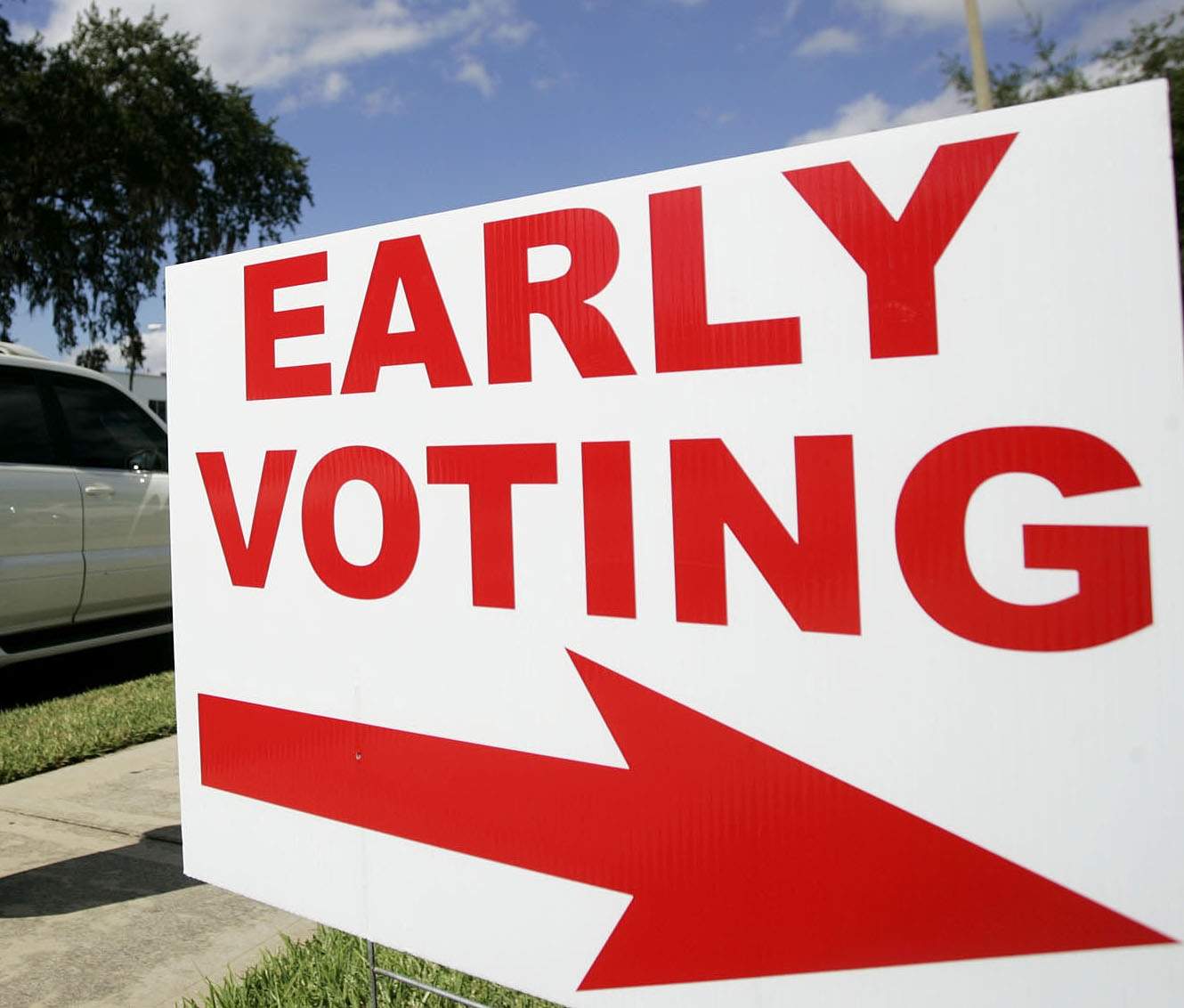
Put early voting locations in our schools, writes the Dallas Independent School District math teacher in an op-ed written for the Dallas Morning News.

I am slapping myself on the side of my noggin over that one. Why didn’t I think of it?

Curts is one of four essayists whose ideas were published in the Sunday Morning News. I want to focus on her commentary because it makes so damn much sense.

She writes that government “must make it less of an ordeal to vote. In my experience, students are willing to vote — as long as they don’t have to go too far out of their way.”

Her idea is to install early voting stations in high schools. Hey, 18-year-old citizens can vote; many of them are still in high school. According to Curts, “Government classes could take a class trip downstairs to the polls, and because early voting stretches over days, students who forgot their voter identification cads one day could simply come back the next day.”

Dang, man! This is a good idea!

We have heard a lot of talk in the wake of the Parkland, Fla., massacre at Marjory Stoneman Douglas High School about high school students being “energized” to get out the voter among their peers. They want to make a difference. Some of those students at Douglas High have become media stars, making public appearances around the country.

I am not yet certain their outrage over the deaths of their classmates this past Valentine’s Day is going to manifest itself in a surge of voter turnout among young Americans, who traditionally vote in puny numbers compared to their elders. These kids’ grandparents came of age in the 1960s and 1970s when they were rallying against an unpopular war in Vietnam and against government shenanigans relating to that scandal called “Watergate.”

I want to salute Rosemary Curts for putting forward an outstanding idea to make voting just a bit easier for today’s young people … not that it’s all that hard in the first place.

Still, whatever works.

We’re sitting out these important decisions

What do you know about that? I have known for a long time that Amarillo, Texas, where I used to live wasn’t the only city that produced pitiful municipal voter turnouts.

I have bitched about it for a couple of decades, trying — using my forum as editorial page editor of the local newspaper — to reverse that trend. It fell on blind eyes.

Hey, it could get worse. Amarillo could be as non-involved in this most important civic act as Dallas, just down the highway from where my wife and I now reside.

An analysis in the Dallas Morning News tells me that Dallas delivers the worst municipal voter turnout among the nation’s largest cities. How do Dallas residents do? Six percent of them vote on average for election of the mayor and city council members. Six percent!

I’ll take some pride in revealing that my hometown, Portland, Ore., votes on average at a 59 percent clip in municipal elections.

Dang, man! Why can’t we get more of us to the polls at these local elections, the elections that determine who runs local government, the level of government that has the most direct impact on our lives?

It’s not as though Texas doesn’t do what it can to make it easy for us to vote. We can vote early. The state opens up many venues for Texans to cast their ballots early. Still, I have laughed virtually out loud over many years when I hear local election officials brag about the large number of early ballots being cast … as if that means a greater voter turnout. It usually means nothing of the sort. It only means that more people are voting early, period.

As Michael Lindenberger writes in the Dallas Morning News:

Some studies have even suggested that voting makes citizens healthier, and not just because they can influence health policy. Voting itself, as proof of civic engagement, boosts one’s health, according to researchers at the University of Wisconsin.

More than that, even, a city that relies on only a tiny fraction of its residents to vote leaves our leaders operating on such pencil-thin support it’s a wonder they are able to be effective at all. 

Take Mayor Mike Rawlings. He was elected for his second term in 2015 on a huge margin, but with just a bit over 30,000 votes. That’s in America’s ninth-largest city, anchor to the fourth-largest urban area in the nation.

That’s ridiculous. A second term for 30,000 votes and change? What happened to hundreds of thousands of eligible voters?

This guy is speaking my language. It’s ridiculous, indeed!

I have tried to point out over many years that sitting out these important local elections leaves important public policy decisions up to the guy next door, or the dude down the street, someone who might — or might not — share your view of how your community should be governed.

Time to change this dismal voter participation

I applaud the Morning News for bringing this issue to the fore.

Will it matter? Will it bring more voters to the polls next spring when we elect our municipal officials in Texas? Probably not, but man, it needs to be said over and over again.

Why put our children at health risk?

Albert Karam is alarmed. If what he says is true, and I have no reason to doubt what he has written, he has good reason to be alarmed.

So am I.

Karam is a Dallas pediatrician who writes in the Dallas Morning News that too many Texas children are being denied vaccinations by parents who are exercising what is commonly referred to as “non-medical exemption.”

For the life of me, I don’t understand the so-called “logic” of forbidding vaccinations of children in school.

He writes about encountering sick children at the hospital where he was working. He was just out of medical school. The kids’ illness were severe. Why were they so sick? They hadn’t been vaccinated.

As Karam writes: In today’s pediatric world this is unheard of because of one thing only: immunizations. This marvel of modern medicine is truly one of man’s greatest accomplishments. Yet, our state is moving in a disturbing direction, putting us in danger of losing this protection especially for our most vulnerable — babies too young to be immunized or those who are immune-suppressed because of disease or medication.

Read Karam’s full essay here.

He adds: Unfortunately, those opposed to immunization have made inroads into spreading misinformation and falsehoods about the disproven notion that vaccination causes autism and other disorders.

How can parents convey this kind of mindless demagoguery and, in the process, endanger their children’s health and well-being?

Yet they do. They deliver frightening — and false — messages that spread like contagion throughout the nation.

Disgraceful.

Let’s see how can I say this clearly and without equivocation: Our children need to be vaccinated against childhood illness. Refusing to do so on the basis of lies amounts to child abuse.

That is unforgivable.