Tag Archives: US Constitution

Founders didn’t get it perfectly right … but they came close

I feel this need to come to the defense of our Founding Fathers over the work they did to create a “more perfect Union.”

The very words of the document they crafted to form the framework of our government — “more perfect Union” — recognize that the founders knew they hadn’t reached perfection.

I’ll tell you this: They came pretty close to it.

Accordingly, I also believe the founders would be horrified at how the political winds are blowing these days and, for that matter, have blown for some time. They would disapprove mightily of a president who seeks to usurp legislative authority by blocking Congress’s oversight responsibilities. They would bristle at the influence being exerted on our national election by foreign powers and the president’s seeming acceptance of it.

The founders would not like one bit the introduction of religion into our political debate, the notion being argued by many that this is a “Christian nation,” and who are horrified at officeholders who swear an oath to defend the Constitution by placing their hand on a holy book other than the Bible.

Our founders knew of the circumstances that brought their ancestors to this land in the 17th and 18th centuries. They were fleeing religious persecution. They did not want their government telling them how to worship. So, the founders ensured that the Constitution they would write would state specifically that Congress shall make no law that establishes a state religion and that citizens were free to worship — or not worship — as they saw fit.

They wrote language into one of the articles that declared no office seeker should be held to a “religious test.”

Yes, the founders argued mightily as they crafted the Constitution over whether it should contain any reference to religion. The document refers to the “Creator” and officeholders swear to “God” to defend and protect the Constitution.

It is the secular nature of the Constitution, though, that protects us against the imposition of radical religious doctrine in our government — be it radical Christian, radical Muslim or radical anything.

The Constitution as it was ratified initially did have some serious flaws. It didn’t allow women to vote. It failed to outlaw the enslavement of human beings. It didn’t allow for the direct election of senators by citizens.

In the years since then, though, the descendants of those great men saw fit to improve the Constitution by fixing those egregious errors.

But the Constitution has held up over the course of 230 years. The separation of powers lined out in the document have kept the president in check. The Constitution has enabled Congress to rise up against abuses of power by the executive branch through impeachment. Indeed, we just might be on the verge of seeing yet another congressional uprising.

We have survived constitutional crises. We have done so because, as Gerald Rudolph Ford said upon ascending to the presidency in a time of monumental crisis that forced the resignation of his immediate predecessor, “Our Constitution works.”

Sharia law? It is not possible in the U.S. of A.

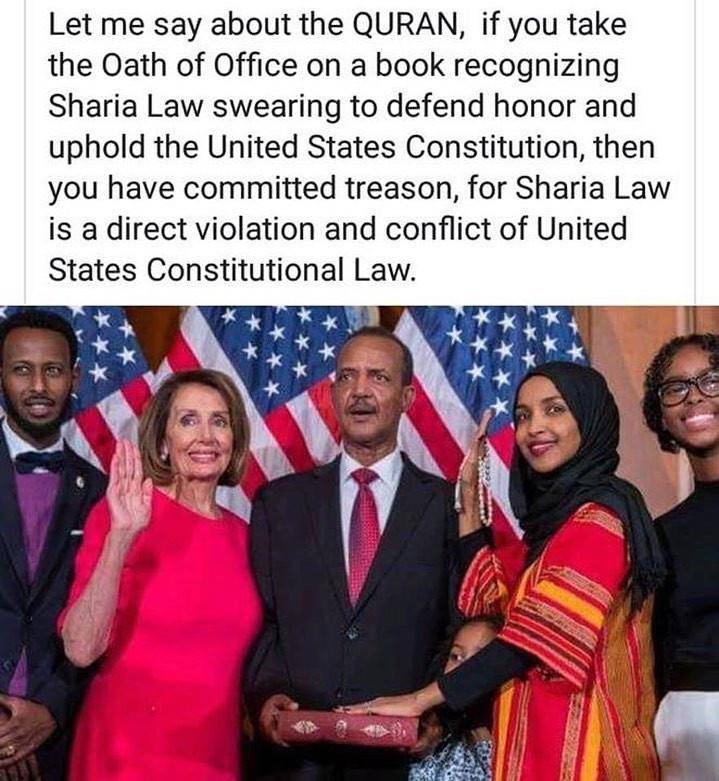
This meme showed up on my Facebook timeline today and it compels me to write a brief rejoinder to what I consider to be the mother of red herrings.

Many Americans — too many of them, actually — seem to have this unnecessary fear of Sharia law. The picture attached to this blog post shows Rep. Ilhan Omar of Minnesota taking her oath of office with a hand on the Quran, the Muslim holy book. The meme accuses Omar of committing an act of “treason” because the Quran recognizes “Sharia law.”

Let me be crystal clear: The U.S. Constitution is a secular document that prohibits the federal government from enacting laws that have their basis on religious faith. The Constitution doesn’t mention Christianity by name; it makes no mention of Jesus Christ; it doesn’t mention Islam; nor does it invoke the name of Mohammad.

It is a secular document!

Therefore, any attempt to invoke Sharia law — the ultraconservative doctrine to which a segment of Muslims adhere — is laughable on its face. Sharia law cannot possibly become part of any federal law enacted by Congress.

Furthermore, let’s get real on this point: Does anyone believe the current U.S. Supreme Court, with its current conservative majority, is going to reject any Sharia law-based complaint that finds its way to the highest court in the land?

The hatred of Muslims and of officeholders who adhere to Islam is far more troubling to me than any unfounded fear of Sharia law.

I also need to point out that Article VI in the Constitution states categorically that there shall be “no religious test” applied to anyone who seeks public office in the United States of America.

I know this post won’t stem the tide of mistrust and outright hatred of Muslims. I just needed to get off my chest this goofy notion that we need to cower in fear of the imposition of Sharia law into the lives of Americans.

The U.S. Constitution itself serves as an impenetrable shield against any such intrusion into the way this country governs itself.

Flag-burning ban … it’s back!

I am both not surprised but still amazed that this issue keeps coming back. Donald J. “Panderer in Chief” Trump says he is “all in” on a proposal to amend the U.S. Constitution to prohibit flag-burning as a form of political protest.

Oh, boy. Here we go. Again!

Trump put a Twitter message out this weekend that said he supports a “strong BAN on burning our American flag. A no brainer.”

He is backing a proposed amendment pushed by Republican U.S. Sens. Steve Daines of Montana and Kevin Cramer of North Dakota.

Where can I possibly begin on this matter? Let me try this gambit.

The U.S. Supreme Court has ruled repeatedly already that flag-burning to make a political statement is protected by the First Amendment guarantee of free political speech. Even high court judicial conservatives, such as the late Justice Antonin Scalia, have upheld the principle of keeping the First Amendment unfettered. According to the Washington Post, Scalia once said he’d prefer to jail “every sandal-wearing, scruffy-bearded weirdo who burns the American flag. But I am not king.” He has joined SCOTUS majorities in upholding the action as a form of political speech.

I am one who cherishes what the flag symbolizes, which is the right to make an a** of oneself, which is what flag-burning does to anyone who burns a flag as a form of criticism of government policy. I have maintained for as long as I can remember that such an act does not win converts to a point of view. It only enrages Americans who — such as myself — who have gone to war under that flag and who love their country … even with its warts.

Banning the act of flag-burning doesn’t do a damn thing but please those who somehow equate a piece of cloth with the doctrine it represents. The flag is merely a symbol of something greater, which is individual liberty — which includes the rights of citizens to act stupidly.

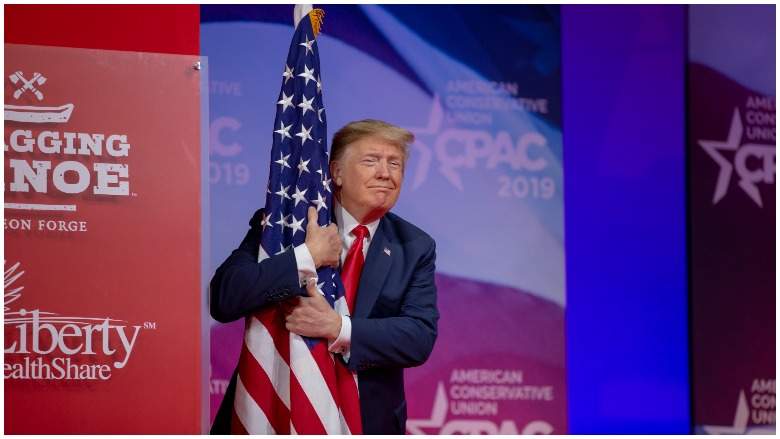
But the president of the United States doesn’t see it that way. He chooses to hug the flag to make some kind of goofy showbiz point.

Impeachment talk has me rattled

I am willing to give you a pass if you believe I am foursquare, solidly and irrevocably behind impeaching the president of the United States, Donald John Trump.

Except that I am not.

Really. This impeachment discussion is giving me serious heartburn.

I am torn into itty-bitty pieces over this matter. I am terribly conflicted and I am anxious — yes, anxious! — for some sort of resolution.

On one hand, I have supported U.S. House Speaker Nancy Pelosi’s notion that the House shouldn’t impeach Trump just yet. She is seeking patience. She wants more information to come forth. She well might be stalling, waiting for a presidential election a little more than a year from now to “settle” this matter for her … with Trump losing his re-election effort.

On the other hand, we have those among House Democrats who say it’s not about politics. It’s about “the Constitution,” they say. They argue that it is their “duty” to ensure that the president is “held accountable” and that “no one, not even the president, is above the law.” They are hellbent on launching what they call an “impeachment inquiry,” which is another way of saying they want to commence impeachment hearings.

What if the House impeaches the president? He will stand forever as one who has been impeached. Trump would become the third president to have been impeached by the House. Never mind what the Senate might do. Senators led by gutless Republicans seemingly aren’t going to convict Trump of any of the complaints brought to him. Many of us see the danger that this individual poses to the country. The Senate GOP leadership is ignoring it, to their everlasting shame!

Does the president run for re-election on the basis of his being an impeached president? How does that play out here among the rest of us in Flyover Country. Well, you know that my mind was made up when the 2016 election results came in: I have wanted him gone since the beginning of his presidency. But I digress.

Another downside of impeachment? You can kiss any type of reform legislation goodbye for the remainder of Trump’s term. The president and the House will have declared war on each other. Immigration reform? Climate change legislation? Infrastructure plans? Hah! Forget about it!

And what in the name of good governance will happen if hell freezes over and Trump is re-elected?

Good grief!

I am on the fence, folks. I cannot get my footing anywhere near stable enough to declare either “yes” or “no” on impeaching this clown.

Someone needs to pass the Pepto.

It’s all about politics

Blogger’s Note: This blog post appeared originally on KETR-FM’s website.

Whether the president of the United States is impeached by the U.S. House of Representatives is going to rely solely on a grim political calculation.

Democrats run the House these days. They seem hell bent on impeaching Donald Trump. The numbers of House members calling for an immediate impeachment “inquiry” is growing. Almost all the pro-impeachment voices come from the Democratic caucus; one Republican House member, Justin Amash of Michigan, has joined that chorus.

Do you want further evidence of the political aspect of impeachment? I offer you a survey done by the Texas Tribune, which has sought answers from the entire 38-member Texas congressional delegation.

How do you think it shakes out?

Read the Texas Tribune survey on this link:

https://www.texastribune.org/2019/06/05/did-texas-lawmakers-read-mueller-report-we-asked/

The Tribune asked all the state’s House members and its two senators, Republicans Ted Cruz and John Cornyn, two key questions: “Have you read the Mueller Report in its entirety?” and “Do you think the report warrants any legislative action?”

I’ll give you three guesses how the answers shook out … and the first two guesses don’t count.

Yes, the state’s Democratic House members – those who responded to the Tribune – said they had read the report and said that Congress should begin at the very least an inquiry into whether to launch a full impeachment hearing against the president.

The Texas GOP delegation sounded, um, a good bit differently. Not all of them responded, either; indeed, Sen. Cruz didn’t respond, which – to be honest – kind of surprised me.

But those who did read the report came to vastly different conclusions about what it said and what Congress should do in response.

One Republican House member, Will Hurd of the 23rd Congressional District, came close to breaking ranks with his caucus. He told the Tribune: “I have read the Mueller Report and I hope that I get the chance to ask Robert Mueller some questions as a member of the House Intelligence Committee.”

To be honest, my favorite response came from freshman GOP U.S. Rep. Van Taylor of the Third Congressional District, who happens to be my congressman, and from GOP Rep. Roger Williams of the 25th Congressional District. Did he read the report? Taylor and Williams said “Yes.” Should Congress take any legislative action? Taylor and Williams said, “No.” Hey, no need to explain themselves, correct? Well, I believe they should lay out some detail on why Congress need not pursue any legislative action.

My point here is that despite the flowery rhetoric we hear from many Democrats and other political progressives about their concern for the U.S. Constitution and why the nation’s governing document is their reason to seek impeachment, I am inclined to believe even more strongly that the issue revolves solely around politics.

The response from the Texas congressional delegation – comprising a healthy Republican majority – makes the point abundantly clear.

Impeachment is all about politics

Elizabeth Warren actually has said with a straight face and in an earnest-sounding voice that impeaching Donald J. Trump is not about politics, but is about “the Constitution.”

Baloney!

It’s all about politics and for Sen. Warren of Massachusetts, one of 23 Democrats running for president in 2020 to say otherwise is, shall we say, empty rhetoric.

That is why House Speaker Nancy Pelosi is correct in digging in on the issue of impeaching Trump.

At least until the House and Senate finish their tedious work in determining whether to proceed.

Impeaching a president is all about removing that individual from office. The House would draft articles of impeachment; its Judiciary Committee would recommend whether to impeach; if it votes “yes,” then the full House votes on whether to file the complaint.

If the House votes to impeach, then the Senate puts the president on trial. Here is where the bar gets high; senators need a two-thirds vote to convict. Senate Republicans occupy 52 seats in the 100-member body. Is there a realistic chance that a dozen or so GOP senators are going to vote to kick Donald Trump out of office?

That is the calculation that keeps Pelosi from pulling the impeachment trigger in the House.

Thus, it’s all about politics. Sen. Warren.

To be sure, I happen to agree that Trump has committed a crime. I believe he has obstructed justice. I also believe former special counsel Robert Mueller was hamstrung by Justice Department policy prohibiting an indictment of a sitting president.

Republicans continue to stand with a president who has committed the very “crime” that drove GOP lawmakers to stampede toward impeaching a Democratic president two decades ago.

Pelosi knows the steep hill she faces if the House were to proceed with an impeachment.

So, let’s quit the high-minded rhetoric about the Constitution. Impeaching a president is the epitome of political action. If the House is going to impeach the fraud masquerading as the president of the United States, it had better do it right.

Or else … the pols don’t want to consider what will happen if they get it wrong.

Unable to find constitutional reference to POTUS indictment

It’s been three days since Robert S. Mueller III issued his extraordinary statement about why he reached certain conclusions about Donald Trump’s alleged collusion and obstruction of justice.

I want to focus briefly on a particular point that the former special counsel made in his nine-minute recitation before the nation.

It’s the part where he said that he and his legal team looking into the Russian attack on our electoral process in 2016 could not indict the president because of a Department of Justice policy that prohibits indicting a sitting president.

Then he said such an indictment would violate the U.S. Constitution.

I believe my eyebrows raised just a bit the moment I heard Mueller make that assertion.

I have a copy of the nation’s governing document on my desk. I have been poring over it. I have looked through Article I, which lays out congressional authority and through Article II, which spells out presidential authority. I have looked through all the other original articles in the Constitution, all the way to Article VII.

I cannot find a single reference that protects the president of the United States from indictment. I cannot locate anything at all that speaks even tangentially about the issue.

I am not going to quibble and quarrel with Robert Mueller, a fine lawyer and a former FBI director. He’s a great man with impeccable integrity. I honor the work he did while compiling his report to the nation and I certainly honor his decades of public service.

Moreover, I understand how DOJ policy could prohibit an indictment. However, a policy is much less binding than anything codified in the U.S. Constitution. Policies can be rescinded. Agencies that enact policies can change them. The Constitution is a different sort of creature. To amend anything, you need a bill to come out of Congress and you then need a super-majority of states to ratify the law.

So I am asking: Can anyone find a constitutional reference that declares that presidents cannot be indicted?

Courts not involved in impeachment, Mr. POTUS

OK, Mr. President. Let me be clear: I am not on your side. I want you gone from the office you occupy.

However, I am not yet ready to climb aboard the impeachment haywagon. Maybe I’ll get there. Just not yet.

There. Having gotten that off my chest, I feel the need to remind you — and all those Trumpsters, if they’re paying attention — about a fundamental aspect of impeachment.

Your statement today that the “courts wouldn’t allow” the House of Representatives to impeach you is born of utter ignorance.

The House has the sole authority to impeach a president, sir. The courts have nothing to say about it. The Constitution doesn’t allow it. The Constitution invests the full power of impeachment in the elected body of politicians comprising the House.

Really, Mr. President, you ought to read the governing document. The impeachment matter is inscribed in Article I as clearly as it gets.

But your base of supporters don’t care about that, either. I know those are the folks to whom you are speaking. They cheer you on. They are ignorant, too, of what the Constitution allows . . . or appear to be ignorant.

Just so that I am clear, Mr. President, please understand that whatever the House decides to do regarding impeachment will come only after it does its homework. The only positive statement I will make to you at this moment is that the Senate and its majority of sycophants do not appear ready to convict you of any charge that the House would bring.

Oh, and Mr. President, the Senate has the sole authority to put presidents on trial. That’s in the Constitution, too.

Listen to this fellow, young Democratic hot shots

U.S. Rep. Hakeem Jeffries is willing to wait, to gather all the facts, make sure all the details are covered before proceeding with impeachment proceedings involving the president of the United States.

The young Democratic congressman from New York stands with House Speaker Nancy Pelosi, who has insisted that the House should not rush headlong into impeaching Donald Trump.

At least not just yet.

Will those young Turks in the House Democratic caucus, those who want to launch impeachment hearings now, listen to their elders?

Jeffries chairs the House Democratic Caucus, which makes him sort of a deputy speaker, given that Pelosi is of the same political party.

Pelosi is a consummate political creature. She knows that impeachment is the quintessential political event. It requires commitment not only from her caucus, but also from a sufficient number of Republicans to give such a bold move the staying power it needs to do what it is intended to do, which is to remove the president from office.

The GOP caucus in the House, not to mention the Senate where a trial would occur, doesn’t yet appear ready to make that leap. Republicans in both chambers are standing with Trump, dismissing the mounting evidence that (a) he is abusing the power of his office and (b) quite probably committed — or is now committing — acts that constitute an obstruction of justice.

As Jeffries told “Meet the Press” host Chuck Todd this morning, the House doesn’t work for Trump. Its members work for those who elected them.

Jeffries called Trump a “studio gangster” who plays the role of a tough guy. As I watch this guy from afar, he looks like a pansy who has been buffaloed by a speaker of the House who is all too willing to stand her ground.

She is standing firm, though, not just against Trump, but also against the young guns within her own partisan caucus in the House.

She makes sense. Impeachment is not going to happen until the House finishes the work that is laid out by the terms of the U.S. Constitution.

Judge suspended for popping off about POTUS

Talk about filling me with terribly mixed feelings!

I just have heard that the Utah Supreme Court has suspended a trial judge for six months — without pay! — for speaking ill of Donald Trump on social media and in the courtroom.

Judge Michael Kwan has bee popping off for some time about the president. He has posted Facebook messages and has said things in court that have disparaged the president.

A part of me happens to agree with the judge, that Trump is so very worthy of criticism.

However . . .

Not from a member of the judiciary who takes an oath to behave himself with dignity and to exercise utmost judicial decorum while serving the public. Judge Kwan has violated his oath.

According to NBC.com: Three days after the 2016 election, Kwan wrote on Facebook, “Think I’ll go to the shelter to adopt a cat before the President-Elect grabs them all” — a reference to the “Access Hollywood” tape in which Trump was heard bragging about grabbing women’s genitals without consent.

That’s a bit of a knee-slapper. It’s also not in keeping with the dignity of the court that Judge Kwan serves.

I’ve been yammering and yapping about Donald Trump’s lack of decorum as president of the United States. Fairness compels me to insist the same of those who hold dignified public offices that are ostensibly supposed to be out of reach of partisan politics.

NBC.com also reports: Almost a month after Trump’s inauguration, Kwan said “welcome to the beginning of the fascist takeover” and questioned whether Congressional Republicans would be “the American Reichstag,” this time referring to the political body of Nazi Germany.

Judge Kwan defended his online commentary by stating that he had a First Amendment right to share his views about elected officials’ political and social stances, calling it “constitutionally protected speech” and describing his statements as “social commentary or humor.”

Yes, the judge has a First Amendment right. His role as a trial judge, though, demands that he exercise the temperament worthy of the office he occupies.

Judge Kwan has failed.