Tag Archives: Golden Triangle

Happy Trails, Part 76

Retirement has delivered many changes for my wife and me. We expected some of them. Others have kind of caught me by surprise.

One of the surprises has been the realization that no longer are we bound to others’ deadlines, others’ demands.

We are free to make our decisions on our own time.

It’s quite cool, yes? Of course it is!

We moved from Oregon to Beaumont, Texas in the spring of 1984 so that I could continue to pursue my career in print journalism. I was hired and I had to move by such-and-such date and report for work on a certain day and time.

Then we moved from Beaumont to Amarillo to continue that pursuit in early 1995. The same requirements forced me to report for duty at a prescribed date and time.

I met those deadlines. My wife came along later after working feverishly to clear up matters enough to enable us to make the move.

We were operating on others’ timetable.

No more. We’re now on our own deadline. We can set it. Or we can choose not to set it.

We’re awaiting word on the sale of our house. We have accepted an offer. We are going to jump through the usual hoops: inspection reports and then signing of plenty of papers to transfer ownership of our property to another party.

Then we prepare to move.

People ask me almost daily: What are your plans? My answer is the same: We don’t have any plans. We’re retired now and we aren’t obligated to make plans by a certain date. We have nowhere to be at a particular date and time.

We are, as I’ve said only half-jokingly, making it up as we go along.

That is the truth!

Yes, we have a general idea where we intend to move. The precise destination isn’t determined.

We will take our time looking for it. Given that our “home” these days sits on four wheels and rides behind our pickup truck, we are free to go wherever we please, whenever we please.

Our first order of business will be to determine where we want to park our RV while we scour North Texas looking for a place to call home yet again.

This foray into the world of retirement has given us the luxury of time and the freedom to use as much — or as little — of it as we desire. Ain’t it cool?

Happy Trails, Part 75

The time has arrived for me to start thinking about what I am going to miss about the Texas Panhandle.

Our retirement journey this week took a big step forward to the next place.

This place, though, has been good to my wife and me. We’ve called it home for 23 years … plus a couple of months. As we prepare to move on down the road, I am filled with many memories.

One of them slapped me in the face the first time I ever laid eyes on this region. It occurred in late 1994. I flew from Beaumont to Amarillo to interview for a job at the Amarillo Globe-News, which had a post to fill: editorial page editor of both papers, the Daily News and the Globe-Times.

I landed at Amarillo International Airport, walked into the terminal and met the man I hoped to succeed. Tom Thompson was about to become press secretary for the newly elected congressman from the Panhandle, Republican Mac Thornberry.

We walked out to the parking lot and I noticed right away: Man, this place looks so … big!

I could not get over how far one can see here. We walked to Thompson’s car and even riding from the airport toward downtown I couldn’t take my eyes off the panorama.

I don’t recall my precise words to Thompson as we drove into the city, but I think it was something like, “I cannot believe how big and spread out everything looks.”

If you’ve been the Golden Triangle, or seen the Piney Woods of Deep East Texas, you get what I meant. The pine trees and the dogwoods are lush. The highways that course through the woods, however, do tend leave one with a bit of claustrophobia.

Not here, man! You see the High Plains of Texas for the first time and you feel, well, sort of liberated.

Yes, I will miss that feeling here. I will miss the big, beautiful sky that I’ve said before is God’s payback to the region for neglecting to grant this part of the world with purple mountain majesty.

I’m like to have more to say in the days and weeks ahead about the many friends my wife and I have made here. I’ll offer a word or two about the professional fulfillment I received while working for nearly 18 years at the local newspaper. I might even say something about how I managed to navigate my way through a community with a significantly different world view than the one I carry with me.

Today, my mind takes me back to that first glimpse of the wide open spaces this region provides. One’s first impression of a place often is the most compelling. So it was when I first cast my gaze on the place we would call “home.”

Happy Trails, Part 74

The Grand Retirement Trail has opened up a bit for my wife and me.

We’ve had plenty of splendid journeys throughout the United States.

We ventured out west, through California and then to Oregon to attend my 50-year high school reunion. We have ventured the other direction, to Nashville, then to Washington, D.C. We took a trip straight north to the Twin Cities, Minn., to visit my cousin. We toured much of Texas in a circular path that took us from the Panhandle to North Texas, through East Texas, to the Golden Triangle, to Houston, to the Coastal Bend, then to the Hill Country.

We’ve seen friends and family along the way through all those journeys.

Our retirement years, though, aren’t restricted to exclusively North American destinations. One of our bucket list journeys involves a trip through the breadth of Canada, from Vancouver to the Maritime Provinces.

But, yes, we have at least one bucket list journey that we plan to take. It will be to Australia.

Friends who have been Down Under tell me the same thing: You will need to take plenty of time, because it takes a long time just getting there. OK. We get it.

I’ve had a fascination for nearly 55 years. My father entertained a career opportunity that would have taken him to a coastal community north of Sydney. I wanted to go. I thought Dad wanted to go, too. I learned a bit about Australia and tried to persuade Dad to take the job he was considering.

Dad didn’t take the bait. We stayed in Oregon. My desire to visit the Outback hasn’t dissipated on little bit.

We’ll get there. I hope it’s sooner rather than later.

My wife and I have been blessed with being able to see a lot of the world together. We’ve been to Taiwan twice together; we have visited Denmark and Sweden. We’ve been to Greece twice; my wife says of all the places she’s been, Greece is one country she could visit repeatedly. We have seen Israel, too.

I am unsure whether we’ll get back to all those places we’ve seen already. I do know that Australia beckons. Maybe New Zealand, too.

I happen to one of those Americans who isn’t as fond of international travel as I used to be. This post-9/11 world makes it a bit of a cumbersome experience.

It’s not too cumbersome, though, to keep me away from fulfilling this bucket-list journey to the other side of the planet.

Happy Trails, Part 73

The question comes to me almost weekly.

I’ll run into longtime friends or acquaintances and they inevitably ask: How do you like retirement?

My answer is usually the same: If I were doing any better I’d be twins.

One former colleague who now lives in Houston asked me that very question about a year ago. I gave him the answer. His response? “I’ve never met a retired person who doesn’t love being retired.”

There you have it. My friend has said I fit the mold of your standard, run-of-the-mill retired guy.

What my friend also understands is that my journey toward retired contentment — and, yes, the joy it brings — didn’t start out that way. My retirement journey began unhappily. I wasn’t yet ready to call it quits when I did. I resigned my last newspaper job — at the Amarillo Globe-News — in a fit of emotional pain.

The truth is that it didn’t take me long to realize that my former employer actually did me a favor. I sent myself out to pasture. The pain that I felt on my last day of employment dissipated quickly.

I’ve known many people over the years who have gone through circumstances quite similar to what I encountered. They had been reorganized out of jobs, too.

Here is what I rediscovered about myself. I am a highly adaptable creature. I discovered by adaptability when my family and I moved from Oregon to Texas in the spring of 1984 and exposed ourselves to a serious culture shock. We adapted. My wife and I went through another form of culture shock when we moved from Beaumont to Amarillo in January 1995. We adapted to that change yet again.

My wife and I are going to embark on one more big challenge as we prepare to relocate once more, from the High Plains to North Texas.

My adaptability skills will come into play once again.

The only part of my new life that won’t change — ever! — is a return to the working world. I’ve done my time there.

Retirement really is so very good.

NFL does well with its Man of Year selection

I don’t normally get excited about pro football awards.

This year is different. The National Football League today announced its Walter Payton Man of the Year award. It goes to someone I just knew would get it: J.J. Watt, the standout defensive end for the Houston Texans.

What did Watt do to earn this honor, named after the late Walter Payton, the Hall of Fame running back and one of the great all-round great gentlemen of all pro sports?

Watt decided to launch a fundraising effort to help victims of his adopted hometown of Houston, after the wrath it suffered from Hurricane Harvey. He set a modest goal of $250,000.

Uh, Watt finished with a lot more than that. He ended up raising a cool $37 million for the waterlogged residents of Houston, whose homes were destroyed by the epic rainfall.

J.J. Watt is a tremendous athlete. I am delighted to know that the NFL has recognized him for possessing a tremendous heart.

Many of us far away from the coast saw this award coming. Our hearts were broken when Harvey came ashore not once, but twice along the Texas Gulf Coast. It pounded the Coastal Bend with killer winds and storm surge, then backed away from the coast and returned as a tropical storm.

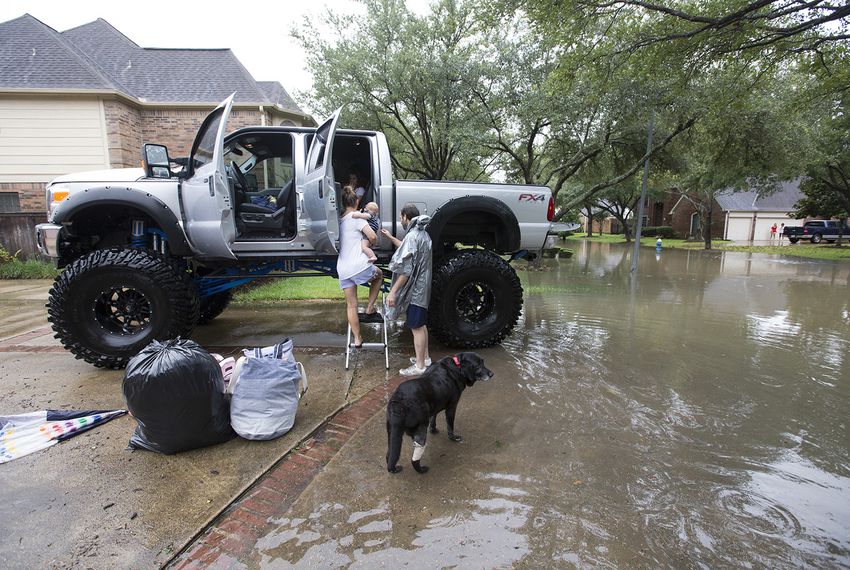
It was on its second visit to the coast that Harvey did its damage to Houston and to the Golden Triangle, just east of the big city.

J.J. Watt stepped up in a big-time way to raise money for those victims — and has richly earned the title of the NFL Walter Payton Man of the Year.

Well done, young man. I would bet that Walter Payton, the man they called “Sweetness,” would be proud of you, too.

Remember when Texas was awash in water?

Mother Nature is so darn fickle.

It was just a year ago when Texas was in the midst of a drenching. Rain soaked the landscape from the Panhandle to the Rolling Plains. The snowfall early in 2017 was welcome, too. The first half of the year brought ample moisture, pleasing our farmers and ranchers to no end.

Then came Hurricane Harvey’s one-two punch along the coast; it arrived as a hurricane and pounded the Coastal Bend with storm surge and heavy wind and returned a few days later as a tropical storm and inundated Houston and the Golden Triangle under 50 inches of rain.

The Texas drought was over! Or so the National Weather Service proclaimed.

Hold on a minute. What happened?

It stopped raining in the Panhandle. Around 40 percent of the state is undergoing moderate to severe drought. The Panhandle has been dry for 107 straight days and is approaching an all-time dryness record, which was set in — gulp! — 1902.

As the Texas Tribune reports: The Texas Panhandle has become ground zero in a drought that has crept into much of the state just five months after Hurricane Harvey — including areas that suffered massive flooding during the storm.

When he was governor of Texas, Rick Perry said it would be helpful if Texans would pray for rain. The 2011 drought was a punishing event and the governor sought to look toward the heavens for relief.

It came eventually. Did the prayer help? It’s equally tough to prove or deny categorically. We are left, then, only to believe.

With that, perhaps it’s time we sought help once again from the Almighty.

Welcome to Texoma

SHERMAN, Texas — I’ve discovered a new region.

Local media in the Sherman-Denison area of North Texas use an interesting and charming term to describe this part of the Lone Star State.

They call it Texoma.

Longtime Texans no doubt will scoff at me for posting this brief post. Too bad. Let ’em scoff all they want. I find the term vaguely enchanting.

My wife and I watch some local TV while we are holed up in our RV — when we’re not visiting with our granddaughter and her family down U.S. 75 just a bit south of us. I’ve been struck by the media’s use of Texoma to describe the region that is partly Texas and partly Oklahoma, given that Sherman is barely beyond spittin’ distance south of the Red River that serves as the common border between the states.

I don’t know when Texoma became the term of art to describe this region. It does kind of roll off the tongue.

This mini-discovery in a way reminds me of a community struggle that occurred in the mid- to late 1980s in the Golden Triangle region of Southeast Texas. It involved a regional name-change effort that was concocted by a committee of civic and business leaders who I guess grew tired of the region being known as the Golden Triangle.

They decided to launch a TV ad campaign featuring some actor dressed up as the late Army Gen. George S. Patton Jr. He would scold viewers about how the term “Triplex” was more suitable than “Golden Triangle.” The ad appeared throughout the cities of Beaumont, Port Arthur and Orange, which are the largest communities within the Golden Triangle.

We at the Beaumont Enterprise newspaper were instructed to use the term “Triplex” whenever we referred to the region in our news and editorial coverage.

The effort failed miserably. The residents of Jefferson, Orange and Hardin counties spoke out loudly and passionately against any such name-change effort. They hated the term “Triplex.” Some folks resorted to calling the outline of the three counties as the “Tri-Pot,” given the shape of the counties kinda/sorta looked like a commode.

Well … the campaign eventually fizzled out. It died a fairly quick death.

I trust the folks of Texoma didn’t endure a similar wrenching of its collective gut when someone decided to name this region. If they did, then they got over it.

Good for them. I like the sound of Texoma.

Climate change made Harvey wreckage worse? Who knew?

Imagine my (non)surprise to read that independent analyses have concluded that climate change likely worsened the misery that Hurricane Harvey brought this summer to the Texas Gulf Coast.

The rainfall that inundated the coast totaled 50 inches in a 24-hour period; it set a continental U.S. record for most rain to fall during a single day.

Get a load of this: Researchers say that climate change — or you can call it “global warming” — worsened the rainfall by about 15 percent.

Not that a 15-percent increase created the tragedy that brought so much suffering to Houston, the Coastal Bend and the Golden Triangle. A 40-inch rainfall would have done plenty of damage, too … correct?

According to the Texas Tribune: ” … two independent research teams, one based in The Netherlands and the other in California, reported that the deluge from Hurricane Harvey was significantly heavier than it would have been before the era of human-caused global warming. One paper put the best estimate of the increase in precipitation at 15 percent. The other said climate change increased rainfall by 19 percent at least, with a best estimate of 38 percent.”

Read the Tribune story here.

However, the federal government keeps insisting that climate change is a “hoax,” that it’s a made-up creation of “fake news” and the Chinese government, which is trying to undermine the U.S. fossil fuel industry.

It’s no hoax. We can debate its cause. I happen to believe human activity has contributed to climate change. To call it a phony story, though, puts millions of Americans in extreme peril.

Happy Trails, Part 63

I am going to miss many aspects about living in West Texas.

My friends; the big sky and the fabulous sunrises and sunsets; Palo Duro Canyon; the distinctly different seasons of the year.

I won’t miss one aspect of life on the High Plains: the distance one must travel to get anywhere.

Our 23 years on the High Plains has acclimated my wife and me to this reality. It is that you don’t measure travel in miles; you measure it in the time it takes you to get somewhere. If it’s only an hour’s drive, no sweat. Even a two-hour drive is tolerable. Three hours? Eh, it’s still doable.

It took me a while to get used to that element of West Texas life. But I did. It’s no longer a big deal for either of us — and I’m presuming this of my wife — to “commute” 30 or 40 miles in a morning. Hey, it’s still less than an hour behind the wheel!

We moved to the High Plains from the Golden Triangle, where any destination of note was much closer to home. Ninety minutes to Houston; four hours to New Orleans; five hours to Dallas-Fort Worth; 30 minutes to the beach.

Soon (I hope) we’ll be relocating to points southeast of the High Plains. We’ll be settling somewhere in the Metroplex. Our precise destination is yet to be determined.

I’m not yet sure how long it will take me to re-acclimate to travel in a region where destinations aren’t spread so far apart. I suspect it won’t take long. I figure it’s always easier to fall back on what we once knew than to venture into a strange — and largely unknown — way of life.

If only we could take our friends, the canyon and that gorgeous sky with us.

‘Climate change’ anyone?

I am acutely aware that one cannot pigeonhole weather forecasting into neat categories.

What’s more, I also know that trying to predict what Mother Nature brings to any region is a crapshoot even in the best of circumstances.

But what in the world is going on this week?

Here we are in the Texas High Plains region. We’re tinder dry. It’s cold, but we’re continuing this dry pattern that’s beginning to cause the TV weather forecasters some anxiety.

Then we get news that snow is blanketing regions of this state and points east. It’s snowing this week in regions where (a) it hardly ever snows and (b) the snow is supposed to fall long after it blankets the Texas Panhandle.

We remain snow free. The Texas Gulf Coast is under several inches of snow. My friends along the Coastal Bend, Houston and the Golden Triangle are bundling up and driving ever so slowly and cautiously in conditions with which they are totally unfamiliar.

Is all of this a symptom of climate change? I’ve long argued that one cannot take a single weather event and equate it with whatever might be happening globally. I usually argue that it’s best to argue climate change by seeing the big picture.

This very weird reversal right here in big ol’ Texas, though, seems to suggest to me that we might be witnessing one element of a much bigger weather story.