Category Archives: environmental news

Nature: Mother of all that is fickle

Can there possibly be another force that is more fickle than Mother Nature?

Consider what has transpired in just the past six months.

We began 2017 enduring a virtual deluge of rain and, yes, some snow. The Texas Panhandle set records for moisture accumulation during the first half of the year. Amarillo reached its annual precipitation level before the summer had expired.

The playas were full. The grass was green and lush. Our livestock were well fed. Dryland farmers were beside themselves.

Life was good, man. Remember?

Then came October. Or thereabouts. It all stopped. Virtually nothing has fallen from the sky since.

The playas aren’t so full these days. The grass that goes dormant in the winter isn’t likely to bounce back with its traditional gusto. Those dryland farmers, the folks who depend on Mother Nature to irrigate their land, enabling them to grow their crops, providing harvests that fill our pantries with food and their pockets with cash? They’re still beside themselves — but for vastly different reasons.

The weather forecasters now are sounding borderline panicky as they report on the extreme fire danger that exists. The wind that usually arrives in these parts in March are howling. The grass that should be somewhat moist from those spring thundershowers are susceptible to being torched by the tiniest of sparks.

What are our remedies? We cannot tell Mother Nature to do our bidding. She doesn’t jump when we tell her to jump.

When he was governor of Texas, Rick Perry took some ridicule when he suggested Texans pray for rain in the middle of an earlier drought. His view was that if we sought divine help, then perhaps we could rely on our collective faith that our fortunes would turn for the better.

They did. The rain came. We were left to wonder whether our prayers made the difference. Who can say categorically that they didn’t?

That time is at hand once again. Mother Nature’s fickleness is causing plenty of angst across our parched landscape. Given that we cannot force her to adhere to our demands, maybe we can go over her head and talk directly to God.

We need help from wherever it’s available.

Wind: a curse and a blessing

I wrote this tweet earlier today: It’s official. I have grown weary of this incessant Texas Panhandle wind. Enough … already!

Truth be told, I view the legendary Panhandle wind in two contexts.

Yes, it’s a curse. The dirt that flies gets in my eyes. It coats everything. Our recreational vehicle that now shelters us full time is constantly dusty, which drives my wife crazy; me, too, actually.

Our RV rocks and rolls as the wind buffets it. Hey, it’s March! We’re supposed to be this windy on the High Plains of Texas. I get it, man!

That’s the curse part of it.

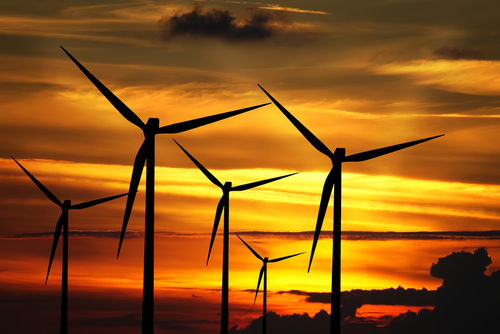
The blessing? It provides “fuel” to turn those thousands of wind turbines one sees on our expansive landscape. When I hear the wind howl outside, when I see the trees bend and the tall grass wave I think of the benefit that the wind brings.

It provides evidence of the wisdom in Texas’s heavy investment in wind energy. I’ve noted already on this blog how Texas and California have more in common than one might think.

Both states have developed sophisticated wind energy economies. I cannot remember at this moment which of these states is No. 1 in the nation; something tells me it’s California. Texas, though, is a strong No. 2 if it hasn’t overtaken California already in the amount of energy produced by wind.

I happen to be a big proponent of alternatives to fossil fuels. I am chagrined in the extreme by Donald John Trump’s continued emphasis on drilling for oil and for the development of what he keeps referring to as “clean coal,” whatever the hell that means.

The wind that annoys the daylights out of folks like me also has contributed to the surplus of fossil fuel that has helped — more or less — keep a lid on the price of oil and natural gas.

As I keep reminding anyone who’ll listen, wind is infinite and clean. There’s no need to call it “clean wind.”

OK, so it blows a lot here. I might be officially sick and tired of it, I also recognize the long-term benefit it brings.

This just in: Global warming is bad!

Someone ought to remind Scott Pruitt what the initials “EPA” mean.

They stand for “Environmental Protection Agency.” The man who runs the EPA is charged with protecting the environment, with searching for ways to maintain the integrity of the surroundings where we live.

But Pruitt has now declared that global warming — aka “climate change” — isn’t necessarily a bad thing.

I believe the former Oklahoma attorney general is mistaken. Yes, it is a bad thing. It’s a very bad thing, dude.

As near as I can tell, global warming produces a number of potential catastrophes. The ice caps on both poles melt, resulting in an inexorable rise in sea levels; the North Pole ice cap is a prime hunting ground for polar bears and if they can’t hunt seals and walruses, they can’t eat and they die of starvation; the rising sea levels endanger our coastal marshes and, oh yeah, they also threaten the many urban areas that have sprung up on coasts all around the world.

The EPA director seems all too willing to dismiss the potential dangers posed by this phenomenon.

I won’t argue the point about the cause of global warming. Whether it’s manmade — which I believe it is — or whether it’s part of Earth’s epochal cycle, it’s a bad thing.

Why can’t the man in charge of the federal agency that is supposed to protect our environment concentrate his energy and attention on his fundamental duty?

Protect the planet, Mr. EPA Director!

Here is an example of drought severity

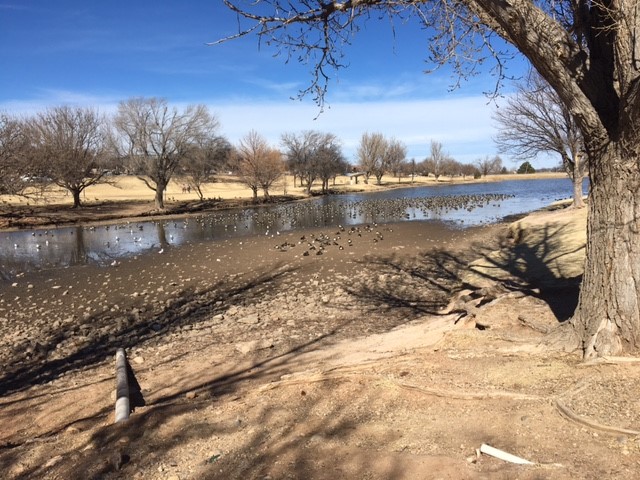
You almost have to squint your eyes to see the water in this picture.

I snapped this shot this morning at MediPark Lake in far west Amarillo. The last time we visited this site — about four months ago — that large expanse of rocky terrain was under about six feet of water.

Not now!

I guess I wanted to share this view just to illustrate a concern I have about the lack of surface water in Amarillo. I believe we’re at the 108-day mark with zero measurable precipitation. The all-time record is approaching quickly and according to my trusty Weather Channel app on my “smart phone,” it looks we’ll break that record in less than a week.

Oh, did I mention that the dry-spell record was set in 1902? There. I just did.

It’s not fun watching the surface water disappear before our eyes. Oh, Medi Park is still full of ducks and Canada geese. Indeed, this morning we witnessed large flights of geese take off and return to what’s left of the lake. I do enjoy watching those birds take flight.

I have no particular point to make with this blog post, other than to alert my Texas Panhandle friends and fellow travelers what they already know: We need to be careful with our water use.

Ice caps are melting, Mr. President! Really, they are!

Donald J. Trump now is expressing an opinion that runs counter to scientific consensus.

The president has declared polar ice caps are at “record levels.” He is trying to buttress his bogus assertion that climate change is a “hoax” cooked up by Chinese conspiracy theorists intent on using the phenomenon as a way to undermine the U.S. fossil fuel industry.

But, but, but …

The evidence suggests something else. The ice caps are diminishing. They are endangering wildlife, such as polar bears that rely on the ice caps for their hunting of prey, such as seals and walruses.

The president isn’t buying it. Has he consulted with anyone? Does he ever consult with anyone on anything? I think we know the answer to that question.

According to The Hill: “I mean, look, it used to not be climate change. It used to be global warming. That wasn’t working too well because it was getting too cold all over the place,” Trump said.

Indeed, spoken like a man with deep scientific knowledge.

I am going to rely on the scientific community and, oh yes, the pictures that NASA is taking from outer space showing precisely what is happening to the world’s Arctic and Antarctic ice caps.

They are shrinking, Mr. President. The pictures don’t lie … unlike a prominent politician who is known to prevaricate with abandon.

Water has returned to top of our minds

Imagine my non-surprise.

The Texas Panhandle drought has gotten us  talking out loud again about water, conserving it, looking for more environmentally sound ways to grow and harvest our crops.

We’re now into a lengthy dry spell with no measurable precipitation. The record is now just a handful of days away. It’s looking as though we’re going to break the record set in 1902. Hey, all records were meant to be broken. Frankly, I’d prefer to see this one stand.

But is Amarillo about to run dry? No. Not even close.

Some aggressive water-rights purchasing over the course of the past decade has enabled Amarillo to maintain a viable water supply. The city in conjunction with the Canadian River Municipal Water Authority — which supplies Amarillo and nearly a dozen other communities with water — acquired many years of water rights from T. Boone Pickens, the former Amarillo oil and natural gas magnate.

Many billions of gallons of water remain undeveloped. It’s under our feet, deep within the Ogallala Aquifer.

We have a serious lesson that needs to be heeded, however.

Our water is not infinite. It won’t last forever. Oh, certainly Amarillo will have water at its disposal for many generations. We can thank an aggressive water-purchasing endeavor led by a municipal management team headed by a city manager, Jarrett Atkinson, with extensive knowledge of water management issues. Atkinson has moved on; he’s now city manager in Lubbock.

The drought that has gripped the Panhandle, though, looks as though it could be worse than it was in 2011, when it got — shall we say — pretty damn severe. Lake Meredith sank to a shockingly low 26-foot depth; it has rallied considerably since then, but the region needs rain badly.

As we wait and perhaps pray for more rain, we at least can rest reasonably assured that Amarillo will stay “wet” for the foreseeable future.

We dare not get wasteful while we wait for a change in our meteorological fortunes.

Remember when Texas was awash in water?

Mother Nature is so darn fickle.

It was just a year ago when Texas was in the midst of a drenching. Rain soaked the landscape from the Panhandle to the Rolling Plains. The snowfall early in 2017 was welcome, too. The first half of the year brought ample moisture, pleasing our farmers and ranchers to no end.

Then came Hurricane Harvey’s one-two punch along the coast; it arrived as a hurricane and pounded the Coastal Bend with storm surge and heavy wind and returned a few days later as a tropical storm and inundated Houston and the Golden Triangle under 50 inches of rain.

The Texas drought was over! Or so the National Weather Service proclaimed.

Hold on a minute. What happened?

It stopped raining in the Panhandle. Around 40 percent of the state is undergoing moderate to severe drought. The Panhandle has been dry for 107 straight days and is approaching an all-time dryness record, which was set in — gulp! — 1902.

As the Texas Tribune reports: The Texas Panhandle has become ground zero in a drought that has crept into much of the state just five months after Hurricane Harvey — including areas that suffered massive flooding during the storm.

When he was governor of Texas, Rick Perry said it would be helpful if Texans would pray for rain. The 2011 drought was a punishing event and the governor sought to look toward the heavens for relief.

It came eventually. Did the prayer help? It’s equally tough to prove or deny categorically. We are left, then, only to believe.

With that, perhaps it’s time we sought help once again from the Almighty.

Drought has returned with a vengeance

I guess we can say with supreme confidence that the Texas Panhandle drought has returned.

In a big way!

The TV weather forecasters remind us that we’ve gone 102 days without measurable precipitation. They bemoan the low humidity, the low dew points. They remind us to avoid doing anything stupid that would torch the landscape.

However, the Amarillo Fire Department today did something I consider to be a bit strange. It conducted a “prescribed burn.” Why strange? The wind was howling! It’s going to howl again — with even more vigor — on Thursday. It was the first such controlled burn in decades.

AFD warns us about the danger of lighting fires in dry conditions. The wind has this way of blowing red-hot embers to places far away. Doesn’t the wind do the same thing to fire departments, too?

Well, no harm today. The burn in southeast Amarillo went off without any serious problem.

The drought is something for us to ponder. We also need to act on it. Don’t waste water. Don’t cause any wildfires. Don’t put your family, friends and neighbors at risk.

The return of the drought demonstrates this fundamental truth: Human beings — no matter our technological advances — are powerless against the forces of nature.

Hey, wasn’t it just a few weeks ago when we completed a year with greater-than-normal precipitation? I guess what’s true in politics is true as it regards Mother Nature: A month is an eternity.

Does this heavy wind equal climate change?

Climate change has become a sort of synonym for “global warming.”

When climatologists talk about the warming of Planet Earth, they drop the term “climate change,” as if the conditions are interchangeable.

I’ve been thinking just a bit about that. I am not so sure we can bind them together.

Out here on the High Plains of Texas, we’ve been battered over the course of several days by high wind. It’s been dry, too.

I bring this up because for the past 23 years my wife and I have called the Texas Panhandle home, we have welcomed those reliable “March winds.” This year, March arrived about, oh, two months early.

For much of January we have been battling the wind that is supposed to arrive just in time for spring. The wind brings with it those threatening clouds, the downpours, the occasional hail storms.

This year it’s just the wind. Fifty mph gusts have followed sustained wind of about 20 to 30 mph.

Is it mere coincidence that the National Oceanographic and Atmospheric Administration reported that 2017 was the second-warmest year on record? Has the worldwide warming produced some of the windblown consequence we’re experiencing in early 2018 out here on what I call the Texas Tundra?

And is climate change generally synonymous with global warming? Does one event mean the existence of the other?

I believe the climate is changing. I also believe the planet is getting warmer. I am not yet willing to link the two conditions together.

Your thoughts?

Nature has this way of tending to itself

A video came to my attention. It apparently has gone viral, which is why it showed up on my Facebook feed the other day.

I opened it — and was filled with wonder at the power of Mother Nature.

It’s about the consequence of the release of 14 wolves into Yellowstone National Park. It recites the impact that the wolves have had on the ecosystem.

It’s all good, I’ll tell you. The video is here: oSN8R80e

I encourage you to take a look.

In brief, it explains how the wolves culled the deer and elk herds in Yellowstone, how the culling has helped the flora flourish, how the increased flora has attracted more birds, improved soil erosion throughout the park, enhanced the rivers, streams and lakes, which attracted more wildlife.

I remember when the National Park Service brought the wolves back into Yellowstone, the nation’s oldest national park. I was pleased to hear about the return of the beasts. I knew they would prey on injured or ailing deer and elk. They did what we all thought they would do.

Yes, the numbers of deer and elk diminished. The quality of the herds, though, improved. The more fit animals were able to survive. They reproduced.

And … shall we say that the rest is history.

Mother Nature is the greatest equalizer of them all.