Category Archives: military news

Why all this fuss over Gitmo?

Detainees in orange jumpsuits sit in a holding area under the watchful eyes of military police during in-processing to the temporary detention facility at Camp X-Ray of Naval Base Guantanamo Bay in this January 11, 2002 file photograph. A cache of classified U.S. military documents provides intelligence assessments on nearly all of the 779 people who been detained at the Guantanamo Bay prison in Cuba. The secret documents, made available to The New York Times and several other news organizations, reveal that most of the 172 remaining prisoners have been rated as a "high risk" of posing a threat to the United States and its allies if released without adequate rehabilitation and supervision, the newspaper said in its report late on April 24, 2011.  REUTERS/Stringer/Files (CUBA - Tags: CRIME LAW POLITICS) - RTXL0IH

I’ll admit that I’m very late in this discussion, but here goes anyway.

Guantanamo Bay — aka Gitmo — has been the subject of a lot of political discussion since it began housing terror suspects after the 9/11 attacks.

I’ve listened to the back-and-forth on all these years and am left to ponder: Why has this effort been so contentious?

President Obama said today he’s going to “change course” and move to close the detention center on the U.S. Navy base in Cuba before he leaves office. He wants to relocate the detainees to the United States.

It’s not that I fear bringing them here. They are being kept under serious lockdown at Gitmo. It’s safe to presume that whatever federal lockup gets them that they will be treated with the same seriousness.

Again, why the consternation over their detention at the military site?

The 9/11 attacks provoked a ferocious initial response from the U.S. military. It embarked on a mission to kill and/or capture as many terrorists as it could. Those who were captured were brought to Gitmo, which existed long before the terrorist attacks on D.C. and New York City.

There reportedly were abuses of prisoners at Gitmo. However, does the location of the alleged abuses matter? What if they had occurred at, say, Fort Leavenworth, Kan., where the military operates another hard-time lockup for military prisoners?

The suggestions by some foes of closing Gitmo that bringing them to the United States somehow puts Americans at increased risk doesn’t wash.

Still, the suggestions that we must close Gitmo because it somehow doesn’t comport with “American values” is equally nonsensical.

The individuals housed at Gitmo are seriously dangerous criminals who’ve been accused of committing acts of war against the United States of America. Whether they’re locked up at the island detention center or somewhere on U.S. soil doesn’t seem to matter one little bit.

Our Navy base is as secure as any of our installations.

Therefore, now that I’m awakened — finally — to this critical issue, someone will have to explain to me why it became so critical in the first place.


Is this the year the U.S. gets hit?

ISIL%20fighters

Well before the sun set on Sept. 11, 2001, defense analysts and terror experts were almost unanimous in their assessment of our nation’s future.

If was not a matter of “if” we would be hit again, but “when.”

The head of the Defense Intelligence Agency, Lt. Gen. Vincent Stewart, told the U.S. Senate Armed Services Committee, that he believes this is the year it will happen.

The Islamic State, he said, is going to continue to hit Europe and well might plan a coordinated attack on our shores.

When will it occur? The general didn’t say. He cannot know.

In reality, though, he didn’t provide a serious scoop on what’s been understood since the terror attacks of 9/11.

That attack on the World Trade Center and the Pentagon was so daring, so audacious, so brilliantly executed that it prompted President Bush and his national security team to create an entirely new Cabinet agency assigned to protect us. The Department of Homeland Security has been on the job ever since.

Now, the question always has been: Will this country be able to protect itself forever against the next terror attack? There can be zero guarantee against another attack that could rival the horror that al-Qaida brought to our shores on the beautiful Tuesday morning in New York and Washington.

But then again, had we been fully alert to the dangers that always have lurked, perhaps we shouldn’t have been so totally shocked at what transpired that day.

The Bush administration — once it gathered itself after the horror of that day — managed to keep us safe for the remainder of its time in office. The Obama administration has kept up the fight and has continued to keep the terrorists at bay.

But Gen. Stewart’s prediction of another terror attack — this time by the Islamic State — shouldn’t be seen as a big-time news flash.

Al-Qaida managed to get our guard up. Our task always has been to ensure we stay on the highest alert possible.

The enemy, though, is as cunning as they come. Many of us will not be surprised when they strike again.


Making deals = surrender? Hardly

History_Speeches_1123_Lemay_Kennedy_Cuban_Missile_Crisis_still_624x352

Fox News sent this tweet into the Twitterverse just a little while ago: “I don’t think the conservatives in SC want to nominate another dealmaker . . .  someone who’s going to surrender . . . our principles.”

It came about from remarks that U.S. Sen. Ted Cruz made on the network regarding the upcoming South Carolina Republican presidential primary.

I think I’ll try to deconstruct that view.

Cruz, one of the leading candidates for the GOP presidential nomination, seemed to suggest that cutting deals means — necessarily — that one surrenders principles.

I’ll take issue with that premise.

Let’s harken back to the Cuban missile crisis of 1962, about eight years before the young Texas Republican was born. Some of us remember that event.

The Soviet Union began installing strategic missiles in Cuba. Our spy planes discovered them from high above the communist nation. President Kennedy received word of the missiles. He then met with his national security team and — after hearing options that ranged from doing nothing to invading Cuba — settled on a course of action: He ordered a maritime blockade of the island nation; no ships were allowed to dock in Cuba.

Finally, the Soviets “blinked,” according to the parlance of the time. They agreed to remove the missiles. JFK had warned them in a broadcast to the nation that any launch of those missiles from Cuba against any nation in this hemisphere would be seen as an attack on the United States and would result in a “full retaliatory strike” against the Soviet Union.

What did the United States give up in return? We agreed to take down some missiles of our own based in Turkey.

Did the president make a deal? Yes. Did he “surrender” his principles or those of the nation he governed? Not even close.

The tough talk coming from Cruz and others on the right and far right ignore the reality of dealing in a rough-and-tumble world.

There are times when deals provide the only way out of tense confrontations.

And, yes, they can be finalized without compromising one’s principles.


Torture returns to the political debate arena

peva9h1ifqikizuyye9w

It’s back. Torture has made its return as an issue being discussed by presidential candidates.

Donald J. Trump has dredged it from the has-been issue pile, saying something about how he would order the waterboarding of bad guys in order to get information from them.

Don’t do it, says someone who knows a thing or three about torture.

I prefer to stand with the expert on these things. That would be U.S. Sen. John McCain, R-Ariz., who lost the presidency in the 2008 campaign to fellow Sen. Barack Obama.

What’s a bit ironic, of course, is that McCain and Trump would be at loggerheads over this issue. Why the irony? You’ll recall that one of Trump’s initial insults was tossed in McCain’s direction when he said that the senator is a war hero only because he got captured by the North Vietnamese during the Vietnam War and that he (Trump) preferred people “who weren’t captured, OK?”

Here they are again. McCain has long opposed the use of waterboarding as an “enhanced interrogation” technique. He calls it torture, which he believes breaks faith with American principles.

What does McCain now about torture? More than most Americans ever will know, and certainly far more than Donald Trump knows about it.

McCain’s five-plus years as a captive after being shot down during the Vietnam War included many years of torture: beatings, solitary confinement and the communists’ various versions of “enhanced interrogation.”

When the senior senator from Arizona calls a particular act a form of torture, well, I am inclined to believe him.

I am doing so in this particular exchange.

He’s right as well to suggest that the information gleaned from waterboarding has been sketchy at best and has not provided nearly as much actionable intelligence as has been suggested.

Sen. McCain isn’t speaking as some soft-pedaling, squishy, politically correct liberal. He speaks as someone who’s been straight to hell and back.


Indeed, women should register for the draft

f4d20f6d76a0b8f8832cc7dc2253-is-a-military-draft-a-good-thing-for-governments-to-have-in-place-permanently

This almost seems like an oversight on the part of the Pentagon brass.

Defense Secretary Ash Carter declared a year ago that women should be able to serve in the combat arms of all military services.

But wait! They don’t yet have to register for the draft the way their male colleagues have to do.

The Marine Corps commandant and the Army chief of staff have testified before the U.S. Senate Armed Services Committee that, yes, women should be required to register with Selective Service.

U.S. Sen. Claire McCaskill, D-Mo., a member of the panel, agreed.

Generals testify

So, didn’t they think of this earlier, when they were deliberating in the Pentagon about allowing women to serve in direct combat? Women now are able to serve in the infantry, armor and artillery branches — the three combat arms — of the armed forces.

However, if we’re going to extend full equality to both genders, then we need to go all the way.

We don’t have a draft any longer. It ended in the early 1970s during the last years of the Vietnam War. Despite having an all-volunteer military force, young men have had to register for Selective Service in case there would be a need to call them into military duty.

With women now joining men on the battlefield as soldiers and Marines, it’s time to sign them up, too.


Trump wins by not showing up

150915_POL_RepublicanDebate2.jpg.CROP.promo-xlarge2

And the winner of last night’s Republican Party presidential debate is . . . ?

The guy who wasn’t there.

That would be Donald J. Trump.

Why did he win? Because he’s the individual most of American political pundit class is talking about this morning.

This individual’s ability to manipulate the media, those in the know, the public is simply astonishing. It’s the sole reason he remains the Republican frontrunner for the party’s presidential nomination.

His ability to control the media narrative, of course, has not a single thing to do with any single idea he’s put forth. Trump’s showmanship is beyond belief.

He staged a rally for veterans while the rest of the GOP field was bashing each others’ brains in. Trump even lured a couple of his rivals from the “undercard” debate — Mike Huckabee and Rick Santorum — to the vets rally to yammer about how they, too, were going to be faithful to veterans’ concerns and needs.

The veterans rally, of course, was a plug for Trump and had little to do, really, with the issue of veterans care. Every American already wants to do all they can to care for the veterans who are returning home from war. It has become a mantra — as it should.

Trump’s manipulation of this event, though, is what is so astonishing and is what gives this guy his political staying power.

The record is full of events that would have doomed a candidate who didn’t have Trump’s self-promotion skill set. The insults he has hurled at his foes, at media representatives, at foreign leaders, at voters themselves would have sent any other candidate to the proverbial showers long ago.

Not Trump.

He’s still standing at the head of the line. He boycotted a GOP debate because he’s feuding with one of the moderators.

But we’re still talking about him.

The guy’s a genius at one thing . . . and it has nothing at all to do with becoming president of the United States of America.


GOP fretting like crazy over Trump, Cruz

republican-elephant-668x501

The drama being played out in the inner circles of the Republican Party national network is among the most fascinating things I’ve ever seen.

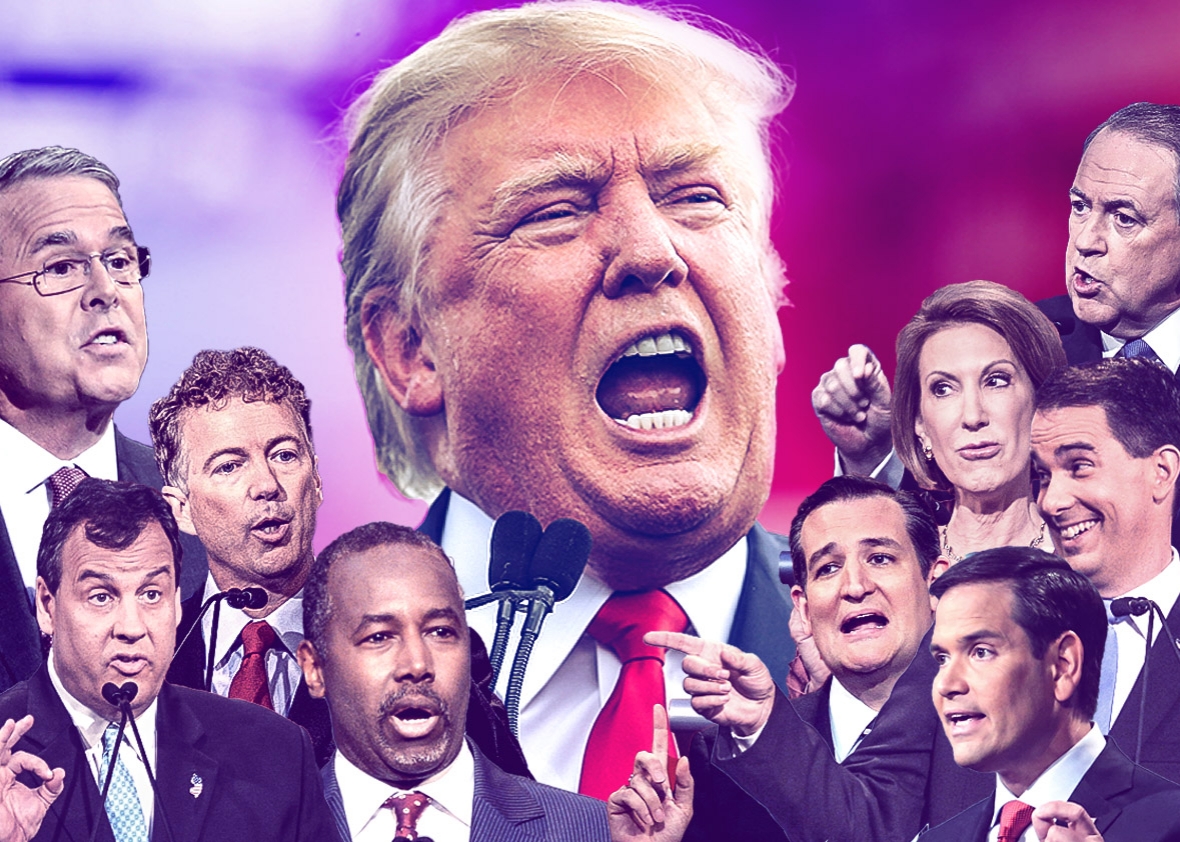
Two men have emerged as co-favorites for the GOP presidential nomination — and the party brass is none too happy about either of them.

Donald J. Trump has managed to insult his way to the top of the still-large GOP heap; U.S. Sen. Ted Cruz of Texas antagonized his Senate colleagues to the point that it’s no generally understood that, well, no one on Capitol Hill likes, or even respects, the junior senator.

Republican statesmen, such as Robert Dole, say a Cruz nomination would bring “cataclysmic” losses to the party; it could cost Republicans control of the Senate and bring Democrats within striking distance of getting control of the House.

Aw, but today’s firebrands label the likes of former Sen. Dole as “has been,” “loser,” “RINO.”

That’s their view. It’s not mine.

Trump is now calling himself a conservative. His prior public statements about such things as abortion and universal health care betray his claim, according to so-called “true conservatives.”

But there he is. Looking down from atop the GOP heap. He’s going after Cruz’s eligibility to run for president. He’s feuding with a broadcast journalist. He’s managed to insult Iowa voters, Hispanics, Muslims, our allies abroad, every working politician in Washington, D.C., women, reporters and editors . . . and others I can’t even think of at the moment.

Hey, it’s all OK with those who think Trump is “fresh.”

Wow!

As for Ted Cruz, well, he took his senatorial oath in January 2013 and began hunting for every open microphone he could find. He had his presidential ambitions planned out even before winning a contest in his first political election . . . ever!

He’s trampled over Senate colleagues, broken long-established Senate rules of decorum by calling the body ‘s majority leader a liar. He questioned whether decorated Vietnam War veterans, such as Secretary of State John Kerry and former Defense Secretary Chuck Hagel, had a true appreciation for the military; and this came from someone who never donned a military uniform!

The Republican Party has a problem, all right.

What will the GOP do? How will it deny either of these men its presidential nomination?

Given that so few of us have ever seen such intraparty angst, I’m afraid the Grand Old Party is on its own.

Good luck, ladies and gents.


Palin invites criticism

47791261.cached

A former colleague of mine took me to task recently for some critical remarks I made about Sarah Palin, who endorsed Donald Trump for the Republican presidential nomination on the same day her son, Track, was arrested for domestic abuse.

I won’t respond to what he said, but I want to post these remarks from Kevin Drum, writing for Mother Jones magazine’s website:

“I know I said that last night’s Palin-palooza would ‘hold me for a year,’ but I guess I was wrong. Palin’s son Track was arrested Monday on domestic violence charges, and today Palin addressed this:

“‘My own family, my son, a combat vet having served in the Stryker brigade … my son like so many others, they come back a bit different, they come back hardened, they come back wondering if there is that respect … and that starts right at the top.’

“I’m not happy with liberals who use Track’s problems as a way of snickering at Sarah. Yes, when you use your kids as campaign props, you open yourself up to some of this. But parents do their best, and kids sometimes have problems. Whatever Track’s problems are, he and his family should be allowed to deal with them in their own way.

“That said, if you decide to use your son’s problems as a political cudgel, you can hardly expect to others to hold back forever. Palin should be ashamed of herself.'”

Indeed, this is the steep price any politician pays by dragging private, personal family grief into the public arena.


Commander in chief test? Trump’s already failed it

Trump-and-gun-and-cadets

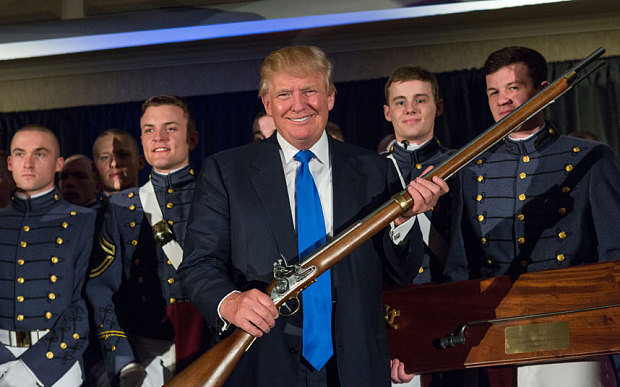
Politico asks in a story whether Donald J. Trump will flunk the commander in chief test.

Republican Party brass is terrified, Politico reports, of Trump getting nominated and then having to answer difficult questions regarding national security.

Trump already has failed that test, in my oh-so-humble view.

In spades.

Time and again on the campaign trail, Trump has exhibited a shocking ignorance of such things as the “nuclear triad,” which is the nation’s three-pronged nuclear weapons system involving land-based missiles, submarine-based missiles and bombs dropped from aircraft.

He cannot articulate with anything approaching precision how he intends to solve the myriad defense-related issues. His answer to illegal immigration is to “build a wall” and “make Mexico pay for it.”

He praises leaders such as Russian leader Vladimir Putin and — get this — North Korean despot/maniac Kim Jong Un for their “leadership” skills.

But I keep coming back to the wackiness of this campaign.

It has produced surprise upon surprise all along the way.

Trump has been criticized by leading conservatives for not understanding the details of foreign and military policy. Never mind what progressives are saying about him; it goes without saying that they would be highly critical of the real estate mogul/reality TV personality.

Before you get all twisted up, I’m also well aware of those who believe the current president has failed the commander in chief test — while he’s been on the job. I simply do not share that criticism.

I totally get that one man’s buffoon is another man’s statesman.

You know where Trump fits in that equation as far as I’m concerned.

North Koreans ask for peace treaty?

BBofjOR

There might not a more untrustworthy nation on Planet Earth than the one that occupies the northern part of the Korean Peninsula.

North Korea says it will end its nuclear testing if two things happen: it gets a peace treaty with South Korea, and the South Koreans and the United States end their joint military exercises.

OK, let’s do it. Right now.

Well, that won’t happen. Nor should it, not without a bucket load of assurance from North Korea that it not only would end its nuclear testing, but that it would dispose of the nukes it has in its arsenal.

How does that occur when we’re dealing with someone as unpredictable, vain and utterly contemptible as Kim Jong Un, the guy who runs the world’s most secretive nation?

Kim Jong Un kills those who disagree with him. The people who live in his country are starving to death and yet he continues to pour money that North Korea doesn’t have into a nuclear arms program. He blusters about going to war with the United States of America.

North Korea has long wanted a peace treaty with South Korea. The Korean War, you’ll recall, ended in 1953 with a mere cease-fire. The two sides never formalized the end of the war that cost about 50,000 American lives. It was a brutal conflict involving many nations that came to South Korea’s defense after the Marxist North Koreans invaded the south in 1950.

China joined the fight and fought head-to-head with Americans on some of the most barren and desolate battlefields of the 20th century.

However, more than 60 years after most of the shooting stopped, the two nations — South and North Korea — remain technically “at war.”

Do we  relent and sign that treaty and pull back our military preparedness in South Korea? Not a chance.

If the North Koreans really mean what they say about ending their nuclear testing program, they need to go a lot farther than merely saying they’ll stop exploding nukes. Their record is replete with examples of how their words cannot be trusted.