Category Archives: media news

Time of My Life, Part 21: What goes around, comes around

It’s no secret that newspapers are cutting staff to maintain their profitability in the face of the changing media climate that has produced declining circulation and advertising revenue.

The Amarillo Globe-News in Texas is no exception — quite obviously! — to that trend. The G-N, indeed, managed to eliminate its entire photo staff over time, instructing the reporters it has left on staff to shoot their own pictures while covering events.

Well, guess what! That isn’t a new notion for some of us who got their start in small-town newspapering back in the day.

My reporting career began full-time in the spring of 1977. I got hired at the Oregon City (Ore.) Enterprise-Courier as a temporary sports writer; the sports editor, one of the very few women in the business, had taken maternity leave to give birth to her daughter. The editor of the paper needed someone to fill in. I applied; he hired me; then a position opened up on the news staff and I was allowed to stay after the sports editor returned from her leave.

Part of my job was to take pictures along with reporting on events I was covering. Football games? Basketball games? Wrestling matches? I packed my notebook and pen — and a camera! Then I became a general assignment news reporter, so I took my camera to city council, school board and county commission meetings. I had to take what we called “wild art” photos we would publish without a story accompanying them.

I knew how to report on those events and how to write about them in cogent manner. Photography was a brand new concept. I had to learn about “photo composition” and how to eliminated “dead space” in pictures.

That was just part of it. I also had to learn how to develop those pictures. Yes, we had dark rooms back then. They had basins filled with smelly chemicals into which we had to dump our film. Then we had to dry the film on lines strung across the dark room. Once the negatives were dry, we then had to print what we called “contact sheets,” which were “positive” reproductions of the images on the “negatives.”

Yes, those were days when reporting and writing also include plenty of picture-taking. We were well-rounded back then, just as reporters today are being asked to become more well-rounded now.

I hope the kids today have as much fun as I did back in the journalism “stone age.”

Incumbents quite often got our nod

I published a blog post this week in which I declared that the Amarillo Independent School District board of trustees needs to get a serious electoral wake-up call from voters this year. The board has delivered shabby treatment to a young high school girls volleyball coach, meaning that it didn’t measure up to its public office.

Then came a question from the reader of the blog. He wondered how many times during my years as an opinion writer and editor I endorsed those who challenged incumbent officeholders.

That was what I described to him as a “tremendous question.”

I edited editorial pages in Texas for nearly 30 years: 11 at the Beaumont Enterprise and nearly 18 years at the Amarillo Globe-News.

I had the pleasure of interviewing likely hundreds of political candidates during all those years.

I told the reader of my blog that during that time our newspapers recommended the re-election of incumbents far more frequently than we recommended the election of newcomers.

Why stay the course? Well, I suppose we placed a huge premium on experience. Absent overt malfeasance or incompetence on the part of incumbents, we usually gave them the benefit of the doubt. If the communities they served were doing well economically, they quite often deserved some measure of credit for that performance.

Sure, we would go with challengers on occasion. In Beaumont, the Enterprise once recommended the election of former Beaumont Mayor Maury Meyers, a Republican, over incumbent U.S. Rep. Jack Brooks, the irascible Democrat who chaired the House Judiciary Committee; Brooks won re-election anyway, but held a bit of a grudge against yours truly for authoring the editorial. Many years later, the Amarillo Globe-News recommended the election of Patti Lou Dawkins over incumbent Randall County Judge Ted Wood in the county’s Republican primary; Wood defeated Dawkins.

Perhaps the most controversial non-incumbent endorsement we made in Amarillo occurred in 2010 when we recommended former Houston Mayor Bill White over Texas Gov. Rick Perry. White, the Democratic nominee, got thumped by the Republican governor. The reaction from our readers was ferocious. But . . . we called it the way we saw it.

But over the span of time, we usually went with the incumbent mostly on the basis of the experience they brought to the office.

All of this, I suppose, is what got my blog reader’s attention when I recommended that the AISD board of trustees incumbents get shown the door when Election Day rolls around later this year.

I just try to call ’em the way I see ’em.

Time of My Life, Part 20: Going local

The final three years or so of my journalism career were fraught with challenges as the shape and substance of media were undergoing significant change.

The Amarillo Globe-News and its parent company were seeking ways to cope with those changes, with limited success . . . or so it appeared to me.

One of the ways I sought to cope with those changes was to redirect the emphasis of commentary on our opinion pages. I obtained buy-in from the publisher of the paper, which as I look back on it now was peculiar, given that our relationship was deteriorating at the time.

I proceeded with the change. It was to place much greater emphasis on local issues, while forgoing comment on national or international issues. By “local,” that included editorial comment on matters of regional concern throughout the High Plains region we sought to cover. I sought to make daily comment on issues pertaining to our core circulation areas covering Randall, Potter, Moore, Deaf Smith and Armstrong counties. Amarillo and Canyon remained central to our concern as well.

Then there were state issues that spilled over into our part of Texas. Those issues got our attention as well.

I would keep a daily log of those editorials. I categorized them: local/regional, state, national and international. My goal always was to focus on local/regional issues first.

Why the change? Well, it became obvious to me that national media — cable TV and the Internet — were absorbed with national and international matters. Our readers had access to that information and to those opinions. Their own opinions were cast in stone. We would be wasting our energy trying to guide them into accepting whatever we thought about those matters.

So we turned our attention to City Hall, the county courthouse, the State Capitol.

There were a couple of months when we were able to devote every day of editorial commentary on local/regional or state matters. Those days gladdened me and made me more determined to continue on that course.

I believe it produced a positive result. We had tremendous traffic in letters to the editor and unsolicited essay submissions from readers. They wanted to weigh in on some of the local issues of the day and, yes, to speak out on the national and international issues we were setting aside.

The Globe-News tossed those changes aside after I resigned in August 2012 and returned to commenting on national and international matters. That was their call. I am just proud to have concocted a strategy I thought was a reasonable response to the change that is continuing to upend print media.

Time of My Life, Part 19: Not totally right, or wrong

I learned a great deal during more than 37 years working in print journalism. I learned that criticism of my work usually kept me humble and that no one is totally right or totally wrong.

My interaction with readers was mostly invigorating and always instructive at some level. Readers would challenge our newspapers’ editorial policy or would take me personally to task for opinions I would express in my signed columns. Indeed, I get a good bit of that even now writing this blog and sharing my views with a worldwide audience.

A few callers stand out.

Once, at the Beaumont Enterprise, I wrote a column endorsing the idea of mandatory helmet laws for Texas motorcycle riders. A reader from Orange County called to challenge me on my view. He thought it was an invasion of his personal liberty. The state didn’t have the right, he said, to order him to wear a helmet if he didn’t want to do it.

I asked him what does the helmet deprive him. He answered with what I presume was a straight face: He didn’t want to be deprived of the wind blowing through his hair.

Suffice to say we didn’t change each other’s mind.

At the Amarillo Globe-News, the newspaper endorsed the notion of installing red-light cameras to catch those who ran through red lights. They are breaking the law. Police can’t be everywhere at once, so the city deployed the cameras to catch the offenders.

One fellow, a prominent lawyer in Amarillo, argued with me that the cameras deprived him of the right to “face my accuser.” We did argue over that idea. I reminded him that offenders have the right to appeal. They could argue their case in front of the municipal judge. If they’re effective defenders of themselves, the judge could overrule the citation that was issued. What’s wrong with that process? I asked him.

Again, we agreed to disagree on that one.

One of my all-time favorite calls came from a reader in Amarillo. She had submitted a letter to the editor. She wanted us to publish it. One of my jobs as editorial page editor was to screen letters; not all of them saw print, although most of them did.

This particular letter contained a false assertion. I decided the letter wouldn’t see print. The writer called to inquire about the letter. I informed her I wouldn’t publish it. She became indignant. She asked, “Why not?” I told her it contained a falsehood and that the newspaper would not foment misinformation.

“I know it’s all true,” she said. I asked her how she knew it. “Because I read it on the Internet.”

I laughed out loud.

My give-and-take with readers gave me a wonderful insight into our constituencies. I always tend to look for the good in people and I found that most of those who took the time to write to us and to discuss their submissions had noble intentions.

They also taught me about the world, and about the communities where we all lived and worked. It gave me great pleasure to interact with them.

Trump vs. Bezos; Fake News vs. Real News

I am trying to wrap my arms around what I believe is one of the richest ironies I can find in today’s political discourse. Follow me for a moment.

Donald Trump despises Jeff Bezos, the owner of Amazon and the Washington Post. He has denigrated Bezos, bastardizing the mega-billionaire’s name by referring to him via Twitter as “Jeff Bozo.” He hates the reporting that comes from the Post, which to many of us is one of the premier newspapers in the world.

Bezos — reportedly the world’s richest human being — has filed a complaint against the National Enquirer, the world’s pre-eminent supermarket tabloid and purveyor of tawdry, juicy and occasionally defamatory gossip. The owner of the Enquirer also is a big-time friend and ally of Donald J. Trump. Bezos alleges that the Enquirer is blackmailing him by threatening to publish salacious pictures of the Amazon/media magnate with a woman who is not his wife.

The irony? Try this on for size: Trump hates what he calls “fake news,” which in reality is merely news that casts him and the presidency in a negative light. Donald Trump’s supporters stand with him, yet many of them — I will presume — continue to support the world’s No. 1 platform for “fake news” by purchasing the Enquirer from supermarket shelves while they are buying their groceries.

Donald Trump’s friendship with David Pecker — whose company AMI purchased the Enquirer in 1999 — has been in the news of late, given the tabloid’s involvement with the Stormy Daniels (the adult film actress) and Karen McDougal (the former Playboy model) stories involving the women’s alleged relationships with the future president of the United States . . . yep, Donald John Trump Sr.

“Fake news” or real news? Salacious gossip or quality journalism? Donald Trump or Jeff Bezos?

I believe the juxtaposition of it all is, well, more than just a little weird, don’t you think?

Hereford Brand gets new life! How about that?

If there’s a media god in heaven somewhere, he or she is smiling down on the Texas Panhandle journalism community at this moment.

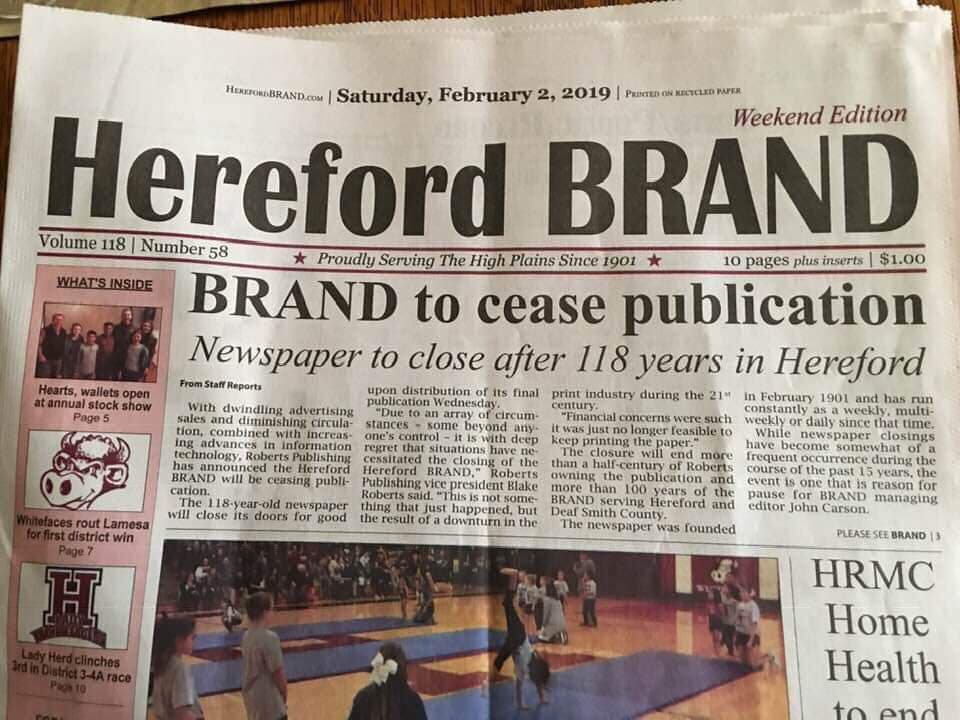
Jeff and Angela Blackmon have stepped forward to take over the daily operation of the Hereford Brand, a small community publication that was slated for the scrap heap effective today.

It ain’t happening. The Brand is still alive and presumably kicking.

This is happy news. I hope it is cause for long-term happiness among those who want community journalism to survive and one should hope flourish in this changing media climate.

The Brand’s former owners announced this past weekend that they planned to shutter the 118-year-old publication. Its final day was supposed to be today. Jeff Blackmon, who I understand is the former sports editor of the newspaper, and his wife stepped up. The news story I saw this morning said they will honor all the paper’s advertising and circulation commitments.

I presume they’ll also honor the paper’s commitment to the community by telling its story and by chronicling the happenings of the folks who comprise the Deaf Smith County region.

The peril remains, however, for small-town newspapers everywhere just like the Hereford Brand. Immense pressure is being brought to bear by the Internet, by cable TV, by other sources of “information” and commentary. Community newspapers are losing their relevance in people’s lives.

And yet . . .

When news such as what broke in Hereford, a community about 30 miles southwest of Amarillo, that its paper was about to vanish forever, you could hear plenty of wailing about the demise of the paper and expressions of sadness over its impending demise.

The community is now going to be given a chance to demonstrate its commitment to a century-plus-old tradition.

Here’s hoping for a much longer life for the Hereford Brand.

Good luck, Jeff and Angela Blackmon.

Worry about journalism future is intensifying

I hereby admit to being in a state of denial for many years about the fate of print journalism as I have known it and practiced it.

We all have watched daily newspapers downsize to the point of virtual disappearance. They have gone from daily distribution to twice- or thrice-weekly distribution. We’ve witnessed layoffs; indeed, I watched colleagues and friends get their pink slips and leave a craft that gave them untold satisfaction and a sense of accomplishment.

All of this involved organizations that paid me to do what I did for so very long. In Beaumont and Amarillo, to cite two examples. I didn’t accept what was happening before my eyes, that the fates of two proud journalistic organizations might be in serious jeopardy.

I now have to throw off that denial and acknowledge what others have said for far longer than I have been willing to acknowledge: those community institutions might not be around past the foreseeable future.

The pending death of the Hereford Brand in Deaf Smith County, Texas, is just another example of what is occurring. A Texas Panhandle community no longer is going to have a way to read about its story. The Brand is folding up, going away. Gone forever!

So what happens to other such newspapers that used to serve that community as well? I have the Amarillo Globe-News in mind. The Globe-News, where I worked for nearly 18 years as opinion page editor, used to cover Deaf Smith County like a blanket. That is no longer the case. The Globe-News has been retrenching, pulling back for years.

Its former corporate owners, Augusta, Ga.-based Morris Communications, oversaw much of that retrenchment. Then the company sold the G-N to GateHouse Media, which also purchased the Lubbock Avalanche-Journal from Morris. GateHouse now appears to be finishing what Morris started. It is melding two news and opinion organizations into one.

What does that mean for Amarillo? Or for Lubbock? Or for the West Texas region that both papers serve? If I knew the answer I would still be a working stiff. I’m not. I am on the sidelines now watching from some distance with an increasing sense of dread of what the future holds for journalism as I once knew it.

I have plenty of friends, acquaintances and former professional “sources” who tell me they fear for the worst for Amarillo and the Panhandle. They tell me they believe the Globe-News’s days are “numbered.” I would dismiss those fears as overheated fearmongering.

Today, I am not nearly as serene about it. I am officially frightened for the future of journalism. The Internet Age has inflicted serious wounds on a proud craft. I fear they are mortal wounds.

I hope I am wrong, although my hope is unable to match my fear.

Time of My Life, Part 17: Revealing a little secret

I want to reveal a little secret about newspaper editorials, particularly those that “endorse” political candidates or issues.

I lost count a long time ago of the number of editorial endorsement interviews I conducted. Despite all the high-minded talk we used to offer about our motivations, our intent was to persuade readers to buy into whatever opinion we expressed.

I wrote editorials for three newspapers in my career that spanned more than 37 years. One in Oregon and two in Texas. I interviewed likely hundreds of candidates for public office. We always used to say on our opinion pages that our intent never was to persuade readers to adopt our view. To be candid, that was baloney!

Part of the fun I had writing editorials was helping lead the community we served. Whether Oregon City, Ore., or in Beaumont or Amarillo, Texas, we sought to provide a beacon for the community to follow. By definition, therefore, our intent was to persuade readers of our newspaper to accept that what we said was the truth as we saw it. If you did, then you would follow our lead.

Isn’t that a simple concept? Sure it is! It’s also one we avoided confronting head-on while we published editorials endorsing candidates or supporting issues that were placed on ballots.

I never was naïve to think that readers of our newspapers would be malleable creatures whose minds could be changed by what they read in the newspaper. But by golly, we never stopped trying to change minds.

We used to say publicly on our pages that we recognized and accepted that our readers were intelligent enough to make up their own mind and were able to cobble together rational reasons for the point of view they held. I’ll stand by that principle even though I no longer write for newspapers, but write only for myself.

I was having the time of my professional life interviewing those individuals, who came to us in search of our editorial endorsement or, if you’ll pardon the term, our blessing.

However, when you hear an opinion writer say with a straight face that he or she doesn’t intend to change anyone’s mind with an editorial, well . . . just try to stifle your laughter.

Repeating the same cliche I’ve been hearing

Good grief. I am now repeating the cliché I keep hearing from family and friends when the discussion turns to the fate and cloudy future of print media.

I have talked about the slow and inexorable demise of quality journalism at one of the newspapers where I once worked, the Amarillo Globe-News.

Then I get the response: It’s happening everywhere!

I guess they intend to make me feel better. It has the opposite effect. That response seems to diminish the agony my former colleagues and I felt while we watched the newspaper decline ever so slowly and steadily.

Now comes news of the death of a community newspaper, the Hereford Brand. Wouldn’t you know it? I am now saying the very thing I’ve been hearing: What’s occurring in Hereford is happening in small towns all across the United States of America.

It sickens me, man.

The social media have helped render newspapers — the products of quality journalism — increasingly irrelevant in people’s daily lives.

Who needs a newspaper when people have those phones in their pockets, or hitched to their belt, or tucked in their purses? They have 24/7 access to cable news shows, Internet sources and any manner of other outlets. They are bombarded with opinion, much of it unqualified. They form their world view on the basis of what pours into those phones or into their laptop or desk top computers.

The Brand will close up officially on Wednesday. Its publisher said declining circulation and advertising revenues have brought about this inevitable outcome.

And by golly, it ain’t unique to Hereford or Deaf Smith County or the Texas Panhandle. It’s happening in communities all across the land.

What’s more, every single one of them is poorer because of this relentless trend.

I am saddened beyond measure and I hate with a passion that I am being forced to acknowledge the sad truth that it’s happening everywhere.

Time of My Life, Part 16: This was a ‘good get’

I once had to chase down individuals to interview. There were times I had to work exceptionally hard to persuade someone to talk to me while I worked in daily journalism. I always welcomed the challenge.

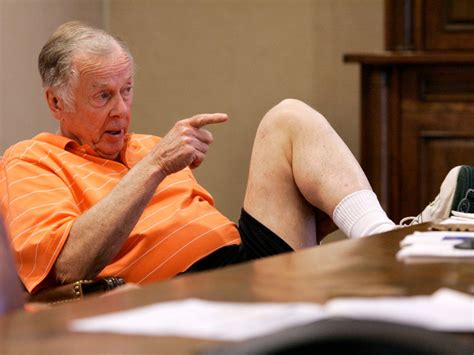
T. Boone Pickens — the legendary oil and gas tycoon — presented both sides of that coin. He was the toughest interview to nail down, but then he was what they call in the business a “good get” when he consented finally to talk to me.

A little history is in order.

I worked for the Amarillo Globe-News for nearly 18 years. I arrived in Amarillo after Pickens had departed Amarillo for Dallas. He left the city where he lived and did business in a huff. He was angry and decided to take his business to Big D.

He also was angry with the Globe-News. In the late 1980s, he began a campaign designed to inflict damage on the paper because he didn’t like the way it reported on him and on the community. He formed a group called People Committed for a Better Amarillo Newspaper — or PCBAN. He ran off the publisher of the paper and hung a banner off his Mesa Petroleum building saying “Goodbye Jerry” Huff.

I arrived in January 1995. Pickens was still mad at the paper. Not long after I arrived in Amarillo, Pickens announced an effort to create a wind farm complex. He also wanted to transport Texas Panhandle water to places downstate. I wanted to talk to him about it all. I called his public relations guy.

The PR guy resisted granted me any time with Pickens. I argued, dickered, bargained; I offered to meet Pickens at a diner in Pampa near his ranch and said I would “buy him a burger.” Pickens wouldn’t budge. The PR guy asked me if I was aware of the bad blood between Pickens and the G-N. Of course I knew about it. That was then. Those players all are gone, I told him.

No can do, I was told.

I called him again years later. I asked for an audience with Pickens. Two days later, Pickens agreed to meet with me. Just like that! He would come to the Globe-News. He would talk about anything I wanted to talk about. I thought: What the hell?

I knew about this guy. He was a ferocious competitor; a wildcatter who made a fortune exploring for oil and natural gas; he harbored grudges; he made lots of enemies as well as friends; he was a tough SOB.

I also had heard about his charm, his intelligence and his generosity.

The Boone Pickens who darkened our door at the G-N was what I have called “The Good Boone.” He was charming to the max. He was talkative. He dropped names like crazy: Barack Obama, George W. Bush, the King of Saudi Arabia, this and that potentate.

Pickens told me he read the paper daily. He said he took note of the columns I would write, or the editorials that appeared in the paper. I don’t know if he actually did all that or if he was just offering a form of false flattery.

Whatever it was, we got along well during the two hours we met.

Our paths would cross a couple more times. I saw him a second time while he was in Amarillo attending an oil/natural gas meeting at the Civic Center. Then, while working as a feature writer for KFDA NewsChannel 10, he welcomed a TV reporter, cameraman and me to his magnificent Mesa Vista ranch in rural Roberts County.

I hear that Boone Pickens has been in ill health. He’s in his 90s now and is divesting himself of his myriad and massive business interests.

I wish him well. Yep, he was a real “good get.”