Tag Archives: MPEV

Early vote is over; now let’s await the MPEV verdict

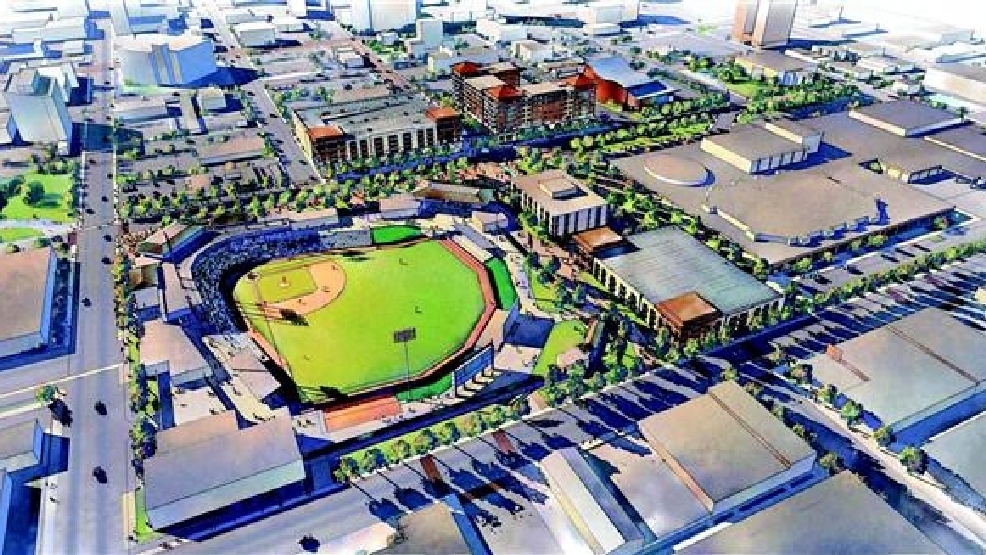
ballpark

Early voting is not my thing.

I prefer to vote on Election Day. But I’m delighted at what I’ve read and heard so far about the early vote turnout for next Tuesday’s big municipal election, the one that decides the fate of the ballpark that’s included in the proposed multipurpose event venue planned for downtown Amarillo.

It’ll be interesting once all the ballots are counted to learn (a) whether the ballpark fails or passes and (b) whether the total number of ballots actually produces anything resembling a “mandate” one way or the other.

Years ago, Texas made it so very easy for voters to cast their ballots early. The idea then was to boost turnout in this state, which traditionally has been quite pitiful. From my catbird seat over many years, I’ve determined that the turnout really hasn’t increased; early voting, though, simply has meant that more voters cast their ballots early rather than waiting for Election Day.

The MPEV vote might change all of that next Tuesday. That’s my hope, at least.

***

At issue is that $32 million MPEV, which includes the ballpark.

I’ve been all-in on this project since the beginning. It’s a good deal for the city on more levels than I can remember at the moment. It’s an economic development tool; it would provide entertainment opportunities; it would spur further growth downtown; it would help — along with the downtown convention hotel that’s also planned — remake the appearance and personality of the downtown district.

The campaigns mounted by both sides of this issue have been vigorous. They have told the truth — most of the time.

There’s been a bit of demagoguery from the anti-MPEV side concerning the role the one-time master developer, Wallace-Bajjali, has played in all of this. The developer vanished into thin air this past year over a dispute between the principals who owned the outfit. They parted company and one of them, David Wallace, has filed bankruptcy.

This MPEV idea, though, was conceived long before Wallace-Bajjali entered the picture, but there’s been plenty of loose talk about nefarious motives relating to the company and its association with the downtown revival effort.

I get that David Wallace proved to be “all hat and no cattle” as he sought to sell his company’s track record when he and his partner arrived on the scene. The planning and execution of this project has involved a lot of other home-grown individuals and groups who are invested deeply in this community.

***

I want the MPEV to earn the voters’ endorsement. If it doesn’t, well, we’ll have to come up with another plan … quickly!

As the campaign comes to a close, though, I remain hopeful that a significant number of Amarillo voters are going to weigh in with their ballots. Do I expect a smashing, presidential-year election-scale kind of turnout? Hardly.

My hope is that all of this discussion — and even the occasional temper tantrums from both sides of the divide — will give us something that resembles a mandate.

And that, friends, is how a democracy is supposed to work.
City vote looms … what lies ahead?

amarillo MPEV

It’s good to look forward, yes?

Amarillo voters are going to the polls Tuesday to decide a critical issue for their community: whether to build an multipurpose entertainment venue that includes a ballpark.

I want the ballpark to be approved. I’ve been all in on the project from the beginning. Nothing has changed my mind about its feasibility, its potential or its actual benefit to the city.

I’ve devoted much of this blog of late to making that case. Frankly, the issue has generated a lot of interest in the blog … for which I am quite grateful.

What lies ahead after the votes get counted?

I am certain the MPEV will provide plenty of grist for future commentary.

If the MPEV vote goes the wrong way, that is, if voters say “no” to it, I plan to keep beating the drums for some sort of venue that will be built on that abandoned property across the street from City Hall.

Coca-Cola vacated the site and relocated at a new business park. The old distribution center is vacant. It would make a fantastic location for an MPEV.

If the MPEV vote goes the other way, and is approved by voters, there will be plenty of affirmation coming from High Plains Blogger — depending, of course, on whether the City Council ratifies the vote and proceeds with construction of the $32 million project.

The referendum is a non-binding vote. The council isn’t bound legally to abide by its result. Politically, it’s another matter. The five-member council comprises three members who don’t like the MPEV as it’s been presented.

Yet they were elected this past spring after pledging to listen to their constituents. Do you get my drift here?

No matter the outcome on Tuesday, I remain supremely confident that this issue specifically — and downtown Amarillo’s path toward restoration and revival — will give us all plenty to discuss.


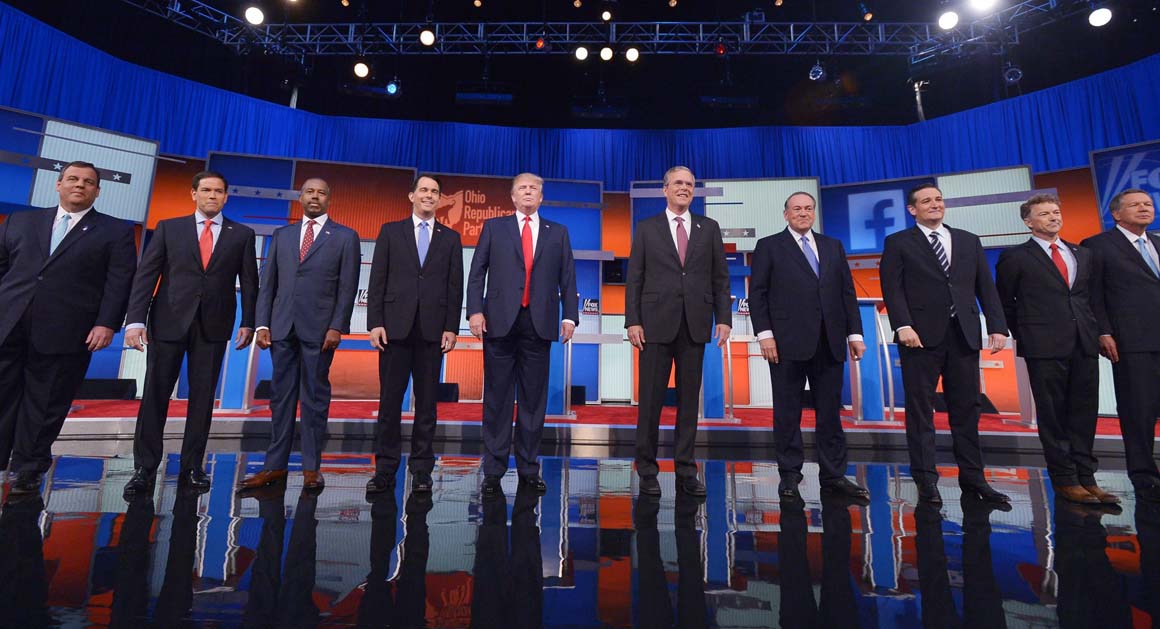
What if MPEV debate had that kind of format?

Republican presidential candidates arrive on stage for the Republican presidential debate on August 6, 2015 at the Quicken Loans Arena in Cleveland, Ohio. From left are:  New Jersey Gov. Chris Christie;  Florida Sen. Marco Rubio;  retired neurosurgeon Ben Carson; Wisconsin Gov. Scott Walker; real estate magnate Donald Trump; former Florida Gov. Jeb Bush; former Arkansas Gov. Mike Huckabee; Texas Sen. Ted Cruz; Kentucky Sen. Rand Paul; and Ohio Gov. John Kasich.  AFP PHOTO / MANDEL NGAN        (Photo credit should read MANDEL NGAN/AFP/Getty Images)

I awoke this morning and a curious thought popped into my noggin about last night’s Republican presidential primary debate … so I thought I’d share it here.

What if Amarillo’s hot topic of the day — the upcoming citywide referendum on a proposed multipurpose event venue — had been the subject of a similar debate format between advocates on both sides of this highly controversial issue?

Suppose, then, that the two sides had gathered their forces, sat them in an auditorium, say, at the Civic Center or the Globe-News Center for the Performing Arts. And then imagine how they might try to out-cheer, out-shout and out-jeer each other whenever someone made a point they either liked or loathed.

You know, these kinds of things rattle around in my head from time to time. In this instance, they make me glad we haven’t resorted to the carnival atmosphere that has overtaken the Republican and Democratic presidential debates as they’ve been staged in front of the nation.

The GOP has staged three of these sideshows; the Democrats just one, so far.

The MPEV debates — and there’ve been a couple of them broadcast on Panhandle PBS — have been models of decorum and relatively good manners.

(Disclosure time: I am a freelance blogger for Panhandle PBS, so — as the Texas saying goes — I’ve got a dog in that fight.)

The second of those encounters will air tonight at 7 on Panhandle PBS. It features Amarillo lawyer Vince Nowak speaking against the MPEV and former Amarillo College President Paul Matney arguing in favor of it. This past week, the contestants were Amarillo City Councilmen Brian Eades (pro-MPEV) and Randy Burkett (anti-MPEV) making their respective cases regarding the $32 million sports and entertainment venue planned for construction in downtown Amarillo, across the street from City Hall.

Check both debates out here.

Were there catcalls? Cheers? Jeers? Zingers? None of that. It was just Panhandle PBS content producer Karen Welch grilling the contestants on why they favor and/or oppose the measure. There were differences of opinion, but on the whole the adversaries were courteous and respectful of each other’s time.

One can learn a lot when one is not distracted by crowd noise, glitz and show-biz bling.

Both sides have their share of passionate supporters. I prefer, though, to gauge the merits of an argument on the points made by the principals rather than relying on applause meters.


Positive vs. negative in MPEV debate

amarillo MPEV

Amarillo’s campaign on the multipurpose event venue is heading for the home stretch. Early voting ends Friday.

A week from today, the polls open and those who haven’t voted early will get a chance to vote on whether to build an MPEV that includes a ballpark, a place where a minor league baseball team can play a little ball for about 50 or 60 dates annually.

Have you heard about an alternative to the ballpark if voters nix the notion? Me neither.

Which brings to the point today: The Against Crowd hasn’t delivered an alternative. It has, as near as I can tell, relied on a purely negative message.

That’s expected. An “anti-anything” campaign by definition must be negative. You don’t like something? Say “no.”

On the other side of the divide is the pro-MPEV group. The leading advocates belong to something called Vote FOR Amarillo. The very name implies a positive message.

And that message is?

Well, as its leading spokesman, retired Amarillo College President Paul Matney, has stressed: The MPEV will put Amarillo on baseball’s “radar” by providing a first-rate sports venue; it will create several dozen permanent jobs and hundreds of temporary construction jobs; the bonds to pay for the $32 million construction will be retired using hotel/motel tax revenue; it will become an essential element in downtown Amarillo’s rebirth; and that rebirth will spur further economic expansion throughout the city; the MPEV could play host to a variety of activities throughout the year that have nothing to do with baseball.

That’s a positive message, yes?

Of course it is.

Those who oppose the MPEV say the Civic Center needs renovation first. How do we pay for that? With, um, public money. They contend the city shouldn’t acquire debt to build an MPEV, but don’t seem to mind acquiring such debt on the Civic Center, with a cost that will far exceed the price tag attached to the MPEV.

They keep bringing up things such as secrecy, nefarious motives, the failed master developer (who was nowhere in sight when the MPEV idea was first floated around 2006).

If only we could hear some options from those who oppose the MPEV — for whatever reason.

If there are alternatives on some hidden table, then let’s not talk among yourselves. Share them with the rest of us.

I’m planning on going with the positive message.


Will local election serve as bellwether?

Old fashionet American Constitution with USA  Flag.

This won’t take long.

The upcoming Amarillo election on the multipurpose event venue well could determine whether the wackiness that’s driving the national political debate has found its way to the Caprock.

The pro-MPEV forces in Amarillo are well-funded and well-organized.

The anti-MPEV forces are neither of the two.

The pro-MPEV side is seen as the “establishment.”

The anti-MPEV folks are seen as “anti-establishment.”

Nationally, the anti-establishment side is winning the argument, particularly as it relates to who should become the Republicans’ presidential nominee.

Locally, well … the jury is still out.

I’m pulling for the establishment — in both instances.

Vote numbers are piling up … good!

EARLY+VOTING_MGN

I’ve blathered, bloviated and brow-beaten folks for years about the value of participating in this form of government of ours.

You know how it goes. If you don’t vote, then you can’t gripe. You can’t take ownership of the decisions that your elected representatives make on your behalf. You cede all of that responsibility to the guy next door … or to the idiot down the street or across town who disagrees with everything you hold dear about public policy.

The early vote on the upcoming Amarillo referendum on the multipurpose event venue continues to roll up some encouraging numbers, no matter how one feels about the $32 million MPEV that’s been proposed for the city’s downtown district.

According to the Amarillo Globe-News, which is doing a pretty good job of tracking the early-vote totals, 6,655 voters had cast ballots as of Friday. The raw number all by itself doesn’t say much … at least not yet.

After all, the city has about 100,000 individuals who are registered to vote. So, as of this week, we’ve seen fewer than 10 percent of the registered voters actually casting ballots.

Early voting continues through this coming Friday.

Then on Nov. 3, the polls open across the city and the rest of us — that would include me — get to vote.

I have no way of knowing what the final early vote total will be.

But based on comparative figures with other key municipal elections, this campaign has generated considerable interest on both sides of the political divide.

The early-vote totals so far are about 2,000 greater than those who voted early in the May municipal election that seated three new members to the Amarillo City Council; the MPEV early-vote number is about 1,000 fewer than the totals to date for the November 2014 general election; this year’s early voting is more than 3,000 votes greater than the early-vote totals year over year for the November 2013 constitutional amendment election.

This is all a very good thing for the future of participatory democracy.

Yes, I wish we could get every registered voter to actually cast a ballot. Better yet, I wish we could get every person who is eligible to vote to actually register and then go out and vote. Wouldn’t that be a hoot!

I’ll keep wishing for such an event, even though I know I’ll likely never see it.

Until then, I plan to keep hoping that Amarillo can turn the tide against the dismal participation we’ve exhibited when it concerns matters at City Hall.

Heavy early interest in MPEV vote bodes well

early voting

I’m going to set aside my bias in favor of downtown Amarillo’s proposed multipurpose event venue for a moment … or maybe two.

Instead, I want to offer high praise for the apparently strong interest in the upcoming election.

The MPEV is on the citywide ballot Nov. 3. It’s a non-binding referendum that will ask voters if they want to proceed with an MPEV that includes a ballpark component.

You know my feelings on it. I’m all in on the proposed $32 million project. I have favored it from the beginning.

But the point here is that the early portion of the early vote seems to suggest a greater-than-normal interest in this issue.

On one hand, that’s not saying much, given the pitiful, abysmal and disgraceful turnout percentages that usually greet municipal elections in Amarillo.

We elected a City Council this past May with a turnout that barely cracked double-digits. And yet the winners all declared some kind of mandate for change. I don’t buy the mandate part.

Yes, I honor and respect the results, as they reflected a majority of those who turned out. The reality, though, is that it was a majority of a tiny minority of those who not only were registered to vote, but who were eligible to vote. When you factor in the voter eligibility number, the percentage of turnout plummets even further.

The early turnout for the MPEV vote appears to be bucking the norm in Amarillo, where folks traditionally have let others decide these issues.

This morning I happened to ask Paul Matney, the retired Amarillo College president who’s now co-chairing the Vote FOR Amarillo effort to win an MPEV endorsement at the polls about the early surge in turnout.

He offered a couple of ideas. One is that it might be a backlash against some of the negativity that’s been occurring at City Hall. He wonders whether voters might be saying they’ve had enough of the back-biting that has accompanied the three newest council members’ involvement in public policy discussions. Voter might not be necessarily in favor of the MPEV, but they want to send a message to City Hall that they’re sick and tired of the negative commentary, Matney wondered.

He also wonders whether there’s an actual positive turnout in favor of the MPEV … or if there’s the reverse taking place, that voters are expressing genuine anger.

He shrugged today and said, “I just don’t know” what’s driving the turnout.

Whatever the case, both sides of the divide have said the same thing: Be sure to vote. Make your voice heard. Speak out with your ballot.

That’s wise advice, no matter how you feel about the MPEV.


MPEV can boost baseball fortunes for city

MPEV

Paul Matney is a diehard baseball fan.

He admits to it readily, telling audiences how — as a high school student — he used to post the scores along the outfield wall at the old Potter County Memorial Stadium.

Matney, who grew up to become president of Amarillo College, also tells the story of how he saw the great Willie Mays — yep, that Willie Mays — get picked off at second base during an exhibition game between the San Francisco Giants and the Cleveland Indians.

Matney, who’s now co-chairing a political action group called Vote FOR Amarillo, is making the case on behalf of the multipurpose event venue that’s up for a non-binding vote Nov. 3. City residents are going to decide if they want an MPEV — which includes a baseball park — built in downtown Amarillo. It’s a non-binding vote, but the City Council would commit political suicide if it went against the wishes of the voters, which makes the vote politically binding.

I got to hear Matney’s pitch once more this morning and he is as convincing as he’s been all along.

Amarillo has been a baseball town for many decades. It can be a great baseball town yet again if we build a venue that can attract the interest and attention of Major League Baseball executives looking for a place to develop a minor-league baseball affiliate.

Amarillo can be ripe for such a relationship, Matney said.

The Amarillo Thunderheads — for whom Matney moonlights as a public address announcer — is an independent non-affiliated outfit that plays in a venue that Matney said is “at the end of its life.” That’s a nice way of saying what many of us have known for a very long time: Potter County’s stadium is a dump. Why don’t more fans attend Thunderheads baseball games? Look at the place where they play.

Matney mentioned how a visiting team — on the advice of its manager and coaches — changed into its uniforms at the hotel where it was staying, rather than doing so in the visitors’ clubhouse.

The MPEV is slated to cost around $32 million. It will be paid for with revenue bonds, which will be retired through hotel/motel tax and sales tax revenue. Matney insisted yet again that “no property taxes will be used” to pay for the stadium.

He described the MPEV as a vital component to the convention hotel that is planned for downtown, along with a parking garage. The Embassy Suites hotel owner is footing the bill himself — with help from investors — for the $45 million hotel.

The parking garage feature 24,000 square feet of retail space and it will be financed through rental and parking fees.

The MPEV, baseball park — or whatever you want to call it — can become a vital component to downtown Amarillo’s rebirth. What’s more, if downtown sees an infusion of new life, the energy will ripple throughout the city.

As Matney noted, using the cliché, “A rising tide lifts all boats.”

In this case, such a saying is more than just a string of words. It speaks to the future of our city.

Play ball!


Early vote numbers for MPEV election … way up!

early voting

The early indications from both sides of the line dividing Randall and Potter counties in Amarillo are encouraging … I hope.

Early voting for the Nov. 3 election is way up over what it was for the municipal elections this past May. I’m quite sure the Texas constitutional amendment proposals aren’t pulling voters to the polls in the early balloting.

What’s more, the 3,063 voters who cast ballots during the first two days is just a shade less than the 3,151 who voted in the first two days of early voting in the 2014 general election — when we were voting for governor.

The multipurpose event venue is pulling voters to the polls.

Is that a good thing? Well, I hope it is.

And by “good,” I hope that means that those who support the MPEV as it’s been presented are turning out. Do I know who’s turning out? Of course not.

Me? I ain’t voting until Nov. 3, which is Election Day. I hate early voting. I prefer to wait until the last minute.

Back to issue at hand.

The early vote totals should bode well for the pro-MPEV side. I count myself among them. Perhaps it’s just wishful thinking. Then again, when I say “should,” I am not necessarily predicting that’s what happening, but instead hoping for what I want to happen.

I’ve been trying to parse through all the arguments for and against the MPEV. I’ve heard the skeptics, the naysayers, the conspiracy theorists. I have sought to examine the issue inside, outside, forward and back.

I keep coming back to this conclusion:

We’re hoping to build a $32 million venue that includes a ballpark in downtown Amarillo; the money will be paid back with hotel/motel tax revenue generated by out-of-town visitors; a hotel developing is plunking down $45 million of investors’ money to build a four-diamond hotel; we’re hoping to build a parking garage with revenue bonds that also will be repaid with hotel/motel tax money.

Property taxes will not increase.

This is a classic public-private partnership that’s seen success throughout the nation. Amarillo’s civic and political leadership has not reinvented the wheel with this project. It’s merely done something new … for Amarillo!

I see virtually no downside to this project. I’ve been on board since the beginning and I have grown weary of the cynics who just know it isn’t going to work.

How do they know it? They just do.

I am going to put my faith in the hard work that’s been done to date.

Furthermore, I am going to continue to hope that the pro-MPEV political action groups have done their spade work and have mounted a massive get-out-the-vote effort that well might be showing itself in these impressive early-vote totals.

As Paul Matney, co-chair of Vote FOR Amarillo, said the other day, the early vote will set the trend. When the city spits out those first early-vote numbers on Election Day after the polls close, we’ll know where the MPEV is headed.

I’m hoping for the best.


What if voters say ‘yes’ to MPEV, council members?

ama city council

Let’s play a little game of “What If?”

It goes like this:

Amarillo voters will vote Nov. 3 on whether to approve a multipurpose event venue that includes a ballpark. It’s a non-binding referendum, meaning that the City Council is not bound legally to follow the voters’ wishes.

It’s an open question today about whether the $32 million project will receive the voters’ endorsement.

However, what if the voters say “yes” to the MPEV? The council currently comprises three members — a majority — who dislike the proposal as it’s been presented. The three men — Elisha Demerson, Randy Burkett and Mark Nair — were elected this past May; Demerson and Burkett defeated incumbents Ellen Green and Lilia Escajeda, respectively, in winning their council seats.

Green and Escajeda are staunch supporters of the MPEV.

Back to the “What If?” game.

What if the majority decides to buck the voters? Are they so wedded to their vision of what the MPEV should look like that they’ll say “no!” to the results of the referendum?

The three men campaigned on a promise to be more transparent, more accountable to the voters, more willing to listen to what voters want.

Well, this vote well could give them their best chance of all to prove they are men of their word.

It also could give them the opportunity to stand behind their combined belief that the MPEV as it’s been developed and presented is a loser.

This “What If?” game, of course, swings the other direction. If voters say “no” to the MPEV, the council members who favor it — Councilmen Brian Eades and Mayor Paul Harpole — face the same conundrum. Do they vote against the residents’ will knowing they don’t have the votes to stop it?

Ah, the change we got on our City Council. Ain’t it grand?

If the vote goes the way I want it to go — with an MPEV endorsement — I’ll send plenty of vibes toward City Hall encouraging the entire council to ratify the voters’ wishes.

And, yes, I’ll do the same if the vote goes badly.